Amarillo has shown through various resources that the community cares about its citizens and those experiencing homelessness.
But what about those who had their homes — and nearly all they owned — destroyed by fire?

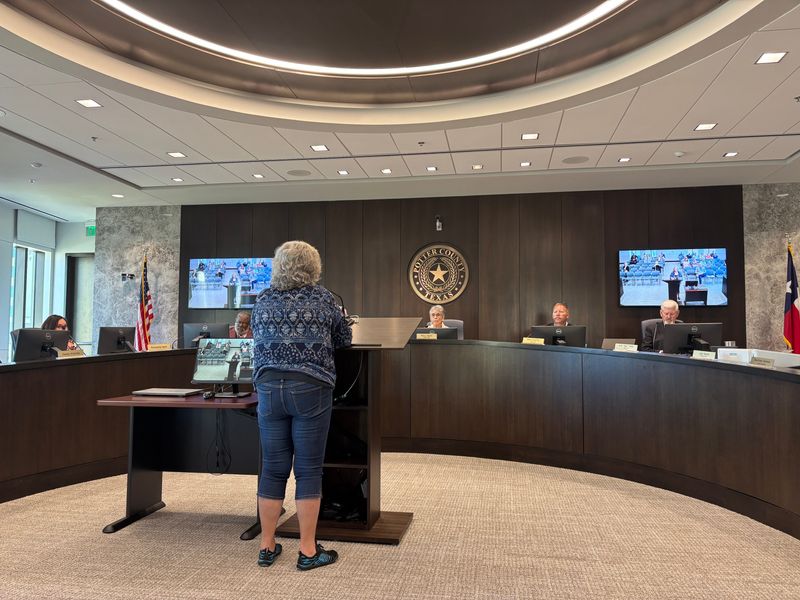
Several citizens, who spoke during the public comments section of the June 8 meeting of the Potter County Commissioners’ Court, expressed concern about the lack of action occurring in Potter County and the city of Amarillo after the recent fires consumed or damaged more than 70 homes and destroyed more property, due to what some allege was neglect.
The fire spread into the Bishop Estates neighborhood in Potter County during critical fire weather May 18 and prompted mandatory evacuations, after the landfill fire was first reported May 17.
During the Potter County meeting May 26, options for communications during emergencies were discussed following the fire response, but no action was taken. A request was made for citizens’ input on the matter.
On Wednesday, May 20, Gov. Greg Abbott announced that the Federal Emergency Management Agency (FEMA) approved the state’s request for a Fire Management Assistance Grant (FMAG) for the Stinky Fire in Potter County, which enabled the group to finally contain the fire, but not to address the personal property lost at the area.
On May 21, Abbott said he directed the Texas Division of Emergency Management to request officials from the U.S. Small Business Administration (SBA) join state and local partners in conducting preliminary damage assessments in Panhandle communities affected by recent wildfire activity to determine if the state meets the thresholds for additional federal disaster assistance.
‘Irreplaceable memories, security and stability’ lost
A woman named Janelle said she was there at Potter County’s meeting June 8 on behalf of her brother-in-law and sister, who lost everything in the Stinky Fire. She said she also knew of some of the elderly who lived out there, including a man who went back to the site where his home had stood had burned to the ground.
“Their ability to start over brings additional hardships,” she said. “These families didn’t just lose everything to a natural disaster,” she said, “but they lost it to an event that could have been prevented, or better contained, if proper preventative steps had been taken and key safety measures. … They lost not just houses, but irreplaceable memories, security and stability, in one afternoon.”
“Imagine leaving here to go home and find your home in just ashes, with nothing left,” she told the Potter County Commissioners. She said the immediate emergency reaction was coordinated, but help now has slowed dramatically or even ceased. “The resource center was only open for one day.”
The woman maintained that during the first weekend, there was an incredible outpouring of help and response; first responders, the Red Cross, volunteers and the community really stepped up. She said that although 2-1-1 was still available for assistance, but families are facing unstable temporary housing, with those who signed up for the service of staying in Airbnbs having to move every 7 to 10 days.
People are facing additional trauma from looting out in the neighborhood, and packages that were ordered can’t be delivered, she said. “Those with pets are often left with no options at all.”
Janelle urged Judge Nancy Tanner to issue a Local Disaster Declaration to start the process of getting relief to people who needed it. Even though the declaration has limits, she was begging the county to use the tools they have available to help the people, to advocate for more state and federal resources and centralize more information.
“There’s no clear handbook for these people telling them what is available, how to access it or what steps come next, especially for those with no insurance,” she said. The families need help now to turn the corner from survival to recovery. “Potter County can help bridge the gaps and show leadership for those families outside the city limits who feel forgotten.”
“Let’s show them as a community that we can get them through this — better, stronger and with a sense of community.”
Ronda Savant then shared her personal story. She said she was forced to leave her home, without her phone, debit card, any cash, and had to leave seven animals behind. She said that on that Tuesday, they weren’t allowed to go into the area and didn’t know the damage, but they started calling 2-1-1.
She said that she tried to call 2-1-1 twice a day for the first week. She was never told that her ZIP code wasn’t in the system. Without the ZIP code in the system, they were very limited in resources they could get.
Savant said that she went to a town hall meeting by VOAD at the Amarillo College northwest campus to see what resources were available. She said her house is damaged but still standing, but many of her friends and acquaintances lost everything.
Savant said that on May 27 she received information with the FEMA emblem on it, showing that they would be involved and would be out in the cleanup and for people to reach out.
“At the bottom, it said that if you had insurance don’t bother applying because they cannot reimburse,” she said. “We are still at a point of not knowing what insurance will cover and what they won’t cover.” Savant said that she had returned to work full-time, which left her with less time to find out answers. She said she also spoke at the city council meeting. “I would like to know why is it so hard for this to be declared a disaster.”
Savant said she was very grateful for the community help so far. The Baptist Mission group of men came out and helped with the cleanup, and American Red Cross, Amarillo Area Foundation and others who stepped up. But, Savant said many people need temporary housing, which could be helped by declaring a disaster, according to what she had learned. She said she gave her information to the city but has not heard anything back.
Mike Fisher asked why the fire issue wasn’t on the agenda.
“It should have been at the last meeting,” he said. “I think you guys should just have it as a general item to update, have updates from each other, on what’s going on with the fire.”
Fisher said a disaster declaration would start the tally of damages, so that an organization called VOAD can start counting how much is lost.
“The federal side has to have like a $570 million threshold before they can trigger help,” he said.
Fisher also encouraged the county commissioners to go to the fire site and visit with some of the victims. “We’ve made some lifetime friends out there,” he said.
Kim Vincent said she had been working with some of the families, and that they were like family now to them. “To go out there and see what they have endured is devastating. I’m not an emotional person … but I broke down.”
County officials respond
Vincent said she took action and called state Rep. Caroline Fairly’s office and was told that she was the first person they had gotten a call from. She said Tom Scherlen had reached out to U.S. Rep. Ronny Jackson’s office and was told that a disaster declaration had to be signed first before they could get the help they need.
She said she had a conversation about the disaster declaration with Judge Tanner, who then said, “I believe I did that though; did I not do that?” and the county attorney answered, “I’m not aware of that.”
“We didn’t have any death, luckily, but you don’t know what these people are going through,” Vincent said.
Tanner then said that, for the record, she had reached out to state Sen. Ken Sparks, and he was going to get back to her to see what they can do to help, so hopefully something can happen in the next week or so.
Potter County Commissioner John Coffee suggested county officials have a meeting with the city and the Office of Emergency Management (OEM) to find out more about what went wrong, what went right and to come up with an action plan to do better. “We used to do that a long time ago, when I was a policeman,” Coffee said. “I don’t know why we haven’t bothered to do that, but we haven’t.”
“We do need to do better,” Coffee added. “We need to have a meeting with those that are involved, the stakeholders involved, and find out why these things weren’t happening.” Those issues included emergency signals and how communication was sent out to the public.
Coffee said that it would be helpful if the city of Amarillo were to send some rigs out to the site, along with trash trucks and rolloffs, to help those affected with cleanup.
“We already should have had a meeting,” he said, “We haven’t done it, and shame on us.”
Potter County Sheriff Brian Thomas informed county officials that OEM did send an alert out about the fire, and the signal went through the towers to every cell phone in the area affected immediately about the fire.
At that point, Judge Tanner clarified that she didn’t ordinarily do a disaster declaration, but that they come from someone else — and she then signs them, “so I don’t know where it stopped.”
Judge Tanner agreed to set up a meeting with the City of Amarillo and have the issue on the commissioners’ agenda for the next meeting to follow up.
This article originally appeared on Amarillo Globe-News: Residents urge Potter County officials to take action in fire relief
Reporting by Nell Williams, Amarillo Globe-News / Amarillo Globe-News
USA TODAY Network via Reuters Connect
By Nell Williams, Amarillo Globe-News | USA TODAY Network