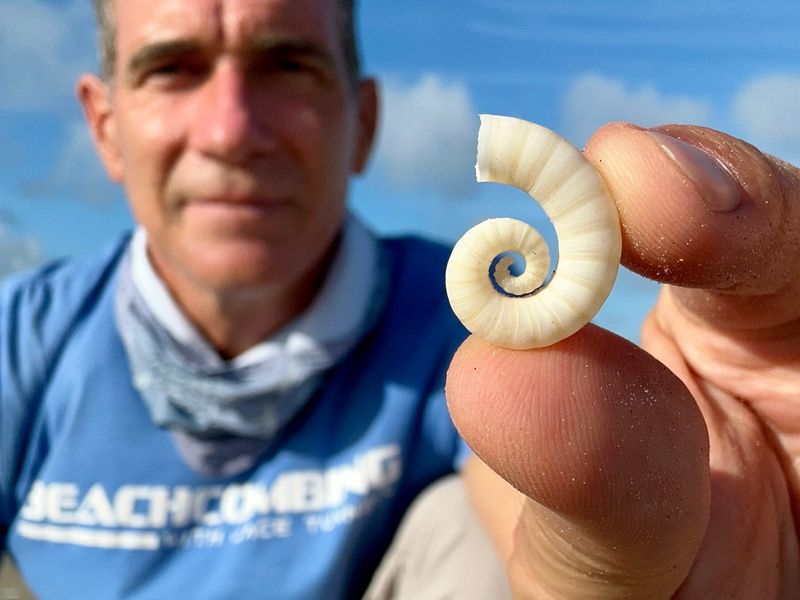
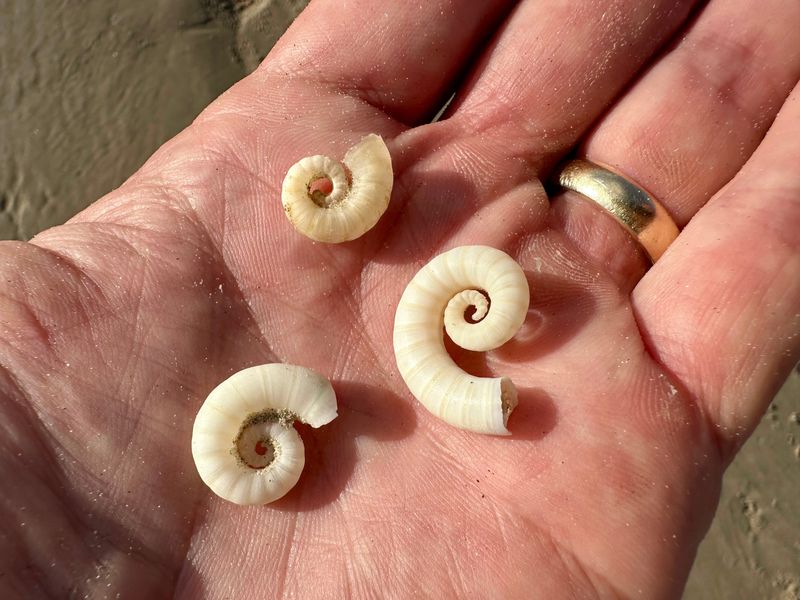
During my beachcombing survey this week along the Texas coast, I was excited to find three ram’s horn shells washed ashore among the sargassum seaweed. Although these tiny white shells are often overlooked, they are among the most fascinating treasures that can be found on gulf beaches.
The ram’s horn shell belongs to a deep-sea cephalopod called Spirula spirula, commonly known as the ram’s horn squid.

Unlike most seashells, this shell was never exposed on the outside of the animal. Instead, it served as an internal buoyancy chamber, helping the squid maintain its position in the water column. The shell is divided into a series of gas-filled chambers and forms a distinctive spiral shape that resembles the horn of a ram.
The living squid inhabits tropical and subtropical oceans around the world and spends most of its life hundreds of meters below the ocean surface. Because of its deep-water habitat, living specimens are rarely observed. Most people encounter Spirula only through the shells that occasionally wash up on beaches.
Along the Texas coast, ram’s horn shells are considered uncommon finds. They are often discovered after periods of strong currents, after storms or when floating mats of sargassum seaweed are pushed ashore. The lightweight shell can float for long distances after the animal dies, eventually becoming stranded along the beach.
Finding three ram’s horn shells during a single survey was a surprise. I’ve found these shells before with live gooseneck barnacles attached to them, which tells me they had been floating in the ocean for some time.
For beachcombers, the ram’s horn shell remains one of the Gulf Coast’s most intriguing and memorable discoveries.
Jace Tunnell is the director of community engagement for the Harte Research Institute at Texas A&M University-Corpus Christi. His Beachcombing series appears in newspapers, as a weekly video on YouTube and KEDT PBS, and as a weekly feature on KEDT NPR. Follow Jace at harteresearch.org, Facebook (@harteresearch) and Instagram (@harteresearch).
This article originally appeared on Corpus Christi Caller Times: Ram’s horn squid shells are uncommon on Texas coast. Here’s why
Reporting by Jace Tunnell, Harte Research Institute / Corpus Christi Caller Times
USA TODAY Network via Reuters Connect
By Jace Tunnell, Harte Research Institute | USA TODAY Network