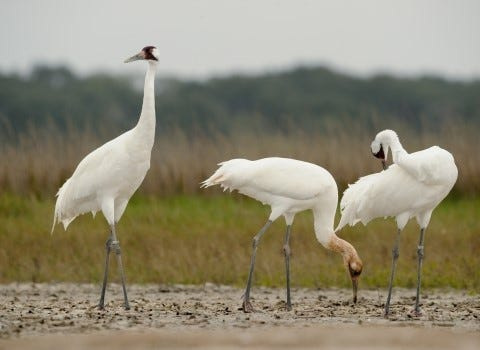
About 540 whopping cranes wintered in the vicinity of Aransas National Wildlife Refuge during the 2025-26 season, a count that is similar to the previous year’s.
The U.S. Fish and Wildlife Service estimates the abundance of whooping cranes in the Aransas-Wood Buffalo population each winter.

The preliminary analyses of the most recent survey conducted in late January indicates there were at least 57 juveniles and 143 adult pairs. The data and results included in the preliminary report are subject to revision.
That’s slightly less than were estimated last year, but the difference between estimates is within the margin of error, according to a U.S. Fish and Wildlife Service news release.
The flock of whooping cranes breeds in Canada at Wood Buffalo National Park, crossing the continent each year to spend the winter 2,500 miles south on the Texas coast. In 1967, there were only about 50 whooping cranes left.
In recent years, the population has remained steady or grown slightly. Abundance estimates in the annual wintering survey have exceeded 500 since 2017-18. The long-term growth rate of the population has averaged 4.24% since 1938.
How whooping cranes are protected
In recent years, many additional acres of habitat have been protected in Texas, inspired by and meant to continue supporting an expansion of the whooping crane’s wintering range.
In December, The Conservation Fund acquired a 2,232-acre ranch, while the International Crane Foundation acquired a 1,150-acre property, both between San Antonio Bay and Matagorda Bay. Both properties join a patchwork of preserves, refuges and private land trusts protecting whooping crane habitat.
Additionally, at least eight whooping cranes spent the winter at Salt Plains National Wildlife Refuge in Oklahoma, the first ever recorded overwintering in Oklahoma. This was discovered in part due to visitors and birders reporting sightings during the yearly Christmas Bird Count.
According to a news release, whooping cranes are known to stop at Salt Plains National Wildlife Refuge during their journey to Texas, but it was new behavior when six adults and two juveniles opted to stay for the full winter season until early March, when they headed north.
“As the population climbs, we are seeing these iconic cranes exhibit new behaviors,” Kevin McAbee, U.S. Fish and Wildlife Service whooping crane coordinator, said in a news release about the Oklahoma birds.
“These resilient birds are showcasing their adaptability, something that will help them adjust to changing landscapes. Each year these whooping cranes seem to do something we haven’t observed in the last 100 years. It is exciting that this species continues to remind us that we have lots to learn about their ecology and behavior.”
How whooping cranes are counted
The overwintering abundance count surveys are conducted using an aircraft, with the team flying over the primary survey area five times and the secondary survey areas once.
The sampling area of the survey is primarily around Aransas National Wildlife Refuge, including much of Matagorda Island, as well as areas in Welder Flats, South San Jose Island and the Guadalupe Delta. Secondary survey areas include Powderhorn Lake, the northernmost portions of Matagorda Island, Mission Bay, Egery Flats and Port Bay near Copano Bay.
Olivia Garrett reports on education and community news in South Texas. Contact her at olivia.garrett@caller.com.
This article originally appeared on Corpus Christi Caller Times: Here’s how many whooping cranes wintered in the Aransas area 2025-26
Reporting by Olivia Garrett, Corpus Christi Caller Times / Corpus Christi Caller Times
USA TODAY Network via Reuters Connect
By Olivia Garrett, Corpus Christi Caller Times | USA TODAY Network