

Editor’s note: Learn more another kind of eagle that is the national bird of the U.S., the bald eagle, here.
Perhaps the non-preeminent eagle species of the United States is the Golden Eagle (Aquila chrysaetos).

This eagle’s scientific name is a combination of Latin and Greek and translates as “dark-colored golden eagle.” The golden eagle is considered a true eagle; whereas, its distant relative, the bald eagle is a type of sea eagle.
A bird with boots
Bald eagles are fishing specialists and usually found near substantial bodies of water compared to the more upland, open country and even arid land distribution of golden eagles. Also, perhaps because of their differing life histories and foraging preferences, the golden eagle’s legs are called booted because they are covered with feathers.
But the bald eagle’s legs are bare. The bald eagle is endemic to North America, but golden eagles have a Holarctic distribution and reside in North America, Eurasia and a few north African localities. Bald eagles are the national bird and symbol only of the United States, but golden eagles are more popular national symbols and represent Mexico, Austria, Germany, Albania, and Kazakhstan.
The golden look
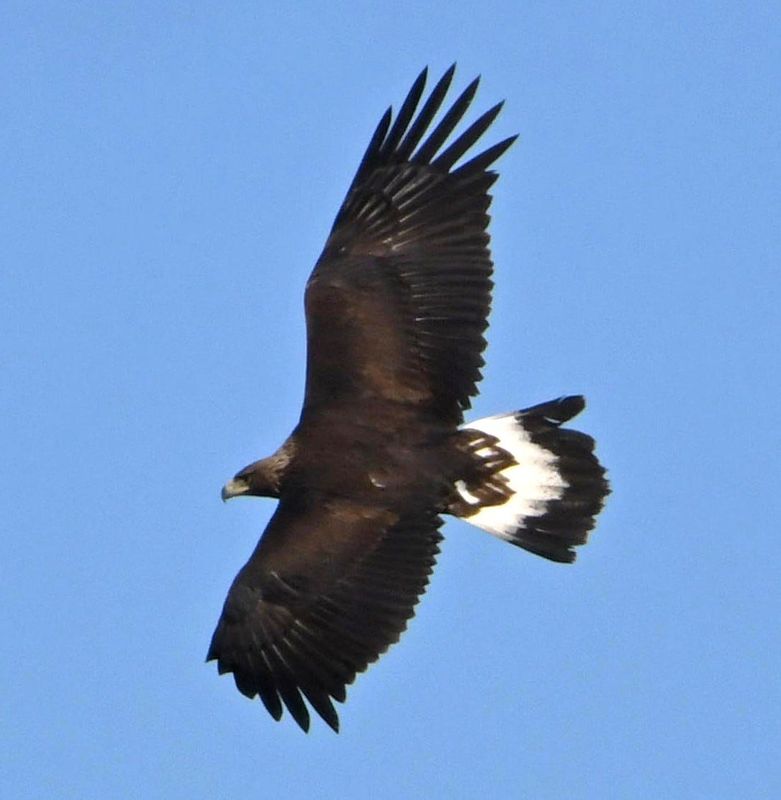
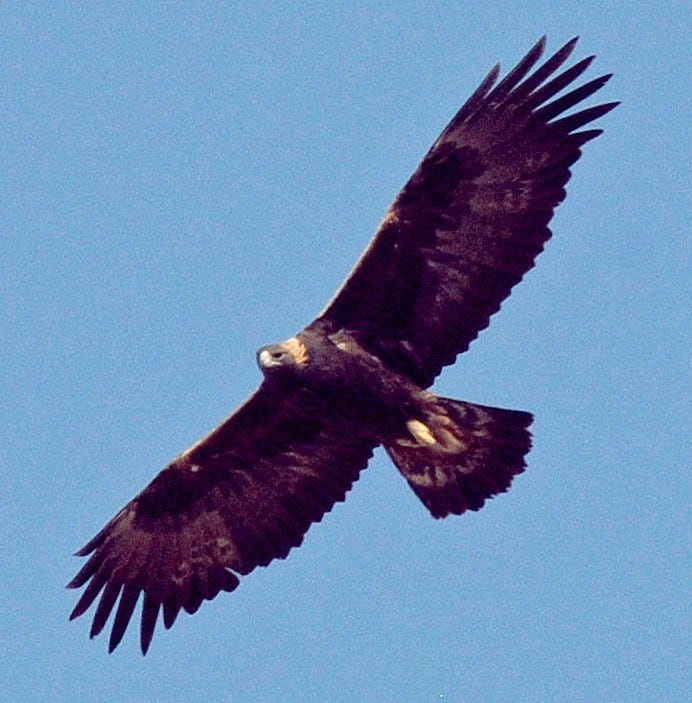
Golden eagles are large raptors with body lengths of 31–40 inches and wingspans exceeding 6 feet — approximately the size of bald eagles. The adult golden eagle’s body and tail are brown, and their nape is a lighter, shiny golden color hence their common name.
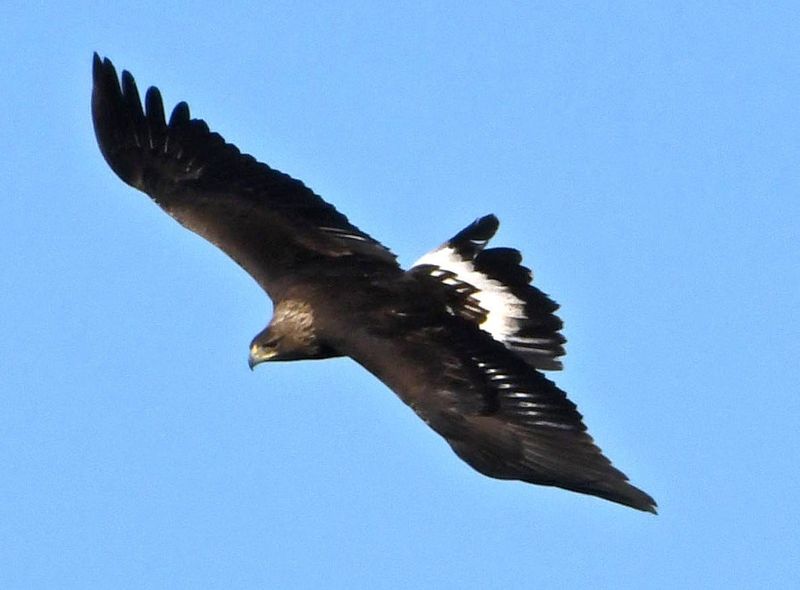
Juvenile golden eagles’ tail bases are often white dorsally and ventrally. Juveniles may also have small, visible, white wing patches dorsally and ventrally. These patches disappear as the birds age.
Bills are dark and golden eagles appear to have relatively small heads in flight compared to bald eagles’ yellow bills and prominent heads. Golden eagles’ secondary wing feathers and wings bulge or curve outward in a V-shape to a greater extent than the flatter, linear, more plank-like secondaries and wings of bald eagles.
Juvenile and second-year bald eagles may be confused with golden eagle juveniles. However, immature bald eagles possess more extensive white patches and streaks upon wings and bodies than immature golden eagles.
The juvenile golden eagle’s tail is distinctly bi-colored brown and white. Juvenile and immature bald eagles may have white-streaked tails and dark tail feather terminal tips, but their tail base is not as singularly white/bi-colored as juvenile/immature golden eagles.
Where they live and nest
Golden eagles are most commonly residents of the western half of North America from Alaska south to central Mexico. They are rare but more frequently seen in the far western portions of our Rolling Plains area, and a few are year-around residents of portions of the Texas and Oklahoma Panhandle and the southern Trans-Pecos Texas region.
Golden eagles prefer open areas and grasslands interrupted with cliffs, canyonlands, rimrock escarpments and broken woodlands. Favored nesting habitats are cliffs and canyonlands, but golden eagles also construct eyries or nests in tall trees and, very rarely, nearer ground-level.
Preferred nesting and roosting areas usually have wide, unobstructed views. Golden eagles usually pair for life and return to nesting areas and old nests each year. The eagles may construct multiple nests. Nests are made of various materials, including sticks, antlers, bones, posts, wire and other man-made objects, and the nest’s inner bowl is lined with local, sometimes aromatic vegetation.
The partners add materials to their eyries each year, and nests may attain massive sizes: widths exceeding 6 feet and depths of 2 or more feet. Both parents brood the clutch of three to four eggs for approximately 45 days, and the nestling period of young golden eagles is approximately 45–80 days.
Speedy hunters
Golden eagles’ primary prey are mammals, including mice and rats, ground squirrels, prairie dogs, marmots and rabbits. Golden eagles often hunt larger, swift prey, such as jackrabbits, in pairs with one bird distracting the jackrabbit while the other eagle stoops and strikes the prey.
Golden eagles are graceful flyers and hunters, and they have been recorded attaining stooping speeds of 200 mph. Golden eagles occasionally prey upon other birds and larger mammals, such as cranes, swans, fawns, pronghorn antelope, bighorn sheep and even bobcats and coyotes.
Golden eagles perform undulating, sky-dance courtship and territorial display flights and curving, pendulum-shaped searching and hunting flight patterns. Golden eagles often engage in play activities wherein one eagle will fly high and intentionally drop an object or dead prey, and the eagle’s partner will catch the item before it strikes the ground! Golden eagles also chase and harass other birds to steal prey items.
Federally protected
These eagles were persecuted in the past for livestock depredations. Both North American eagle species (and all raptor avians) are federally protected, and most current golden eagle mortalities result from human-related accidents and collisions with motor vehicles because eagles were scavenging carrion from roadsides.
Although negatively impacted by changing habitats, agricultural expansion, and urban development throughout its range, golden eagle populations never declined to critically endangered levels. This was perhaps due to differing diets of golden eagles compared to bald eagles.
Because most of the golden eagle’s diet consists of various mammals, golden eagles never accumulated concentrations of DDT high enough to hinder fertility and successful egg brooding. However, the eagles may still acquire toxic levels of lead in body systems and be accidently poisoned by baits meant for coyotes and other predators.
Spotting a golden eagle
Fall and winter months of October through March are probably the best times to search for golden eagles.
The birds have been sighted at Possum Kingdom Lake and further south in the western Edwards Plateau, but they are rare visitors to our area of Texas and Oklahoma. Better viewing opportunities may be found in the Texas and Oklahoma panhandle escarpments and canyonlands and mountainous Trans-Pecos, Texas.
Search for these impressive booted eagles within rocky, escarpment habitats, craggy areas and semi-open, edge habitats, and perhaps you’ll be rewarded with a sighting of the most popular international bird or national symbol!
Jim Goetze is a retired professor of biology and former chairperson of the Natural Sciences Department of Laredo College with an avid interest in all aspects of the natural world. He can be contacted at gonorthtxnature@gmail.com.
This article originally appeared on Abilene Reporter-News: Meet the golden eagle and learn how to spot one | Opinion
Reporting by Jim Goetze, Abilene Reporter-News / Abilene Reporter-News
USA TODAY Network via Reuters Connect
By Jim Goetze, Abilene Reporter-News | USA TODAY Network
