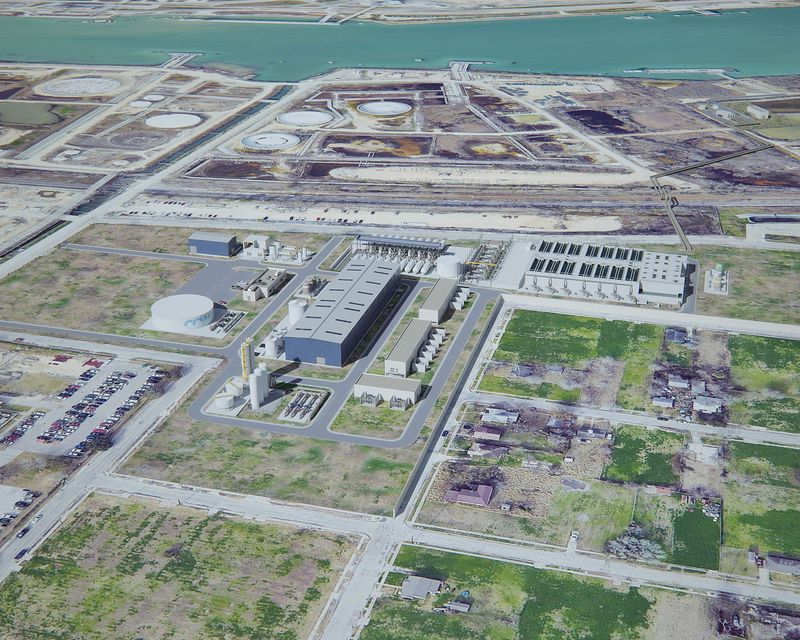
The proposed Inner Harbor desalination plant — likely the most polarizing local project in at least a decade — will again face a likely divided vote by city of Corpus Christi officials who have previously shot down continuing its development.
A roughly $78.6 million contract to further its design will go before the Corpus Christi City Council on June 2 — the same day that the council is also expected to decide measures that would be taken, such as curtailment, should the region eventually plunge into a water emergency.

The plant, now estimated to cost about $979 million, would not in the immediate future provide water. That would be nearly three years out, according to a draft presentation on the 1,000-plus-page contract with Corpus Christi Desal Partners.
Proponents have supported the endeavor as a safeguard needed to protect the economy and diversify water supply that has until recently fully relied upon surface water, vulnerable to drought and evaporation.
Critics have cited a range of concerns associated with the project, largely asserting its development would be at the expense of the bay’s ecology and the community.
Its deliberation last fall culminated in a 6-3 vote to end a contract with a different contractor.
To be located on a 14-acre site off Nueces Bay Boulevard and West Upper Broadway Street, the facility is proposed to have the capacity to generate as much as 30 million gallons of treated water per day.
Debate has ensued for years over the value or detriment to the community that a desalination plant at the Inner Harbor location would have within the scope of economic security, the environment, nearby neighborhoods and utility bills.
There has also been criticism on whether a desalination plant could encourage additional industrial expansion.
Critics have asserted that a desalination plant would primarily benefit industrial operations, the companies already having breaks on purchasing water.
Others have described industry — among the region’s highest economic drivers — as being villainized as companies seek alternative, nonpotable water sources such as treated effluent.
Council members have previously said they have endured pressure from the state and local leaders to either reject or approve the Inner Harbor desalination plant.
Its controversy has played out publicly elsewhere in the state — notably, in comments delivered by Gov. Greg Abbott labeling city officials as indecisive in the management of the water crisis.
“Corpus Christi is a victim not because of lack of water,” he told reporters in a March 10 news conference unrelated to the city’s water situation. “They’re a victim because of a lack of ability to make a decision.”
The contract
The proposed agreement with CCDP that will be considered by the council includes bringing the facility to 60% design, as well as development of a demonstration plant and verification of a guaranteed maximum price, according to a city memo.
CCDP is the second firm to take on the early steps of the venture.
The original firm, Kiewit Infrastructure South Co., lost the contract in the fall — largely, according to officials, because of its estimated $1.2 billion price tag, disclosed about 10% into its design.
The estimate, delivered by Kiewit in July 2025, was nearly 60% higher than a prior opinion of probable cost quoted by a different company in January 2024.
The state has previously signed off on a $757 million low-interest loan to help finance the plant, and city officials hope to be awarded a federal grant.
However, ratepayers will still be on the hook for at least a portion of funding.
In the draft presentation, city officials calculate that residents would bear about 13% cost, with commercial businesses carrying about 14%, and wholesalers and large-volume users responsible for 42% and 31%, respectively.
The council is also expected to consider on June 2 a contract of about $9.5 million to hire a consultant to represent the city in helping to oversee the project as it progresses, as well as a service to independently estimate costs, records show.
The environment
City officials committed to additional environmental studies as part of revisiting the plant in the fall, the intent being to help resolve disputes over sufficiency and quality of research previously undertaken to examine potential impacts on the bay.
Whether the additional study — what is described as a far-field model – satisfies concerns that had been raised has remained unsettled.
The far-field model explored the expected impacts of brine discharge on temperature and salinity in Nueces Bay, Corpus Christi Bay and the ship channel.
Several council members have expressed that they would need assurance that the bays would be protected before they could support moving the project forward.
It had initially been planned that CCDP’s contract would be up for a vote in April, when city officials believed the study would have reached partial, but not full, results that would be adequate for the City Council to make an informed decision.
The vote was delayed after the lead modeler was replaced.
Members of a committee assembled to advise on the modeling effort have not reached consensus on the comprehensiveness of the study, which is planned to be presented in the council’s June 2 meeting.
It’s expected that committee members will address the council on their views of the work as part of the presentation.
Some members in the committee’s May 28 meeting questioned whether performing the far-field model had essentially been a “check box.”
Some also said that while data had been produced, the study was lacking in how it should be interpreted on a practical level.
“Now that we’re toward the end, I still think we haven’t even answered that question — what is the environmental impact for aquatic life,” said committee member Deanna King.
The intent had been for the committee “to provide input and to ensure a collaborative and transparent analysis and interpretation of the Far Field Model process,” according to a city memo.
Some city officials, and Inner Harbor proponents, have maintained that all studies, including the most recent, indicate that a plant’s functions would not significantly alter the conditions of the bay.
The new far-field modeling didn’t show radical differences compared to several studies executed before, according to City Manager Peter Zanoni, speaking in a May 29 media briefing.
Still, CCDP could use the data if any refinement to the design of the facility is needed, he said.
While the model hadn’t included in its scope dissolved oxygen or an aquatic life analysis, “there’s more work that can be done,” Zanoni said, noting that there are experts at the Texas A&M University-Corpus Christi’s Harte Research Institute and the University of Texas’ Marine Science Institute.
“We want to partner with them to continue to work on our bay system because we care about it just as much as they do,” he said.
Communities
The proposed location has raised scrutiny not only about the bay’s health, but also about the wellbeing of nearby residents.
The acreage planned for the project is within the edges of the Hillcrest neighborhood, a historically Black and Hispanic subdivision that has seen industrial encroachment for decades.
In a May 29 meeting at Brooks AME Worship Center, a church where opponents have frequently gathered to organize protest against the plant, representatives of the neighborhood and environmental advocates spoke out about the plans and their possible implications, some as young as 13.
Monna Lytle, a resident and advocate of the subdivision, told attendees that neighbors objected to the plant’s development, adding that “we’ve been going through this fight since 2020.”
Lytle urged attendees to contact their representatives or go to City Hall on June 2 to address council members in person.
“Hillcrest is a neighborhood, has been a neighborhood and will always be a neighborhood,” she said.
Kirsten Crow covers city government and water news. Have a story idea? Contact her at kirsten.crow@caller.com.
Consider supporting local journalism with a subscription to the Caller-Times.
This article originally appeared on Corpus Christi Caller Times: Inner Harbor desalination plant vote returns to Corpus Christi council
Reporting by Kirsten Crow, Corpus Christi Caller Times / Corpus Christi Caller Times
USA TODAY Network via Reuters Connect