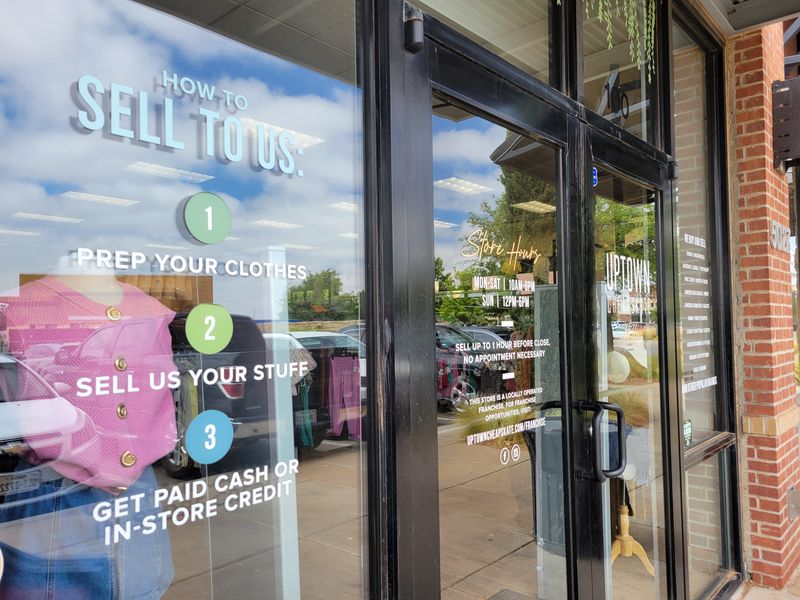
To mark Earth Day this week, two Lubbock organizations suggested a different way to lessen your environmental impact and improve your mental health, by shopping. One goes beyond that, even ensuring that unsold items find new life.
Here’s what Uptown Cheapskate, 5027 Milwaukee Ave. #100, and Goodwill Industries of Northwest Texas do to make a difference on Earth Day – April 22 – and beyond.

How does shopping at thrift stores help the environment?
Tricia Vitela, franchise owner of Uptown Cheapskate Lubbock, estimated that her store has saved 600,000 articles of clothing since opening in 2023. Last year, the Lubbock location was recognized as the third best Uptown Cheapskate in the U.S., and in the past 12 months, the store has kept 193,773 articles of clothing out of landfills.
“I think we underestimate the impact of small decisions,” Vitela said. “It doesn’t have to be a major lifestyle shift. Buy one thing used this month, and then try again next month. Maybe you buy a couple of things used, and little by little, it adds up to making a huge impact. I think little changes can yield some big results.”
It’s not all just reselling what customers trade in. Uptown Cheapskate donates items to local organizations, including the Dream Center.
“I’ve heard the statistic that even if an item’s life is extended just nine moths, wearing it one extra season, that reduces its environmental impact by 20 to 30%,” Vitela said. “And, it’s reducing the need to manufacture a new item, because it already exists and people can have easier access, instead of having to purchase something new.”
Another way local thrift shopping lessens a person’s environmental footprint is cutting shipping, and connected fuel costs, from the equation.
“It lives the rest of its life here, rather than going around,” Vitela said. “We like the local aspect of clothes being here, and staying here too.”
At the same time, Vitela said donating and selling old clothes goes beyond environmental impacts.
“A lot of times, people wear 20% of their wardrobe 80% of the time, and some of those clothes that are just sitting in your closets are kind of bullies,” Vitela said. “They are who you once were, who you could have been, who you thought you might be, and they’re just kind of yelling at you. You don’t want to get rid of it, because you paid good money for it. But, you don’t need those to boss you around. Get those bullies out of your closet.”
What happens to items at Goodwill that don’t sell?
Even if items don’t sell, Goodwill Industries of Northwest Texas make sure things stay out of landfills through their rotation and recycling process.
“Unsold goods from our retail stores are transferred to our clearance location at 714 34th Street,” Goodwill Industries of Northwest Texas said in an emailed statement. “Items that remain unsold there move to our Salvage Department, where they are sorted by commodity category.”
After that, there are three paths. Many will be sold to recyclers, who will recover and repurpose fibers, while others are sold to third-party vendors who ship to developing countries. Stuffed animals are sold to a specialized vendor who repurposes them into fiberfill for car seats, according to the statement.
“Having a refined, large‑scale strategy for recycling unsold goods is a significant advantage — and it’s one of the ways Goodwill differs from smaller thrift operations that may not have the infrastructure to support this level of diversion,” the statement reads. “When you donate to Goodwill, you help fund the Goodwill Career Resource Centers, providing free training and support that helps people overcome challenges, build skills, find jobs, and grow careers.”
Alana Edgin writes about business for the Lubbock Avalanche-Journal. Got a news tip? Contact her via email at aedgin@lubbockonline.com.
This article originally appeared on Lubbock Avalanche-Journal: How do thrift stores help sustainability? Lubbock store shares numbers
Reporting by Alana Edgin, Lubbock Avalanche-Journal / Lubbock Avalanche-Journal
USA TODAY Network via Reuters Connect