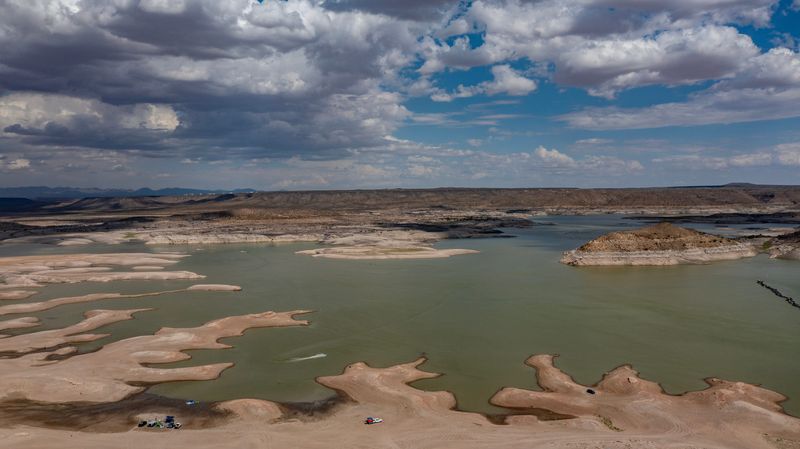
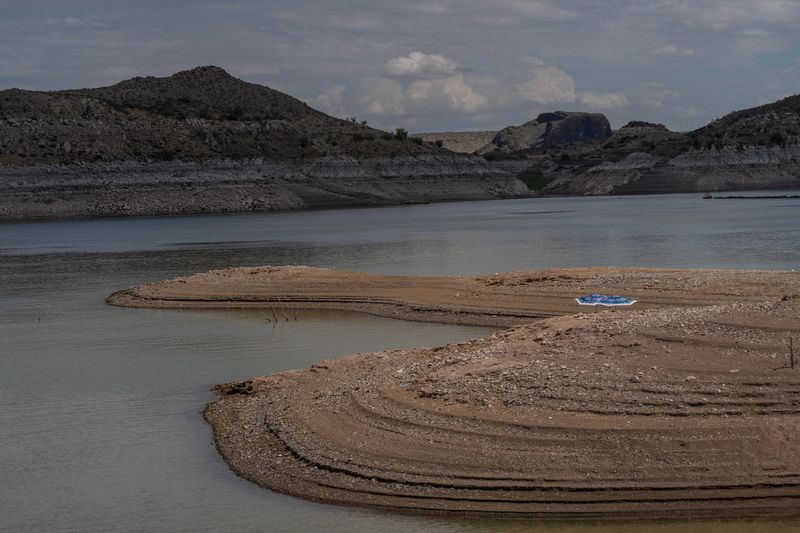
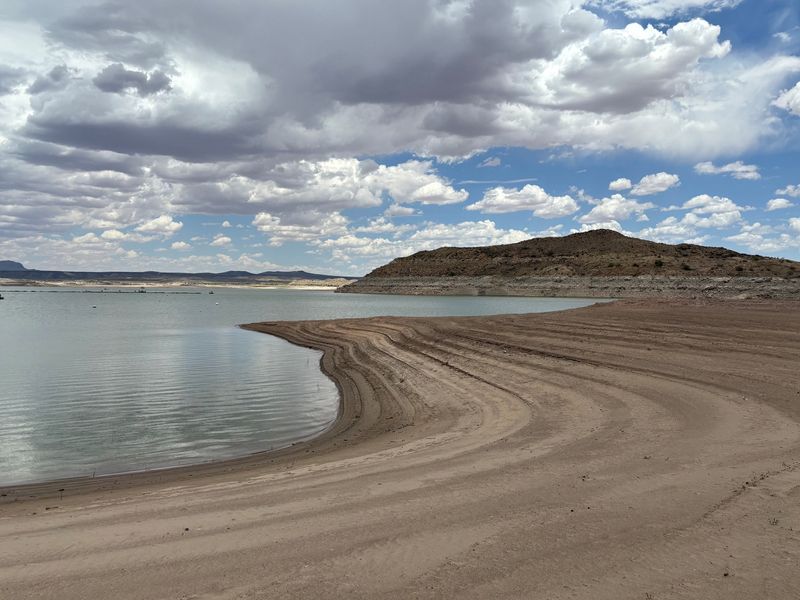
The gently lapping blue waters of Elephant Butte Lake tell a century-old story as indelible and precarious as the striations on exposed islands where water levels once were.

The city of Elephant Butte and the lake created by a dam in 1915 instantly made it a recreation destination for the region. Yet as water levels fluctuated and steadily declined, the economy that grew around it began to feel the pinch.
Now, the confluence of exponential inflation, high fuel prices and historically low water levels in the once-thriving lake only exacerbated drought conditions.
To be clear, Elephant Butte has not run dry. It still holds plenty of water for campers, boaters and fishermen. The record low was in 2013 when the lake north of El Paso dipped to a historic low elevation of 4,286.25 feet.
New Mexico’s largest reservoir dropped to its lowest level in 40 years, bottoming out at a mere 3% of its total storage capacity.
The latest data from the New Mexico Department of the Interior’s Bureau of Reclamation show the lake has about 91,700 acre-feet of storage, or 4,295.3 feet, as of June 26. That is a mere 4.6% of full capacity.
But Elephant Butte Lake State Park Superintendent Jonathan Horsley says there is a silver lining despite the current data.
“Even at low water levels, we have plenty of water, although there is less access in the way of boat ramps,” Horsley said. “We have three boat ramps in the park and right now we only have one. As the water goes down, it reduces the number of lanes that can be used at which boats can launch. To help that, we have friends of the park that come in and help direct traffic for that, especially on holidays.”
It remains the largest reservoir in the state, and, as Horsley noted, its sandy beaches are still a hub for many patrons. He even contended that the decreased water levels have created more beach area for visitors to have more privacy.
The Bureau of Reclamation confirmed the depth varies by location within the reservoir pool and is deepest near the dam. That part of the lake was roughly 170 feet deep earlier this year.
“We haven’t seen a drop in visitation and we’re the largest body of water for many municipalities in the region,” Horsley said. “During Memorial Day weekend, when we were at 12% lake capacity, we had about 45,000 visitors. During the Juneteenth and Father’s Day holidays, we had 42,000 estimated visitors. In terms of boat traffic, we haven’t really seen a dip either.”
During the recent Fourth of July weekend, the lake was between an exceptionally low 3.0% to 3.5% capacity. As of July 15, the water level at Elephant Butte Lake was about 2.4% of its total capacity.
This positioned the shoreline roughly 115 feet below the reservoir’s seasonal flood pool, according to Elephant Butte Lake State Park data.
The lowest the lake has been was in August 2025, at 2% capacity.
Visiting a lake with such cyclical water levels comes with its own warnings, as Horsley reminded the public to have fully functional depth finders on any boating vessel, along with the usual slate of safety precautions like wearing life vests while on the water.
A ‘significant drop’ in business
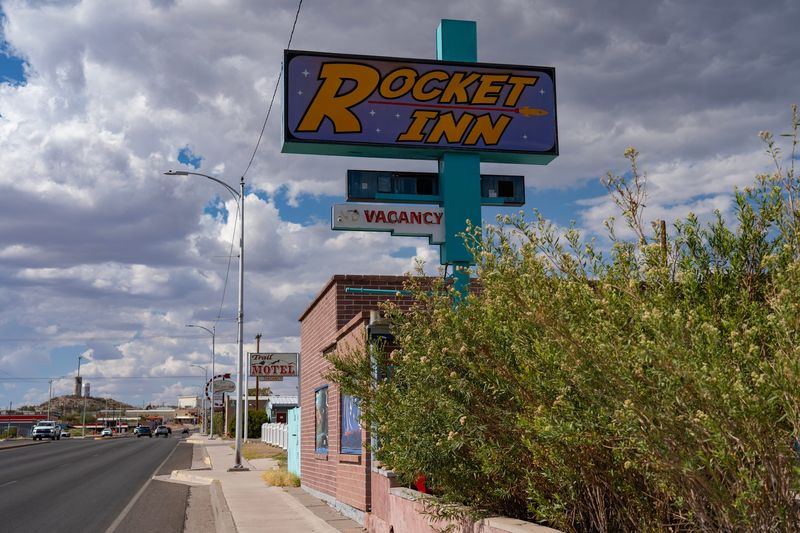
Healthy visitation numbers to the park do not always translate into equally robust economic profit, as area businesses have learned.
“We’ve noticed a significant drop in tourists and boaters coming in,” said Isabella Shetter, the general manager at Comfort Inn and Suites in nearby Truth or Consequences. “When water levels were up, we would usually sell out during the spring and summer season. Now, we’re at roughly 50% capacity during those same times.”
Staying profitable has become a creative task, with offers of lower rates and package deals from local golf courses to attract tourists. For Shetter, adjusting to the lower lake levels has also meant thinking outside the box to avoid downsizing staff.
The same cannot be said for cuts to employee hours, as those have already been made.
“This town is a retirement community, so the majority of the money comes from tourism dollars,” Shetter said. “That’s the money that secures jobs for the younger generation. Without tourists, I wouldn’t be able to hire as many employees as I currently do.”
Such concerns are a far cry from the golden era of the lake in the 1910s, 1920s, 1940s, and most of the 1980s and 1990s. Back then, Elephant Butte was at or near its maximum capacity, over 2 million acre-feet. That meant the lake covered an estimated 36,500 acres. That is comparable to Lakes Lanier and Seminole in Georgia.
For Stephen Gentry, owner of Bigfoot Restaurant in Elephant Butte, water levels are just one of many issues dampening the bottom line in the area.
“It seems the number of visitors has gone way down, but water levels are just one of the issues impacting the economy,” Gentry said. “You have extreme increases in fuel prices and higher prices for things like groceries. So people are being squeezed, so a family coming several times during the summer will only come once or twice at most.”
Gentry recalled weekends of a full dining room at much fuller water levels and stronger economic indicators. Like many in Elephant Butte, Gentry will remind you that water levels are cyclical and a rebound, no matter how small, is always on the horizon. Yet keeping people coming in for a meal only works if they make the trip to the city of Elephant Butte.
Like Shetter, Gentry has not needed to cut any positions. He hopes it stays that way.
What is the future of Elephant Butte Lake?
The Bureau of Reclamation runs a computer model that simulates upstream operations to forecast water that might reach Elephant Butte and Caballo Lakes and also downstream calls for water.
According to their forecast, Caballo Lake is expected to end the irrigation season with about 12,000 acre-feet of storage, similar to the past few years. In 2025, Caballo Lake was reduced further for maintenance.
“Ours is a tourist and farming community and there has been a noticeable difference in people coming to visit,” said Laura Whiteside, interim city manager for Elephant Butte. “There’s a direct impact on our economy if they’re not spending money in our restaurants and other businesses. Tourism is very tied to water levels because there’s a correlation between low water levels and low tourism.”
For Elephant Butte, the forecast is to end the irrigation season with about 20,000 to 30,000 acre-feet of storage. Rain could result in higher storage and dry, hot conditions could mean slightly lower storage.
The official monsoon season at Elephant Butte Lake State Park runs from June 15 through Sept. 30, with this season getting off to a slow start. On June 15, Elephant Butte Lake received roughly 0.94 inches of total rainfall. Elephant Butte Lake typically receives between 4.5 and 5.0 inches of rain during its official monsoon season.
Whiteside echoed others’ sentiment that lake levels are cyclical and that levels have been lower than the current storage. Yet the public still enjoyed it recreationally and emergency teams were able to draw water from it to dump onto nearby wildfires.
Both Caballo and Elephant Butte dams released water on June 26. The Elephant Butte Irrigation District shut off its call for surface water releases from Caballo Dam by June 30, matching their projected timeline.
Mexico is expected to end its call for water release from Caballo Dam on Saturday, July 18, and the El Paso County Water Improvement District No. 1 will do the same near the end of July. That will cease reservoir releases for the 2026 season.
Elephant Butte then shifts to hopefully a recovery phase.
“As it gets advertised that the lake is drying, then people stop coming and that hurts our economy,” Whiteside said. “We go through several years of drought and then we recover. It takes time and we have to go through the dry times. This won’t be the end of the lake and we’re confident the lake levels will return.”
Kristian Jaime is the Top Story Reporter for the El Paso Times and is reachable at Kjaime@elpasotimes.com.
This article originally appeared on El Paso Times: Hoping for recovery: Elephant Butte coping with lower lake levels
Reporting by Kristian Jaime, El Paso Times / El Paso Times
USA TODAY Network via Reuters Connect
By Kristian Jaime, El Paso Times | USA TODAY Network