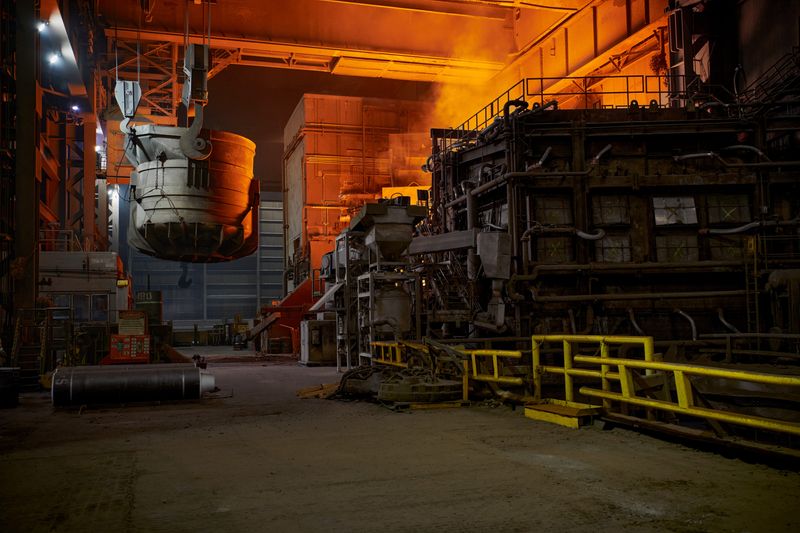
The Ohio Supreme Court has upheld a state agency’s denial of additional death benefits to the widow of a fire technician who died after entering a room filled with nitrogen gas at the Faircrest Steel Mill in Perry Township.
Sharmel Culver, the widow of Kenneth Ray Jr., had been awarded death benefits and sought additional compensation for violation of a specific safety requirement.

In a 6-1 decision on Wednesday, the Supreme Court found TimkenSteel Corporation, now known as Metallus, did not violate a specific safety requirement that entitles injured workers to additional compensation. The company was accused of failing to provide Ray with respiratory equipment when he needed to conduct safety checks in a pressurized, sealed control room.
He died of of asphyxiation on March 20, 2016, seconds after entering the room that had filled with nitrogen accidentally.
The Ohio Industrial Commission concluded the rules in effect at the time of the 2016 accident required respiratory equipment when “toxic gases” were present. Because nitrogen is not considered a toxic gas, but rather is deadly in high concentrations, no rule violation occurred, the commission concluded.
The 10th District Court of Appeals disagreed, concluding that the Industrial Commission erroneously found that nitrogen is not an air contaminant because it is not toxic in and of itself, and returned the case to the Industrial Commission to reconsider the case based on the court’s ruling. The Ohio Supreme Court majority reversed the 10th District’s decision and affirmed the commission’s denial of additional benefits to Ray’s widow Culver.
Ohio Supreme Court TimkenSteel case ruling
“There is evidence in the record that nitrogen is not ‘toxic’ and is not a ‘poison’ as those terms are commonly understood,” the opinion said.
Chief Justice Sharon L. Kennedy and Justices Patrick F. Fischer, R. Patrick DeWine, Joseph T. Deters, Daniel R. Hawkins, and Megan E. Shanahan joined the opinion.
In a dissenting opinion, Justice Jennifer Brunner wrote that Alabama has executed four inmates using nitrogen gas since 2024, Louisiana has used nitrogen once for an execution, and pending legislation in Ohio proposes the use of nitrogen for executions.
She wrote that a nontoxic gas can be considered poisonous in “suitable quantities” and the 10th District correctly found the commission should have considered the concentration of nitrogen in the room when determining whether there was a safety violation. She stated that “deeming nitrogen gas per se ‘nontoxic’ despite its being used to execute inmates – flies in the face of reason.”
Kenneth Ray Jr. dies dies doing inspections
As a member of the security and fire team, Ray was responsible for conducting safety checks and inspecting fire extinguishers. In March 2016, he inspected the extinguishers in an elevator control room at a TimkenSteel facility in Perry Township. The room was pressurized to prevent contaminants from entering and interfering with machinery. The room was equipped with an air-handling unit, which filtered outside air and circulated purified air into the room.
The air-handling unit contained a cleaning system, which used bursts of compressed nitrogen gas to dislodge debris from the air filter. Unknown to anyone at the time, the cleaning system malfunctioned and was continuously releasing nitrogen gas rather than just short pulses. Nitrogen displaced the oxygen in the control room. Ray entered the room, which contained 4.7% oxygen and 95% nitrogen. Air containing less than 19.5% oxygen is considered dangerous.
Ray entered and the door closed behind him. He died of asphyxiation seconds later. TimkenSteel, a self-insuring workers’ compensation employer, paid Culver death benefits.
Widow seeks additional death benefits
In 2017, Culver applied to the workers’ compensation system for additional benefits for violations of specific safety regulations. TimkenSteel objected, and an Industrial Commission staff hearing officer conducted an investigation.
Ray, a 32-year-old resident of Atwater in Portage County, worked with TimkenSteel’s security and fire team. He also was an 11-year veteran of the Uniontown Fire Department and had worked as an officer with the Creston Police Department.
Since the fatality, TimkenSteel stopped using nitrogen to power tools and it removed all connections from the ventilation systems, an official of the Cleveland office of the the Occupational Safety and Health Administration told The Repository in September 2016.
Reach Nancy at 330-580-8382 or nancy.molnar@cantonrep.com.
This article originally appeared on The Repository: Widow loses benefits case over husband’s 2016 nitrogen gas death at TimkenSteel plant
Reporting by Nancy Molnar, Canton Repository / The Repository
USA TODAY Network via Reuters Connect