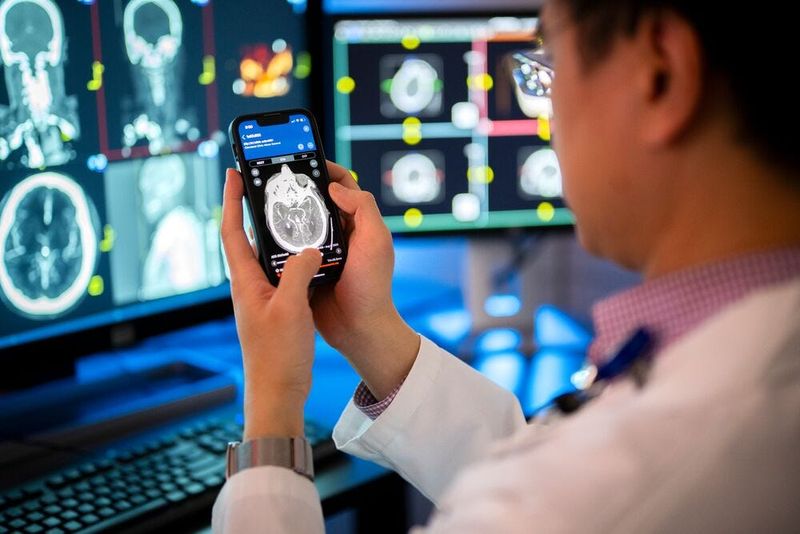
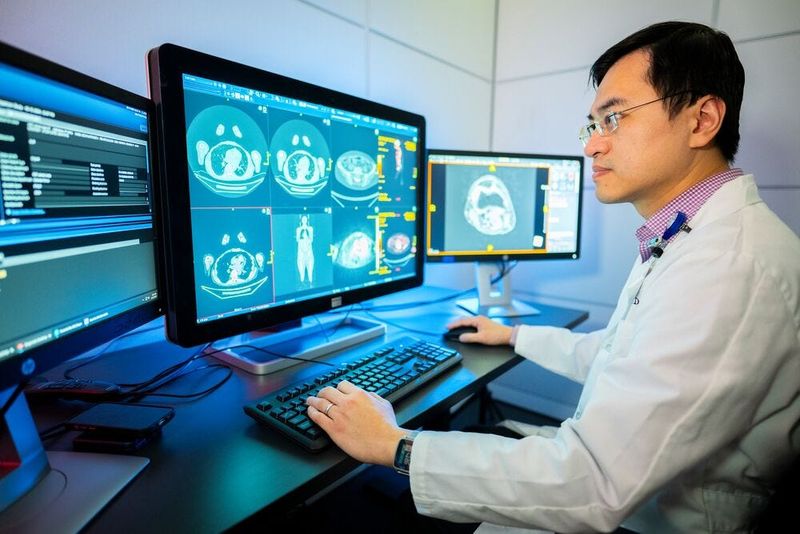
There is a treasure trove of artificial intelligence-powered medical technology out there.
Northeast Ohio hospitals are increasingly partnering with tech companies to meet their specific needs and improve patient care through customized AI workflows.

Though most widely used in radiology, AI is being adopted by hospitals for everything from summarizing reports to identifying stroke patients in emergency rooms more quickly.
When it comes to implementing AI at hospitals, Tom Valent, chief business and marketing officer for Aidoc, a health care technology company, said it can’t be one-size-fits-all.
“What we’ve learned in health care, at least in the U.S., is every hospital, and sometimes even within a hospital, is kind of its own unique creature,” he said.
He said the physician workflow of each technology is completely configurable to the specific hospital setting.
“The AI is the intelligence, but the real impact is the actual workflow solution, meaning being inside of how physicians normally practice medicine and making that better,” Valent said.
How Northeast Ohio hospitals are using AI
Building AI algorithms for use in health care settings has become a much quicker process in recent years. Where it used to take years to develop a single algorithm, or a set of rules to perform a specific function, companies and researchers can now create one in a matter of months.
AI algorithms “are the base of intelligent systems, which make it possible for machines to learn from the data, decide, and solve problems,” according to the Artificial Intelligence Board of America.
As of February 2026, the Food and Drug Administration approved over 1,300 artificial intelligence-enabled medical devices and programs.
At Summa Health, Dr. Brian Bauman, head of pulmonary services and a pulmonary and critical care physician, said the hospital uses these AI programs:
At University Hospitals, Dr. Leonardo Kayat Bittencourt, vice chair of innovation, said they use Aidoc along with these five program:
At the Cleveland Clinic, Dr. Po-Hao Chen, vice chair for artificial intelligence in the Diagnostics Institute, said they use direct decision support, indirect clinical support and image generation programs. Along with Riverain Technologies, the Clinic uses these AI programs:
The Cleveland Clinic regional hospital system includes Akron General and Mercy and Medina hospitals.
Aidoc, a one-stop-shop for medical AI
Aidoc, which Valent said has become a one-stop-shop platform for multiple algorithms, works through an AI operating system.
Valent said it’s essentially the connective tissue between a hospital’s existing IT and the algorithms. The operating system can identify the patient and the type of scan to be read, and it activates the correct algorithm on its own.
Then, it triggers a specific customized workflow setup for that hospital and physician.
Aidoc has three different product lines:
Bittencourt, who also works in abdominal imaging, said University Hospitals uses just over 10 of Aidoc’s algorithms.
“[Aidoc] is kind of an alarm or an alert that pops up whenever we see a case or whenever we are covering a certain list that then calls the attention of the radiologist to ultimately give their own adjudication and assessment to the exam,” he said.
Valent said over 1,600 hospitals are using Aidoc, and they cover almost 50% of patients in Ohio.
ClearRead CT used to read radiology scans
It’s becoming more common for hospitals to use AI when reading radiology scans.
Studies have shown that AI can meet or exceed the performance of human experts in image-based diagnoses from several medical specialties.
Steve Worrell, CEO of Riverain Technologies, which created ClearRead CT, said the algorithm can read a patient scan in about 4 minutes and identify lung nodules that may be cancerous.
“Because radiologists are more and more burdened with more data, the potential for oversight is greater,” he said. “So, we want to improve their accuracy, but also improve their reading efficiency.”
When a patient gets a scan, and ClearRead CT is used, the data is routed to a picture archiving and communication system at the same time as it’s routed to the algorithm.
ClearRead analyzes all the individual slices of a CT scan. Its results are pushed to the archiving system, and when the radiologist opens a patient file, both the original scan and ClearRead’s content are available to them.
“We are doing our processing before the radiologist ever even thinks about opening that patient file,” Worrell said.
The radiologist is able to do a concurrent read of the scan while seeing ClearRead’s results at the same time, double-checking areas the algorithm flags, he said.
Worrell said roughly 250 sites nationwide are using ClearRead CT.
AI implementation and training
Chen, who is also a diagnostic radiologist, said when Cleveland Clinic is implementing a new type of AI, it’s important that physicians are trained on its intended use and intended users.
“You need to know what the AI is not going to do for you — that’s still on you,” he said.
Everyone also needs to be trained to be part of the developed workflow. Medical care doesn’t happen with just one doctor — it takes entire teams, he said.
Worrell said Riverain has its own virtual training that helps doctors understand ClearRead’s limitations and sources of false positives.
“You can’t trust a ‘no’ flag, meaning a negative result on the AI, for what it is,” Chen said.
Building and validating AI tools
Bittencourt said University Hospitals is part of a consortium created by Bunkerhill Health that makes getting algorithms into clinical practice easier.
Nishith Khandwala, CEO and co-founder of Bunkerhill, said the company’s goal is to bring more AI into the health system to help hospitals increase efficiency and deliver better care to their patients.
“We want to bring every idea that you have that could help patients, that could help health systems, that could help the health care ecosystem more broadly, to the clinic as quickly as possible,” he said.
He said it can be difficult to get algorithms into clinical practice after they’ve been built.
Because they’re often created using one hospital’s data, the chances of the AI working at other hospitals are low because every patient population looks different — and it can take years to get data from other hospitals, he said.
Bunkerhill’s consortium involves 27 academic medical centers and creates a “legal bubble” where researchers from one health system can share data and algorithms with researchers at other health systems.
“A project that might have lost momentum otherwise, or a project that would have taken two or three years to go from start to finish, can potentially be compressed in a matter of months,” he said. “You can go from idea to something that has been tested on data from multiple hospitals many times.”
Internally, Cleveland Clinic has an overarching AI task force that oversees approval of AI algorithms before they go into clinical practice, Chen said.
University Hospitals has a “hardcore group” of AI experts who are radiologists in different subspecialties who analyze new AI tools together, Bittencourt said.
Bittencourt said no AI algorithm is running autonomously or in a way that is replacing a doctor’s judgment.
“The algorithm and AI are just a piece,” Valent said. “The other pieces are as important.”
Lauren Cohen is a community reporting intern for the Akron Beacon Journal and Signal Akron. The position is funded through a grant from the Knight Foundation.
This article originally appeared on Akron Beacon Journal: What role is AI playing in Northeast Ohio hospitals? Experts weigh in:
Reporting by Lauren Cohen, Akron Beacon Journal/Signal Akron / Akron Beacon Journal
USA TODAY Network via Reuters Connect