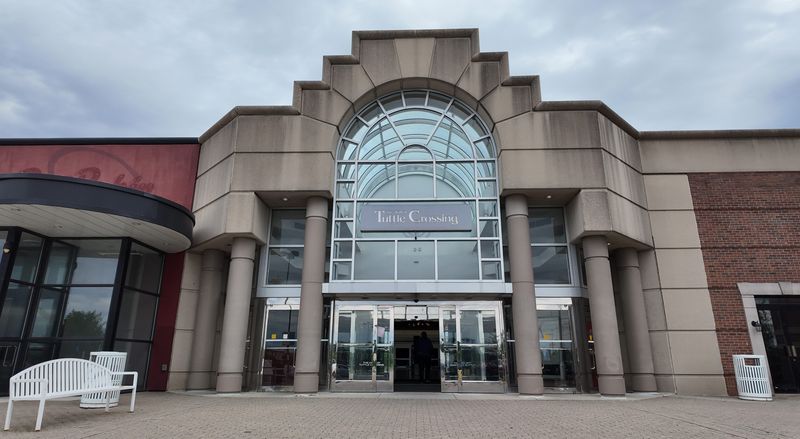
It’s 3:30 p.m. on a Friday, but it feels like closing time at the Mall at Tuttle Crossing.
Silver security gates seal off dozens of storefronts, many of which are vacant. Escalators sit idle. National brands are scarce, and only a scattering of shoppers drifts through the almost eerie corridors, few actually carrying bags.

“This is probably my fourth or fifth time here, and I have never seen it this dead,” said Sakuna Blackheart, who was waiting to play games at Scene75, the entertainment venue that became one of Tuttle’s anchor tenants in 2019. “I am blown away. There’s no one here, and the service is horrible.”
It’s a stark contrast to the 1.5-million-square-foot mall’s heyday in the early 2000s – and a sign, some experts say, of a property nearing the end of its run.
The mall’s troubled ownership
The Mall at Tuttle Crossing, built in 1997, fell into receivership in 2020 and was later bought by a trio of New York-based investment firms – Namdar Realty Group, CH Capital Group and Mason Asset Management – in 2023.
Mark Lundine, the city of Columbus’ economic development administrator, said to the best of his knowledge, he’s not spoken with Tuttle’s owners in over a year. A city spokesperson later said she couldn’t find any contact for Namdar beyond what’s publicly listed on the firm’s website.
Namdar has frequently been in the news – and the courts – for complaints about its malls, many echoing issues seen at Tuttle. A 2021 Bloomberg report characterized the firm as a “bottom feeder” and made reference to various lawsuits from both tenants and buyers who’ve alleged mismanagement.
Most recently, Ford City Mall in Chicago was ordered to shut down by a county judge after health and safety concerns came to light, according to a May 16 report from SRP Local News. Remaining tenants said Namdar had invested “nothing” in the mall and allowed it to decline since purchasing it in 2019 for $16.6 million, according to the report.
Meanwhile, Namdar is headed to criminal trial over the deteriorating condition of roads surrounding the Galleria at Pittsburgh Mills mall, according to a May 11 report from TribLIVE. The owners also face more than 300 code violations tied to maintenance issues at the property, with the bulk of more than $17 million in fines already under appeal in court, according to the report.
A Namdar spokesperson sent a statement from Tuttle mall’s general manager, Steve Hinkle, who said his focus is to bring more “experiential and community-oriented tenants” who encourage visitors to spend more time at the mall beyond traditional shopping.
“We are currently exploring entertainment concepts, such as a pickleball operator, while also looking to attract local food-and-beverage tenants along the lines of a neighborhood hamburger shop, coffee concept, or ice cream operator,” Hinkle said in the statement.
Hinkle added that his team’s goal is to strengthen Tuttle’s connection to its surrounding community through a mix of local businesses, entertainment, and events that make it “a more active and engaging destination.”
A Namdar spokesperson declined to comment on the firm’s legal challenges.
What’s driving Tuttle’s decline?
The Mall at Tuttle Crossing has entered “late-stage decline,” according to Carl Goertemoeller, executive director of the University of Cincinnati’s Real Estate Center.
Some of that downturn can be attributed to broader industry shifts, like a decline in in-person shopping, he said. Like many markets, Columbus once had enough demand to support several regional malls.
“They can’t support that many malls anymore,” Goertemoeller said. “It’s too much retail square footage.”
But Goertemoeller also said it would be unfair to chalk up all the mall’s challenges to external factors. Tuttle, he said, has failed to keep up with newer competitors like Polaris Fashion Place and Easton Town Center, which experts say have invested heavily over time and built out dense clusters of shopping, dining, entertainment, and even housing.
These “diverse, highly curated” centers like Easton and Polaris are thriving, said Mike Copella, a commercial real estate executive at CBRE.
Traditional, older malls without these features are not, he said.
What’s next for Tuttle?
Considering these factors, plus Tuttle’s many vacancies and location within a booming corridor, the site has “the makings of a strong redevelopment” potential, Copella said.
The mall has a Dublin mailing address, but it’s located in the city of Columbus. Though he hasn’t had any direct conversations with the owners about potential redevelopment, Lundine pointed to the city’s ZoneIn initiative, which encourages more mixed uses, as one pathway for reimagining an aging commercial property like Tuttle.
That’s not to say it would be easy or quick. The mall’s ownership structure includes multiple parcels governed by reciprocal easement agreements, or REAs, Goertemoeller said. These legal agreements dictate how different portions of the property can be used, and untangling them could present a significant hurdle on top of what would already be a hefty price tag.
Merely demolishing a property the size of Tuttle – situated on 85 acres – could run $10 million to $15 million, Goertemoeller said.
“The right developer should not be afraid of tackling that,” he said, adding that it could still take years before any tangible redevelopment takes place. “At the end of the day, the economics may be such that it doesn’t make any sense, but it shouldn’t keep them from trying.”
As for what redevelopment at the Mall at Tuttle Crossing could look like, Lundine pointed to the former IBM office campus northwest of I-270 and Tuttle Crossing. Once a four-building office complex with a parking garage, the site is now being reworked with two office buildings and preserved and new residential and retail space added.
“That might be an analogous project,” Lundine said. “It’s much smaller, obviously, and was commercial office, but it’s just interesting that that’s happening very close to Tuttle.”
Goertemoeller agreed that a mixed-use redevelopment that includes housing is likely, but beyond that, it’s unclear to him what would best suit the Tuttle site.
“I’m not exactly sure what should go there,” he said, “but I know that the one thing that should not be there is a two-level, enclosed regional mall. It’s not going to succeed in its current format.”
Reporter Emma Wozniak can be reached at ewozniak@dispatch.com or @emma_wozniak_ on X, formerly known as Twitter.
This article originally appeared on The Columbus Dispatch: Tuttle Mall in ‘late-stage decline,’ experts say it must change to survive
Reporting by Emma Wozniak, Columbus Dispatch / The Columbus Dispatch
USA TODAY Network via Reuters Connect