Cincinnati has distinction as the first all-American city, the first founded after the ratification of the U.S. Constitution in 1788.
The name Cincinnati itself is symbolic of the political ideals of the American Revolution.

That wasn’t the original name, though. When the first settlers came ashore Dec. 28, 1788, the settlement was known as Losantiville, a name coined by cofounder John Filson to mean “city opposite the mouth of the Licking River” in Kentucky.
When Gen. Arthur St. Clair, governor of the Northwest Territory, arrived at Losantiville on Jan. 1, 1790, to inspect Fort Washington, he renamed the town Cincinnati. The name was derived from the Society of the Cincinnati, a fraternal order of Continental Army officers, of which he was a member.
“The name Cincinnati honored the Society and its members, who settled in large numbers in the towns of the Northwest Territory,” states the Society of the Cincinnati website.
The society, founded by Henry Knox in 1783 to preserve the ideals of the revolution, was named for the Roman hero Lucius Quinctius Cincinnatus, who famously answered the call to lead Rome to victory, then gave up power and returned to his farm.
The society’s motto, “Omnia relinquit servare rempublicam,” means “He relinquished everything to serve the Republic.”
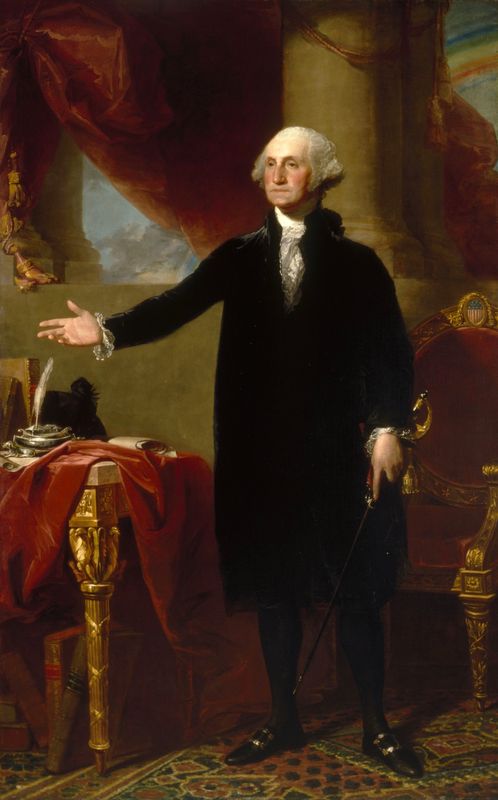
George Washington emulated that ideal when he gave up a chance to be king of America and went back to his Mount Vernon plantation. Washington, known as the American Cincinnatus, served as the first president general of the Society of the Cincinnati.
Was the connection to Washington the reason for naming the settlement Cincinnati?
Consider the timing. Eight months before St. Clair’s arrival, Washington was sworn in as the first president of the United States. And the name of the fort in Cincinnati? Fort Washington.
Cincinnatus and Washington were entwined in the minds of the early Americans.
Cincinnatus or the American Cincinnatus?
Little is known of Cincinnatus. His name means “having curly hair.” He was born about 519 B.C. as part of the ruling class, and served as a consul, the highest elected position in the Roman Republic.
Historians consider most of the stories of Cincinnatus to be legends, but they were familiar to those with a classical education.
Livy’s “History of Rome,” recorded in the first century B.C., includes the most famous tale of Cincinnatus. “The one hope of Rome” left his farm to lead the battle against invaders in 458 B.C., and upon victory, he resigned as dictator and returned to his plow.
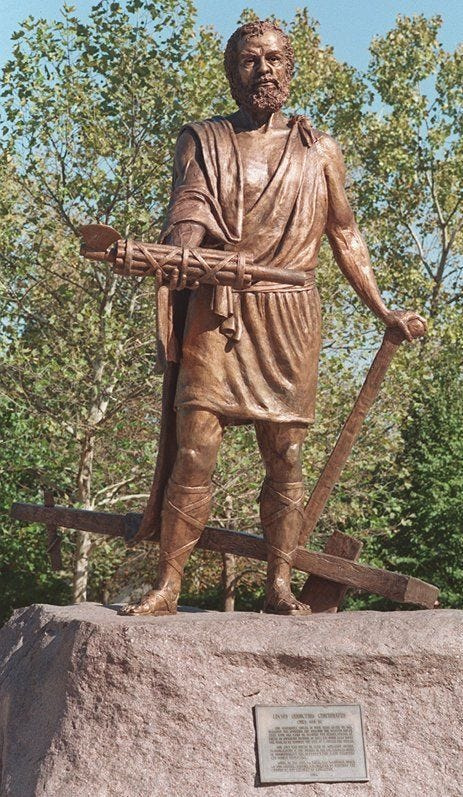
A statue of Cincinnatus by sculptor Eleftherios Karkadoulias stands at Cincinnati’s Bicentennial Commons to honor the sort-of namesake. The hero is depicted handing back a fasces, a Roman symbol of power, while leaning against a plow.
A similar statue of Washington, commissioned in 1784, is displayed in the rotunda of the Virginia State Capital.
After the Revolutionary War, Washington resigned his command and returned to Mount Vernon. But concerned America might turn back to a monarchy, Washington stepped up to preside over the Constitutional Convention in 1787.
While defining the head of the executive branch, the delegates were fully aware the man in the room was the best choice to be president – even though he didn’t want the job. That was what made him perfect for it.
Washington, as Cincinnatus, was called from the farm once again to lead. That was the imagery in mind when Cincinnati was named.
Yet, the city was not called Cincinnatus or Washington. It was named Cincinnati, for members of the society who believed in those ideals.
The Society of the Cincinnati had been criticized because membership was hereditary, passed down exclusively to the eldest male descendant. That felt too much like the aristocratic elitism the American Revolution was against.
But Washington viewed it as a political revolution only, not a social one, and had worked hard to achieve privilege and rank.
“For him, the Society of the Cincinnati did not defy the best ideals of the American Revolution; it embodied them,” historian Joseph J. Ellis wrote in “His Excellency: George Washington.”
After two terms as president, Washington resigned, setting a precedent for presidents to serve two terms only, rather than for life.
That was right in line with the Cincinnati principle: a call for leadership to step up, but no kings.
This article originally appeared on Cincinnati Enquirer: What is the meaning of the name Cincinnati? The answer is nuanced
Reporting by Jeff Suess, Cincinnati Enquirer / Cincinnati Enquirer
USA TODAY Network via Reuters Connect