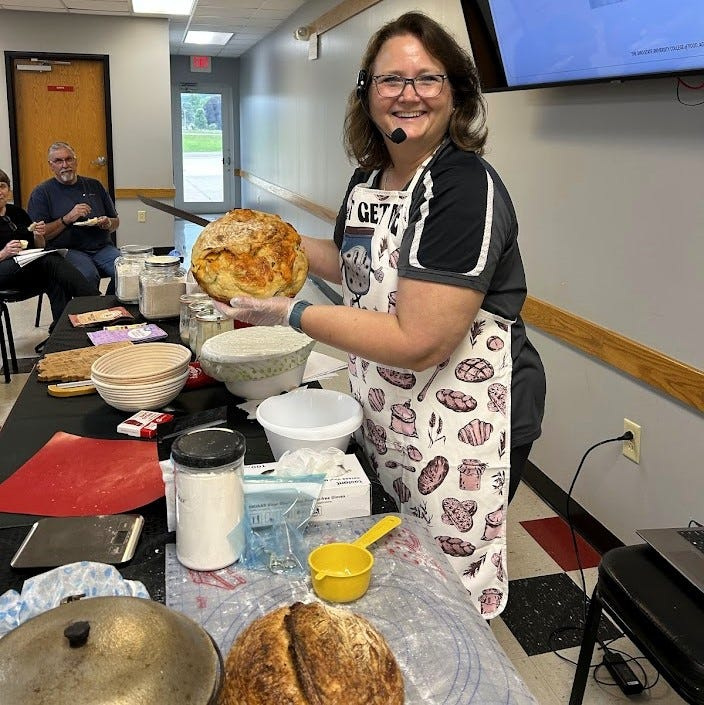
I’m not sure if sourdough has ever been more popular than it is right now. Last week, I had the pleasure of hosting my Ohio State University Extension colleague from Carroll County, Corinna Gromley, to teach a sourdough breadmaking workshop here in Coshocton County. More than 50 people were breaducated and walked away with a new appreciation for both the art and science of sourdough.
People have been making sourdough bread for thousands of years. Before we could buy that package of yeast at the grocery store, bakers relied on yeast found naturally in the environment. Commercial yeast is convenient and consistent, but lacks the complexity of flavors and other characteristics that make sourdough unique.

Sourdough is characterized by a lactic-acid fermentation. This means there are more microorganisms involved in flavor development than just yeast. Lactic acid bacteria can be naturally present on flour and other areas of our environment.
Though there are several steps, the concept of making sourdough bread is simple. A sourdough starter is made of just flour and water. It can take two to four weeks to establish a starter, and it needs to be fed with additional flour regularly. You could also get a starter from a friend or purchase a starter from an online source.
Bread flour is recommended for sourdough bread because of the higher protein content compared to all purpose flour. The protein provides more structure to trap the gases from the fermentation process. This structure is built through a series of stretch and folds of the dough.
One unique step in the sourdough process is cold fermentation. This is one of the last steps before baking where the shaped dough is stored in the refrigerator. It can last for a few hours up to three days. The longer the fermentation, the more sour the bread will be after baking.
This is not proofing with the intent to make the dough rise nearly as much as to develop flavor. It also helps for the bread to be cold when you score it. Making cuts on the top of the dough is necessary to allow gas to escape as the dough rise in the oven during baking.
Another unique aspect is that you never use all your starter. There is always some left to feed for future baking. And this remaining starter can also be used as the leavening source in many types of quick breads like pancakes, muffins, cinnamon rolls, crackers and, even, cakes and cookies. Just remember, in these cases the starter is essentially replacing baking soda or baking powder in a recipe. It is not as involved as making sourdough bread and also will not have the same characteristic flavors of sourdough.
There are research studies that show that sourdough bread can be more easily digested by people who may have digestibility challenges with other yeast breads. If you purchase sourdough bread at a store, be aware that there is no standard of identity set for sourdough bread. It is a good idea to look at the ingredient statement on the label to see what you are purchasing.
Remember, traditional sourdough bread is water, flour, salt and a cultured sourdough starter. If the label contains ingredients like baker’s yeast, baking soda, vinegar, yogurt, oil, honey or any type of preservative like benzoic acid or cultured wheat; then this a not a traditional sourdough bread recipe.
To learn more, check out these sourdough resources from university extension offices across the country at go.osu.edu/sourdoughinfo.
Today, I’ll leave you with this quote from Tara Jenson: “I bake for myself as a form of therapy, I bake to participate in a larger cultural movement and I bake to remember it in my bones.”
Emily Marrison is an Assistant Professor, Family and Consumer Sciences for Ohio State University Extension in Coshocton County. She may be reached at 740-622-2265 or marrison.12@osu.edu.
This article originally appeared on Coshocton Tribune: Trendy sourdough bread has been baking staples for thousands of years
Reporting by Emily Marrison, Special to the Tribune / Coshocton Tribune
USA TODAY Network via Reuters Connect
By Emily Marrison, Special to the Tribune | USA TODAY Network