In 2007, a seemingly exasperated John Roberts wrote, “The way to stop discrimination on the basis of race is to stop discriminating on the basis of race.” The chief justice did so in writing for a 5-4 majority of the Supreme Court, striking down a voluntary effort of the Seattle city school system to improve the racial balance in its classrooms.
The advice appeared simple enough: Just don’t discriminate.

It indicated something else, too. Roberts and colleagues view the Constitution as colorblind. They hold that practically anything involving civic decision-making or policy-making by race runs contrary to the constitutional amendments approved after the Civil War, long viewed as the second founding.
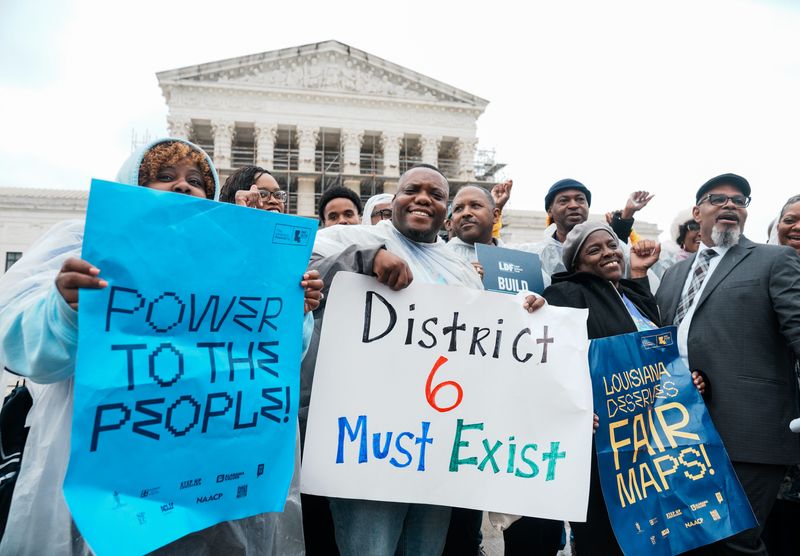
This thinking drove one of the most consequential rulings of the high court’s latest term. In Louisiana v. Callais, a 6-3 majority struck down a redistricting map that created a second majority Black district, arguing that race played a defining and thus unlawful role in the map-making.
Now the way is open to new rounds of extreme partisan gerrymandering, as Republicans especially look to tilt maps in their favor, no longer constrained by the Voting Rights Act and its first purpose: ensuring the right of Black Americans to choose the representatives of their choice.
No doubt, the idea of colorblindness carries appeal, along with bringing a halt to discrimination. The trouble is that both notions are easier said than achieved, as the country’s experience sorely reveals.
What Congress understood well in the wake of the Civil War is that the South would resist mightily moving into a new world of true equality for Black Americans. In crafting the 13th, 14th and 15th Amendments, lawmakers knew mere words on paper would be insufficient. Enforcement would be required, and they made certain the primary enforcer would be Congress.
In that way, the Constitution is not colorblind. Race plays a leading role, the three amendments at their core about enforcing the rights of Black Americans.
Unfortunately, lawmakers proved correct. Racism held in the South and beyond. After a brief time of hope and advancement, Black Americans again suffered brutally, denied equality and opportunity for another century.
When the country finally rallied to its promise, prodded by the courageousness of Martin Luther King Jr. and the many in his movement, Congress had this history in mind. Enacting legislation was one part. How would the country make its commitment to Black Americans stick?
In June 1965, two months before passage of the landmark Voting Rights Act, Lyndon Johnson framed an answer. He explained to graduates of Howard University that “freedom is not enough. You do not wipe away the scars of centuries by saying: Now you are free to go where you want, and do as you desire, and choose the leaders you please.
“You do not take a person who, for years, has been hobbled by chains and liberate him, bring him to the starting line of a race and then say, ‘you are free to compete with all the others,’ and still justly believe that you have been completely fair.”
This is what Johnson meant by taking affirmative action, initiating steps to ensure the necessary fairness.
For instance, the Voting Rights Act included provisions requiring states with a legacy of racial discrimination to gain federal approval before enacting changes in their election laws. It also opened a path to securing adequate representation for minorities in Congress.
When the act fell short, lawmakers, Republicans and Democrats, joined multiple times to make fixes as they reauthorized the law. In 1982, they altered the standard for proving discrimination. No longer was a showing of racist intent needed. Practical results were enough, for instance, Black Americans without the representation they deserved because of partisan gerrymanders.
For decades, these enforcement mechanisms served well. Then, starting notably in 2013, the Supreme Court began dismantling them. Gone is the requirement for prior federal approval. In April, a court majority reverted to requiring a show of discriminatory intent, something easily veiled, as opposed to discriminatory results, or what you can see with your eyes.
In making the case for such a retreat, the court invites the question often expressed: Haven’t we done enough to address the long injustice endured by Black Americans? Some justices have even toyed with deadlines for enforcement. Until 2026? Or 2030?
Better indicators surface in measures of such things as household wealth, academic performance, rates of infant mortality and incarceration. Black Americans long have trailed their White counterparts on these fronts. If much progress has been made, the gaps mirror glaring and persistent inequality and a lack of opportunity.
Put another way, this isn’t the moment to back off a commitment to enforcing voting rights, let alone the “more perfect union” the Constitution urges us to pursue.
Douglas is a retired Beacon Journal editorial page editor. He can be reached at mddouglasmm@gmail.com.
This article originally appeared on Akron Beacon Journal: The Supreme Court wrongly thinks Constitution is colorblind | Opinion
Reporting by Michael Douglas, Retired opinion editor / Akron Beacon Journal
USA TODAY Network via Reuters Connect
By Michael Douglas, Retired opinion editor | USA TODAY Network