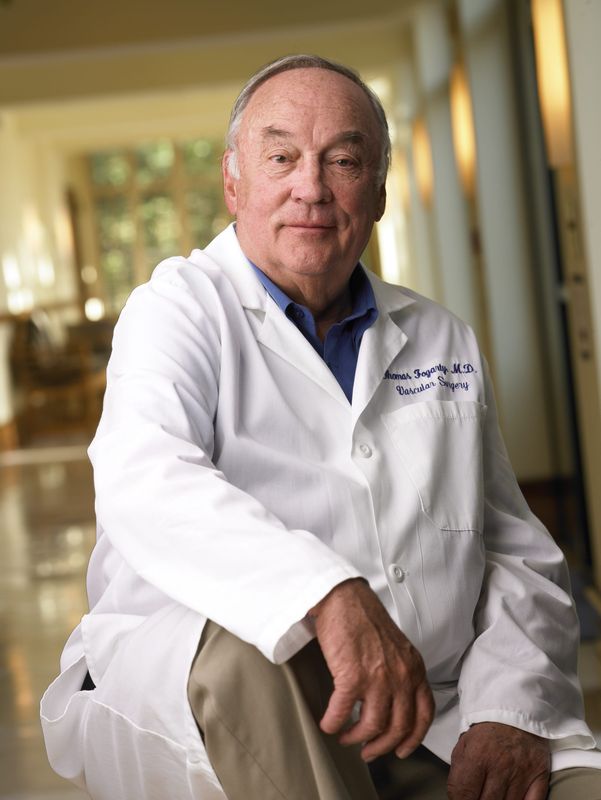
Dr. Thomas J. Fogarty, an esteemed cardiovascular surgeon, medtech inventor and winemaker, died Dec. 28 at the age of 91.
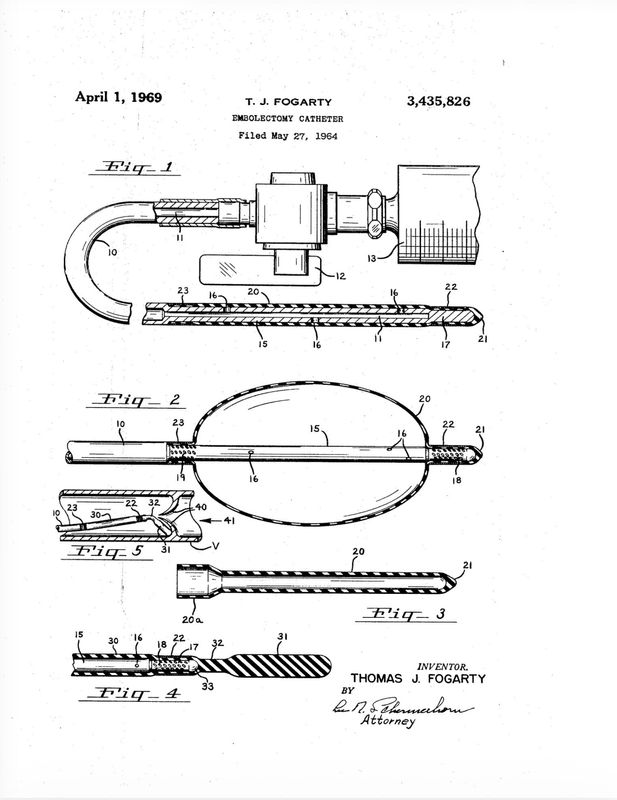
Fogarty pioneered minimally invasive surgery with his invention of the balloon catheter in the 1960s, an innovation he developed while he was a medical student at the University of Cincinnati College of Medicine.

Dr. William R. Brody, president of Johns Hopkins University, once said Fogarty “singlehandedly changed the face of cardiovascular surgery.”
A constant tinkerer, Fogarty went looking for new ways to tackle medical problems. He was granted over 160 medical patents, cofounded more than 45 medical technology companies and founded Fogarty Innovation, a nonprofit medical innovation institute in California, according to the foundation’s website.
His inventions are credited with saving the lives of millions of patients.
He was honored with numerous awards, including the Lemelson-MIT Prize and the Presidential National Medal of Technology and Innovation, and he was inducted into the National Inventors Hall of Fame.
He also ventured into winemaking with his own Thomas Fogarty Winery in California.
Growing up in Cincinnati, Fogarty tinkered with ways to ‘fix things’
His medical achievements were the result of his great curiosity and the desire to fix things, qualities evident while growing up in Cincinnati.
Fogarty often spoke of his Cincinnati childhood in interviews. Born Feb. 25, 1934, he was the youngest of three in an Irish Catholic family. His father, trained in railroad engineering, died when Fogarty was about 8. Anything he or his mother needed, he had to figure out how to make it work.
He admitted to being bored in school but had an early aptitude for “fixing things.” He made his own model airplanes (including a design for a flying wing) and built a soapbox racer called the Flying Irishman that won the Cincinnati derby.
When he was 15, he and a friend nicknamed Pinhead invented a centrifugal clutch for a Cushman motor scooter. Tired of falling off the back of his friend’s scooter when they shifted to low gear up a hill, they came up with a clutch mechanism and built one in a motor scooter repair shop. They didn’t realize that gave the shop ownership rights to the invention.
“If you’re going to do something, don’t do it in somebody else’s shop,” Fogarty told Irish America magazine in a 2001 article.
At age 13, he got a job cleaning surgical instruments at Good Samaritan Hospital in University Heights and was promoted to scrub technician, the one who hands the instruments to the surgeon.
There, Fogarty caught the attention of Dr. John J. Cranley, a vascular surgeon (and grandfather of former Mayor John Cranley), who became an important mentor.
Fogarty graduated from Roger Bacon High School in 1952 (his alma mater named the school athletic center for him in 1988), then earned a Bachelor of Science in biology from Xavier University in 1956. To pay for college, he worked three jobs: X-ray technician, night shift orderly and operating room tech – while somehow having the time for classes and studying.
He also fought as a semi-pro lightweight boxer and considered a pugilist career, but under Cranley’s influence, he chose medicine instead. Fogarty earned a medical degree from UC College of Medicine in 1960.
Invented the balloon catheter while a medical student at UC
While working with Cranley as a medical student, Fogarty observed the horrible casualty rates of surgeries to remove blood clots. At the time, the operation required incisions in both legs and the abdomen to open up the whole artery, and 50% of cases resulted in amputation or death.
Cranley challenged him to find a way to fix that. Fogarty said he had a light bulb moment and came up with the idea for a balloon catheter.
Fogarty explained his idea to Irish America: “I just said, ‘Christ Almighty, they’re making these incisions all over the place. If they had a pathway, they could put something up there. Once you get into that pathway, all you’ve got to do is have a way to pull it out.’ Almost intuitively I said, ‘Well, it’s a balloon on a stick.’ It actually pulls out the clot by mechanical traction.”
For a prototype, he attached the cut-off fingertip of a latex glove to a urethral catheter. Glue wouldn’t work to affix latex to a vinyl catheter, so he tied the balloon on like he did his fly-fishing lures.
Fogarty developed the balloon embolectomy catheter, the first minimally-invasive surgical device, before he even received his medical degree.
He moved to California in the 1970s where he taught cardiovascular surgery at Stanford University Medical Center and was part of medical teams for many groundbreaking procedures.
Sources: www.fogartyinnovation.org; “Dr. Fogarty’s Fantastic Voyage Through the Human Heart” by Joseph McBride, Irish America magazine; Society for Vascular Surgery interview (2012); “Inventing Modern America” by David E. Brown.
This article originally appeared on Cincinnati Enquirer: The Cincinnati-born surgeon who revolutionized cardiovascular surgery
Reporting by Jeff Suess, Cincinnati Enquirer / Cincinnati Enquirer
USA TODAY Network via Reuters Connect