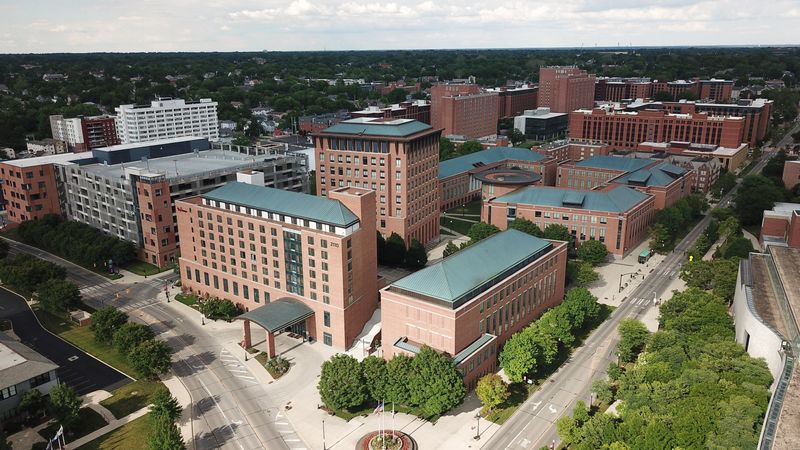
When Yondris Ferguson was a member of Ohio State University’s Undergraduate Student Government, he twice introduced resolutions calling for the university to remove Les Wexner’s name from campus buildings.
Wexner, the New Albany billionaire retail mogul and former university trustee, has given millions to Ohio State since he graduated in 1959, including the university’s largest single donation of $100 million. That donation in 2011 supported a major expansion of Ohio State’s health care infrastructure, including the university’s Medical Center that now bears Wexner’s name.

He is also the namesake of the Wexner Center for the Arts, a campus museum which opened in 1989 and was founded with $25 million from Wexner.
But that philanthropic reputation was put under a microscope after more details emerged of Wexner’s deep ties with disgraced financier and convicted sex offender Jeffrey Epstein, who died in 2019.
“Wexner has contributed greatly to the university and that’s wonderful, but you should really look at his associations,” said Ferguson, who graduated from Ohio State in 2023 and now works at the Ohio House of Representatives. “Do you really want to be associated with Epstein’s best friend?”
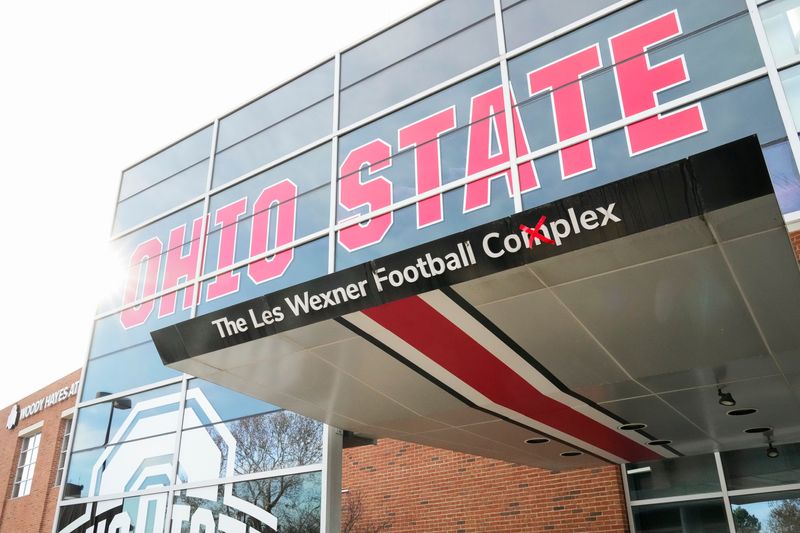
In late January, Ohio State officials rejected a new request by an alumnus to consider removing Wexner’s name from the football facility at the Woody Hayes Athletic Center. Survivors of sexual assault perpetrated by former university doctor Richard Strauss say Wexner’s association with Epstein is contrary to Ohio State’s values. Wexner has for years accused Epstein of stealing tens of millions of dollars from him and denied knowledge of Epstein’s abuse and trafficking of girls, an assertion that an attorney for Epstein’s victims has said was “very highly likely to be true.”
Wexner was not the only individual named in Ferguson’s resolutions. He took aim at nine different Ohio State buildings and scholarship programs “that pay ode to racists and other lascivious characters,” according to the resolution.
For three years, members of OSU’s Undergraduate Student Government introduced resolutions to rename several campus spaces that they said did not align with the university’s mission. Though none of the resolutions were ultimately approved by the board of trustees, Ohio State did create a naming review procedure out of the process.
“The naming review procedure was introduced in 2022 and allows current Ohio State students, faculty and staff, as well as alumni, to submit requests for the review of university space and entity names,” Ohio State spokesperson Ben Johnson said in a statement. “Each request receives full consideration in accordance with the overview spelled out online.”
What other named buildings at Ohio State have students, employees and alumni previously taken issue with?
Thompson Library
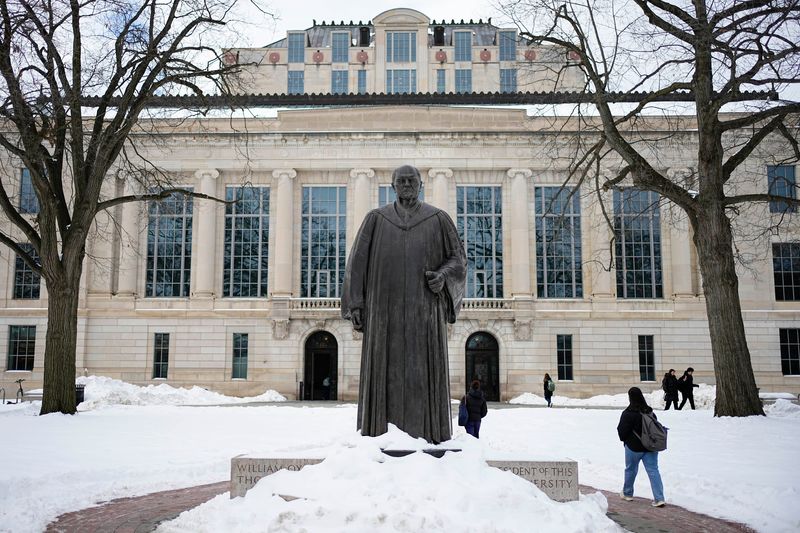
There are only two pending requests sitting in Ohio State’s naming review portal: a recently resubmitted request regarding the Les Wexner Football Complex and a four-year-old request to rename William Oxley Thompson Memorial Library.
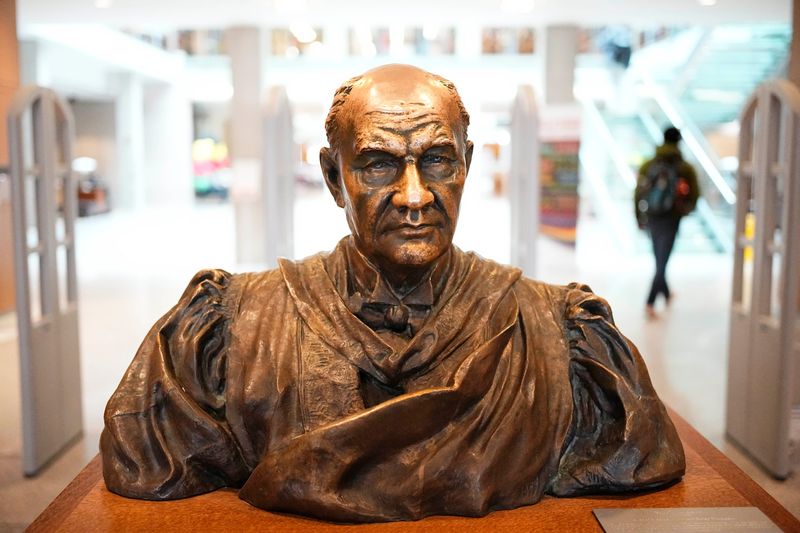
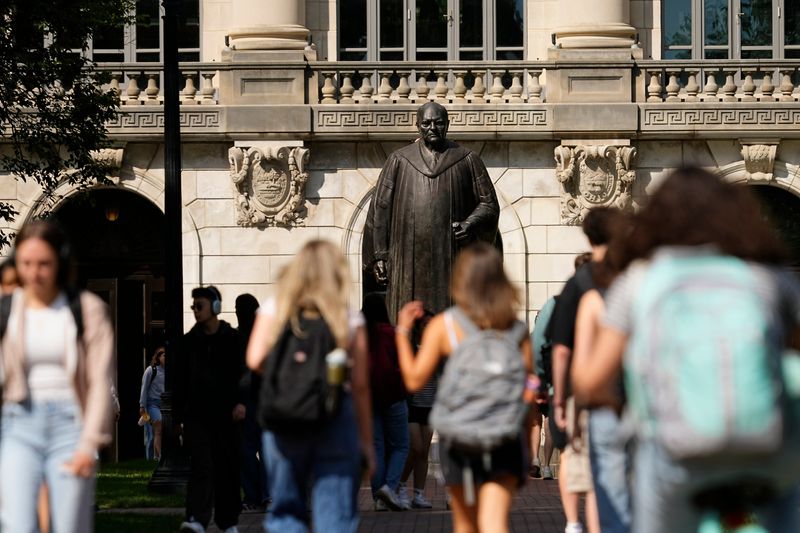
Thompson Library, located on the west side of the Oval, is Ohio State’s largest library with more than 1.25 million volumes inside. A 10-foot-tall bronze statue of its namesake sits outside the library’s entrance.
In 1951, the library was named for William Oxley Thompson, the university’s fifth president. He held that position from 1899 to 1925. For nine of those years, Thompson also concurrently served as president of the Columbus City Schools Board of Education.
Citizen Advocates for Public Education – a local advocacy organization that supports public education policies – submitted a request to remove Thompson’s name from the library.
The group’s rationale for the request lies in Thompson’s history as a supporter of racial segregation.
“William Oxley Thompson was an avowed segregationist. Unlike many people who shared this view at the time in our history, he was in a position to help develop and implement policies and practices that were discriminatory and harmed generations of students,” according to the request, as reported by The Lantern.
Under Thompson’s leadership, the Columbus City school board approved the opening of racially segregated Champion Avenue School. That decision established de facto racial segregation and gerrymandering of the districts’ schools from 1909 until 1977.
Thompson and his colleagues “feared miscegenation, and the long-term effects of children of different races in the same classroom,” according to a historical analysis of the school by Ohio University professor Adah Wolfe Randolph. They believed that it was in the best interests of both Black and White students that they be educated in separate schools.
Thompson also maintained racially segregated student housing during his tenure as Ohio State’s president.
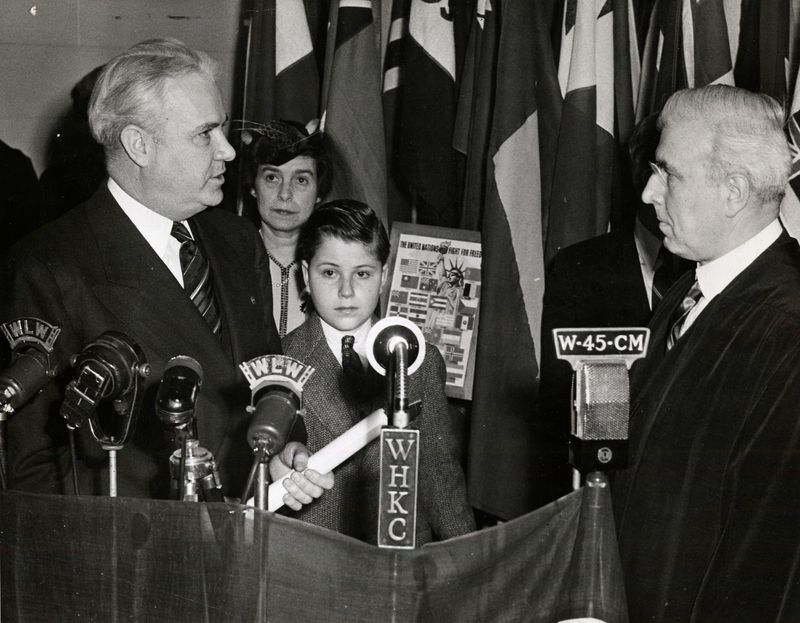
Citizen Advocates for Public Education suggested Thompson Library be renamed after Robert M. Duncan, a federal district judge appointed by Richard Nixon and an Ohio State College of Law graduate.
Duncan was the first Black man to serve on the Ohio Supreme Court and is credited for deciding the Columbus schools’ historic desegregation cases, according to the court.
James J. Bishop, a retired educational administrator and CAPE member, told The Lantern that the advocacy group “thought it much better” to replace Thompson’s name with that of Duncan, “who worked on the segregated Columbus schools and brought some sort of remedy that would address the longstanding problems of a segregated school district.”
Bricker Hall
Located on the Oval, Bricker Hall was named in honor of John W. Bricker in 1983. The building formerly housed the university president’s office and space for other senior administrators.
Though there has never been a formal name change request regarding Bricker Hall, the building has been included in all three Undergraduate Student Government resolutions calling for name changes.
Bricker served as Ohio attorney general from 1933 to 1937, served three consecutive terms as Ohio’s governor from 1939 to 1945, and was twice elected to the U.S. Senate in 1946 and 1952.
Bricker served a long tenure on Ohio State’s Board of Trustees from 1948 to 1969.
It was as attorney general that Bricker was responsible for successfully defending the university’s position before the Supreme Court of Ohio to keep Ohio State residence halls racially segregated.
In 1933, Bricker argued on behalf of Ohio State to keep separate but equal facilities for minority students in a case against Doris Weaver, a Black home economics student who sued the university after she was denied campus housing.
During his time in Congress, Bricker also proposed an amendment to the U.S. Housing Act of 1949 alongside U.S. Sen. Harry P. Cain that aimed to prevent agencies from prohibiting segregation.
Ferguson included Bricker Hall on his list of buildings to consider renaming on both of his resolutions.
“Bricker was a profound segregationist,” he said.
Ferguson proposed instead that Bricker Hall be renamed for Weaver, the woman who sued Ohio State for equal housing.
The first resolution to rename Bricker Hall was introduced in 2021. It passed the Undergraduate Student Government unanimously and went on to pass in OSU’s University Senate, a body comprised of faculty, students, staff and administrator senators.
“Through his role as attorney general of Ohio, [Bricker] actually defended Ohio State’s tradition of separate but equal, which ended up in resulting that Black students were barred from continuing with their education,” then-Undergraduate Student Government President Roaya Higazi told WOSU at the time.
There has never been a formal request made through Ohio State’s naming review procedure to remove Bricker’s name, Johnson said.
Blackwell Inn
Another building that has never seen a formal naming review request but was once consider for renaming was the Blackwell Inn.
In 2001, then-Ohio State marketing professor Roger Blackwell announced he would donate $7 million to the university for the naming rights to the executive residence at the Fisher College of Business.
The 151-bed, eight-story building across the street from Ohio Stadium was named the Roger D. Blackwell Inn at Fisher College thanks to the gift from Blackwell and his then-wife, Tina.
Blackwell was a well-known business expert and Ohio State professor for more than 40 years. His class had a reputation for being tough but worthwhile, according to a 2005 Dispatch article, and many of his lessons could be applied to any discipline. He was also a renowned author and frequent speaker on the conference circuit with a hefty fee.
In 2005, Blackwell was convicted on multiple counts of insider trading. “Though Blackwell doggedly maintained his innocence, the evidence was overwhelming,” The Dispatch wrote at the time. “The verdict, guilty on 19 of 27 counts, was not a surprise.”
Blackwell retired immediately upon the jury’s verdict, which determined he informed his office manager and her husband about the impending purchase of Worthington Foods by Kellogg’s in 1999. Blackwell, who did not personally profit from any sale of stock, sat on the board of Worthington Foods at the time.
He served nearly six years in federal prison and several months in home detention. He also paid a $1-million fine.
In a 2012 interview with The Dispatch, Blackwell said he still planned to fulfill his multi-million-dollar pledge to keep his name on the Blackwell Inn on the Ohio State campus. Blackwell said he will not ask to have his name removed, even though contractually OSU would allow him to take back the money.
“I don’t want it. I’m glad they honored me,” he told The Dispatch.
The Lantern reported just after Blackwell’s sentencing that the university was possibly considering removing his name from the hotel. An OSU spokesman at the time repeated for months that a name change was still an option. But the student newspaper heard from university officials in January 2006 that the Blackwell Inn would keep its name for the immediate future.
Higher education reporter Sheridan Hendrix can be reached at shendrix@dispatch.com and on Signal at @sheridan.120. You can follow her on Instagram at @sheridanwrites.
This article originally appeared on The Columbus Dispatch: Ohio State keeping Wexner’s name, but what about other buildings?
Reporting by Sheridan Hendrix, Columbus Dispatch / The Columbus Dispatch
USA TODAY Network via Reuters Connect