Kristina Woods went through hell the week after she bought a puppy.
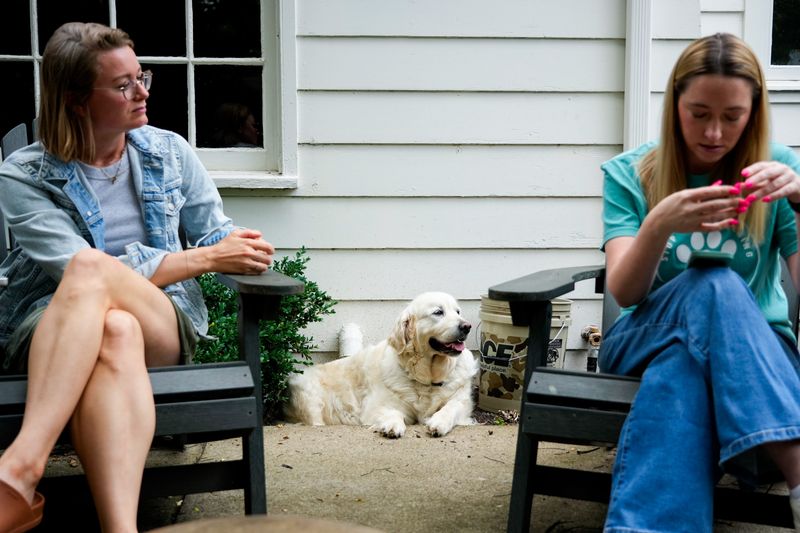
Woods, a social worker who lives with her wife Stephanie in Vermillion along Lake Erie, wanted a new dog after losing her old companion, a dog that belonged to her mother, who died in 2025. The couple wanted a fresh start. They were excited to have a new puppy.

They didn’t know they were buying a puppy from a high-volume dog breeder, referred to by animal welfare groups as a puppy mill, who can make thousands of dollars on just one dog.
A Dispatch investigation found Ohio’s high-volume dog breeders are often cited by state regulators for neglecting the health and well-being of the dogs they sell. Sick or old dogs that breeders don’t want end up with animal rescue groups across the state.
The Woodses knew immediately that something was off with their new puppy, Otie. His heart rate and respiration rate were extremely high. He was so filthy that they were afraid to bring him inside out of concern that he would spread fleas to their cats. Otie was also afraid of the Woodses, and any male voice that came on their TV would send him fleeing to his crate.
Kristina stayed up all night to track Otie’s heart rate. Two days after getting Otie, an X-ray showed he had an enlarged or malformed heart. Their veterinarian told the Woodses that Otie didn’t have long to live.
“That’s not what we were anticipating at all. My wife has been at the vet, just destroyed, hearing that they thought it was something very serious,” Kristina Woods said.
Ohio Department of Agriculture [ODA] inspection reports from 2024 and 2025 show almost 350 of Ohio’s registered breeders violated the state’s dog breeding rules over the course of two years. In 2024, 248 breeders had violations, or around 44% of the state’s 553 licensed breeders that year. In 2025, 88 breeders had violations, or around 18% of the state’s 468 licensed breeders as of June 2025. Thirty-nine breeders had violations in both 2024 and 2025.
Only 35 of these breeders had their violations referred to ODA’s legal counsel for an enforcement action, most commonly a fine, according to the inspection reports. Just one of those 35 had their license suspended by the state.
After Otie’s diagnosis, the Woodses said they struggled to get a refund from the breeder who sold them the dog, Allen Miller. And when their vet called Miller, they learned that his name was really James A. Miller, who is registered as a high-volume dog breeder in Millersburg.
Miller has violated Ohio’s dog breeding laws at least 10 times over the past five years, The Dispatch’s investigation found. He’s also appeared four times in the Humane World for Animals’ annual Horrible Hundred Report, which documents 100 “problem puppy mills and puppy sellers” across the country.
An ODA inspector found in June 2022 that eight of Miller’s dog enclosures did not meet the state’s minimum square footage requirements. One of Miller’s pens that held three dogs was only 8 square feet, half the 16 feet the law requires. He was fined $1,500 for these violations.
Two years later, an inspector found one of Miller’s dogs, a King Cavalier puppy, had eye discharge. Miller started treatment only after the inspector visited.
Miller declined to comment to The Dispatch for this story.
The Woodses would eventually discover that Otie did not have a fatal heart condition. Instead, he had an upper respiratory infection, Giardia, a common and highly contagious intestinal parasite that causes diarrhea and is transmitted by contaminated water, soil, or feces, and another parasite. Around 10 days of medications cleared up those issues.
In just the first week of having Otie, the Woodses spent around $900 on medical care for him − more than the $850 they paid to buy the pup. The emotional toll of thinking her new puppy was going to die, right after her deceased mother’s dog died, was steep, Kristina Woods said.
“I told my wife this is probably one of the worst things that ever happened to me,” Woods said.
Who enforces Ohio’s dog breeding laws?
The Dispatch, with the assistance of an AI text-extracting tool, reviewed thousands of pages of ODA’s high-volume dog breeder inspections from 2024 and 2025 and created a database of breeder violations. Counts from this database include violations that were corrected the same day of an inspection, violations that were corrected upon a re-inspection but were still listed as noncompliant, and violations from when inspectors wrote multiple inspection reports for one visit to a breeder.
ODA is required to inspect each high-volume dog breeder once a year. High-volume breeders have at least six breeding dogs, sell five or more dogs to dog brokers or pet stores, or sell 40 or more puppies to the public in a year. Any breeder that has more than 40 puppies less than four months old that were bred on their property is also considered high volume.
Melissa Simmerman, the veterinarian administrator of ODA’s commercial dog breeding program, said the state has a very strong and robust inspection program.
“Again, we operate within the authority that the Ohio Revised Code gives us. We have, in my opinion, we have very few folks that are repeat offenders,” Simmerman said.
The majority of the department’s inspections are announced to breeders beforehand, but some are unannounced, Simmerman said. They often announce the inspections beforehand so that the breeder will know to be home when an inspector comes, she said.
ODA only retains inspection reports for two years and does not have a violation database or spreadsheet of its own, Simmerman said. Jennifer Jarrell, ODA’s Chief Communications Officer, said inspectors have access to all past inspections and adding every breeder violation to a spreadsheet “would not add value to the inspection process or improve decision‑making.”
ODA does track which violations are most common. In 2025, it was a line of the Ohio Administrative Code that requires breeders to document medical treatments that breeders violated most often, according to Simmerman.
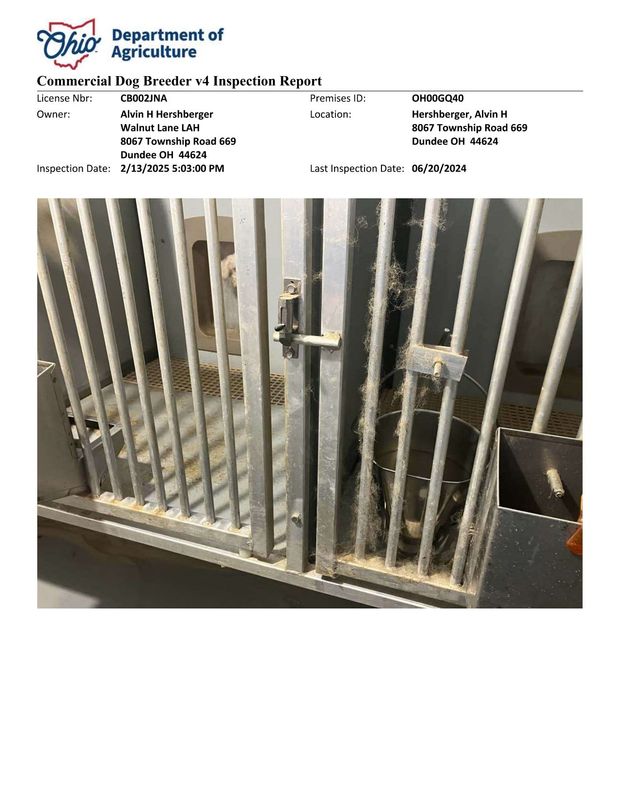
Alvin Hershberger, a breeder from Tuscarawas County, had his license suspended for six months after an inspector found an accumulation of excrement in and on his dog enclosures, a repeat violation, according to the inspection report.
ODA suspended Hershberger’s license for six months, but the entire length of his suspension was placed in abeyance as long as he had no further violations during that time. That meant he could keep operating.
Hershberger did not respond to requests from The Dispatch for comment.
Another breeder, Leroy E. Yoder, of Coschocton County, held one of his dogs in the air and threatened to kill it if an ODA inspector didn’t leave his facility in July 2022, according to an inspection report. Before the threat, he spent the inspection yelling at the inspector after she told him the flooring in his enclosure was not correct. He ended up with a $1,000 fine from that inspection, not for threatening to harm the dog but for violating the state’s flooring rules.
Yoder remained a licensed high-volume dog breeder through at least September 2024, according to ODA inspection reports.
Yoder did not respond to several phone calls from The Dispatch seeking comment.
It has been around 10 years since ODA fully revoked a high-volume dog breeder’s license, Simmerman said.
Mark Finneran, Ohio state director for Humane World for Animals, said ODA’s five inspectors for hundreds of breeders do the best job they can and are pretty good at what they do. What his organization takes issue with is how difficult it is for a breeder to have their license revoked, and how low Ohio’s fines are.
“(Breeders) have no incentive to really improve the conditions for their animals or change the way that their business is operating. Because they know they’re never going to get kicked out of the program. They’re never going to face real repercussions beyond just that monetary slap on the wrist,” Finneran said.
The three most common violations that ODA inspectors cited in 2024 and 2025 were all about dogs’ health, The Dispatch found. Breeders most commonly violated a state law requiring dogs “to be monitored by the high-volume breeder regularly for evidence of disease, injury or improper or inadequate care” and correct these issues with veterinary guidance. Breeders were cited for violating that statute 135 times in 2024 and 2025.
Raymond Yoder, of Coschocton County, had 57 violations in 2024 and 2025, the most of any breeder. Most of his violations were for not keeping adequate records of his dogs, but he also had violations for improper enclosure flooring, using unapproved instruments to dock dogs’ tails, breeding dogs before they were examined by a vet, and expired medication.
He was fined $2,500 in 2024 after an ODA inspector found several of his male dogs had not received a physical exam in 2023, and he did not test his dogs that year for Brucella canis, a harmful bacterium with no definitive cure.
In December 2025, Yoder was fined another $2,000 after an ODA inspector found three of his female dogs were bred without a physical examination just months after they last whelped a litter of puppies.
Yoder told The Dispatch he should have made sure he had the dogs examined before he bred them.
“I felt kind of bad about it. Why did I do that? So, I just tried to write things down a little better and try to make sure I get them all done,” he said.
The inspector also found that Yoder was using an unacceptable instrument to dock the tails of a litter of puppies. Yoder said that violation resulted after his son used an old pair of pliers to dock the dogs’ tails. They have all the correct docking instruments now, he said.
High-volume dog breeders are currently permitted by state law to dock the tails or remove the dew claws of puppies between two and five days old if they use proper instruments, sterilization and care techniques.
Veterinarian Michelle Gonzalez of the Rascal Unit, a group of mobile animal hospitals in Ohio that frequently treats dogs from breeders, said breeders use whatever they have on hand to perform these procedures. Ohio’s dog breeders violated the state’s rules for using proper tail docking and dew claw removal instruments 29 times in 2024 and 2025.
“I’m talking about like dirty knives, just instruments for like cutting wire, just things that are not surgical instruments. They’re not clean, they’re not sterile,” Gonzalez said.
Scared, sick dogs
Jody Butz’s home fills with barks as several dogs bound up to greet you, tails wagging, as soon as you step inside. But there’s one dog that cowers in a nearby room. Tina, a young mini Goldendoodle, shies away from people, even Butz herself.
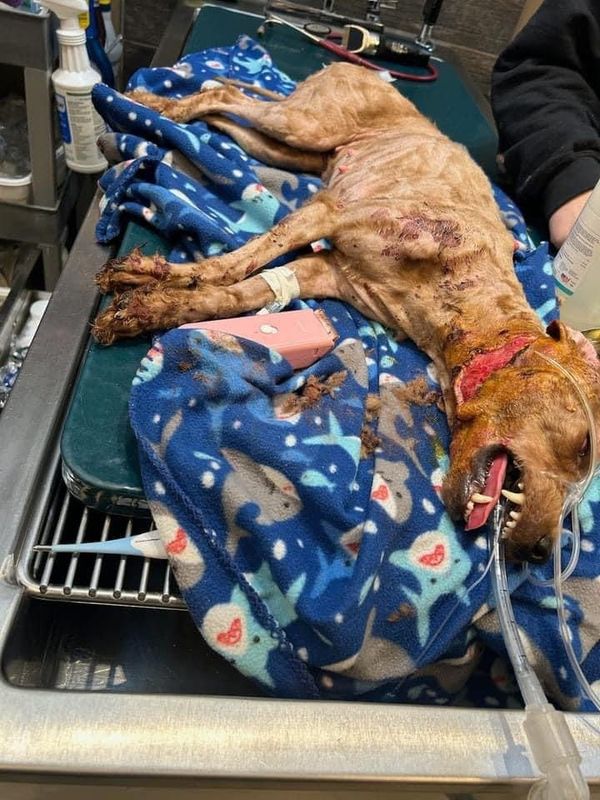
Tina is a former breeding mother from a high-volume breeder. She was surrendered to a vet to be euthanized after her neck was cut. The breeder offered multiple stories of how her neck was cut, saying it was the result of a botched haircut or a dog fight, said Elle Miller, Butz’s daughter and a volunteer with Stop the Suffering, a Columbus animal rescue.
Butz got Tina through Stop the Suffering, which collects unwanted dogs from high-volume dog breeders across the state.
Every week, a Stop the Suffering volunteer travels across Ohio to pick up dogs that high-volume breeders gave up to veterinarians. They bring them back to Columbus, where Stop the Suffering and other rescues take them into their care.
Sometimes, breeders offload dogs when they know an ODA inspection is imminent, Miller said.
“We’ve gotten calls before where the breeders are like, ‘I’m going to kill these dogs unless you guys take them ’cause I have an inspector coming,’” she said.
A recent trip brought back nine dogs, including a Golden Retriever puppy that had its ear bitten off by its mother, a Bulldog puppy with bowed legs, and a Cavalier puppy with a grade 4 or loud heart murmur that can indicate significant structural heart disease. Most of the sick or injured dogs that Stop the Suffering receives are brought to vets by breeders to be euthanized, said Lynne Aronson, executive director of Stop the Suffering.
Taylor Hollowell, of Columbus, decided to foster an 8-year-old cream Golden Retriever, formerly used for breeding, that Stop the Suffering posted on Facebook. The dog, named Poppy, was covered in mud and excrement when they got her.
Hollowell also noticed Poppy was panting heavily, but figured it was just because she was nervous. But a vet found that Poppy had something seriously wrong with her heart, and likely only had weeks to live, maybe a year. Now, Poppy was a hospice foster dog.
“It was not exactly what we had signed up for. We thought we were just like taking in this Golden for, you know, a couple weeks and then getting her adopted out,” Hollowell said.
A cardiologist whom Hollowell followed up with was shocked that Poppy had lived past age 2 given her condition. She had likely passed on the inherited heart defect to the puppies she littered during her eight years as a breeding dog, the cardiologist told Hollowell.
Another Stop the Suffering dog, a Bernese Mountain dog named Harper June, was used for breeding at 8 months old. As a result of her pregnancy, her uterus twisted and ruptured. It took a week for the breeder who owned Harper June to take her to the vet, said Keri Collins, an adoption coordinator with Stop the Suffering.
The puppies inside Rita were delivered dead, Collins said.
Harper was later fostered by Columbus resident Cynthia Martin and her family. While Martin was interviewed by The Dispatch, Harper June hid behind her, visibly shaking and loudly panting.
“(Breeders) don’t care for their (dogs’) teeth, they don’t care for their bodies. It makes me upset,” Martin said.
Transportation and neighborhoods reporter Nathan Hart can be reached at NHart@dispatch.com, @NathanRHart on X and nathanhart.dispatch.com on Bluesky.
This article originally appeared on The Columbus Dispatch: Ohio puppy mill violations stack up as dog owners face soaring medical bills
Reporting by Nathan Hart, Columbus Dispatch / The Columbus Dispatch
USA TODAY Network via Reuters Connect