Editor’s note: Each month, Dispatch reporters will profile astronauts from Ohio, culminating in a larger story toward the end of the year about all Ohioans who became astronauts.
You know his name. You know what he did, what he said on July 20, 1969.

If you were old enough to form memories, you probably still remember huddling around a vacuum-tube television or a radio that summer evening to watch or listen to one of the United States’ sons, and one of Ohio’s sons, go where no man had gone before.
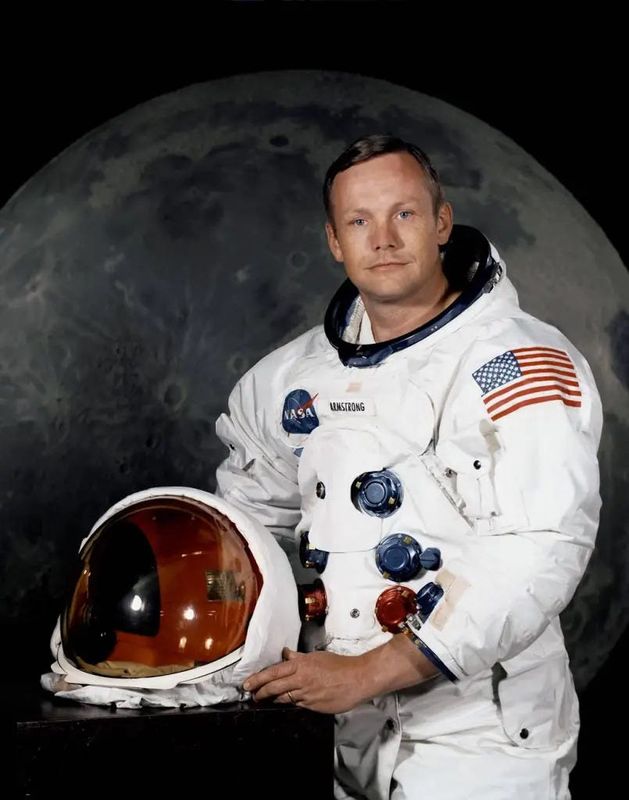
Neil Armstrong, born Aug. 5, 1930, in Wapakoneta, Ohio, was the first human being to set foot on our cosmic companion, the moon. But you already knew that.
Armstrong was born to parents Stephen and Viola Armstrong. Stephen Armstrong was an Ohio auditor, and the family moved around the state 13 times during Neil’s childhood, Logan Rex, museum curator and communications director at the Armstrong Air & Space Museum in Wapakoneta, told The Dispatch.
The family eventually settled back in Wapakoneta, where Armstrong first learned to fly, Rex said. Armstrong’s college years were split between earning his aeronautical engineering degree at Purdue University and serving in the U.S. Navy as an aviator.
Armstrong flew 78 combat missions during the Korean War, including a mission where his jet became disabled and he had to parachute out, according to the U.S. Department of War, formerly the U.S. Department of Defense.
Armstrong earned a bachelor’s degree in aeronautical engineering from Purdue in 1955. He began working for the National Advisory Committee for Aeronautics – the predecessor to NASA – in Cleveland before transferring to NACA’s High-Speed Flight Station in Edwards, California, later in 1955, to work as an aeronautical engineer and a test pilot, according to NASA.
Aeronautics and airplane design were Armstrong’s true passions, Rex said. He enjoyed being an astronaut, and he wanted to emulate famous aviators like the Wright Brothers and Charles Lindbergh, but his heart belonged to aeronautics.
“People would talk to him about walking on the moon, but if you start talking to him about aircraft, that’s where he would start having a conversation with you. That’s where that twinkle in his eyes was,” Rex said.
In one of his final interviews, Armstrong said he was just a regular guy, and being an astronaut was just another step in his career, according to Rex.
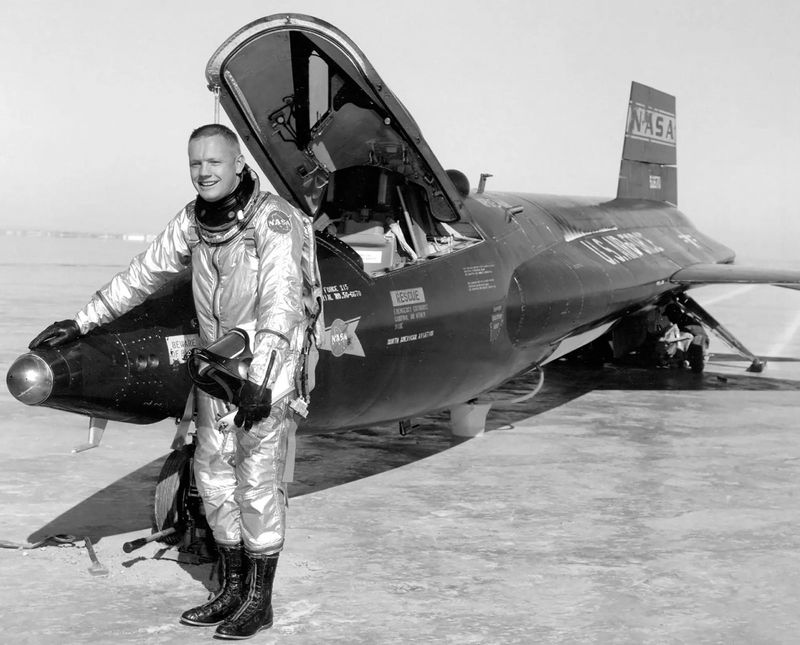
Armstrong racked up more than 2,450 flying hours piloting hypersonic rocket planes, fighter jets and more during his time with NACA. His test pilot duties ended in 1962, when he was selected for the second group of the NASA Astronaut Corps.
His first space mission was commanding Gemini 8 in 1966, which made Armstrong the United States’ first civilian in space.
The Apollo 11 mission
Armstrong was a great fit to command the Apollo 11 mission, according to Rex. He was humble, calm and able to perform extremely well under extraordinary pressure, Rex said.
As Apollo 11’s commander, Armstrong guided the lunar module down to the moon’s surface with the help of the module’s pilot, Edwin “Buzz” Aldrin, who read out telemetry and terrain reports while Armstrong controlled the landing. Being commander also meant Armstrong was the first person to step on the moon, a responsibility that he took very seriously, Rex said.
Armstrong brushed off suggestions from NASA employees for what his first words on the moon should be, choosing instead to say something more personal to him. He had a kernel of an idea of what he would say when Apollo 11 took off, but it wasn’t until they were on the lunar surface that Armstrong decided what his first words would be, according to Rex.
“That’s one small step for [a] man, one giant leap for mankind,” Armstrong said at around 10:56 p.m. on July 20, 1969, after his left foot touched the moon’s surface.
While you can’t hear Armstrong say “a” before “man” in NASA’s recording, the Armstrong Museum includes the “a” article because it was Armstrong’s intention to say it, and the recording has static right when he would’ve said it, Rex said.
Back on Earth, Armstrong’s parents watched their son from their home in Wapakoneta. Viola was relieved to see him step safely on the moon; she was worried he would sink into the moon’s surface, according to a July 21, 1969, story in The Dispatch.
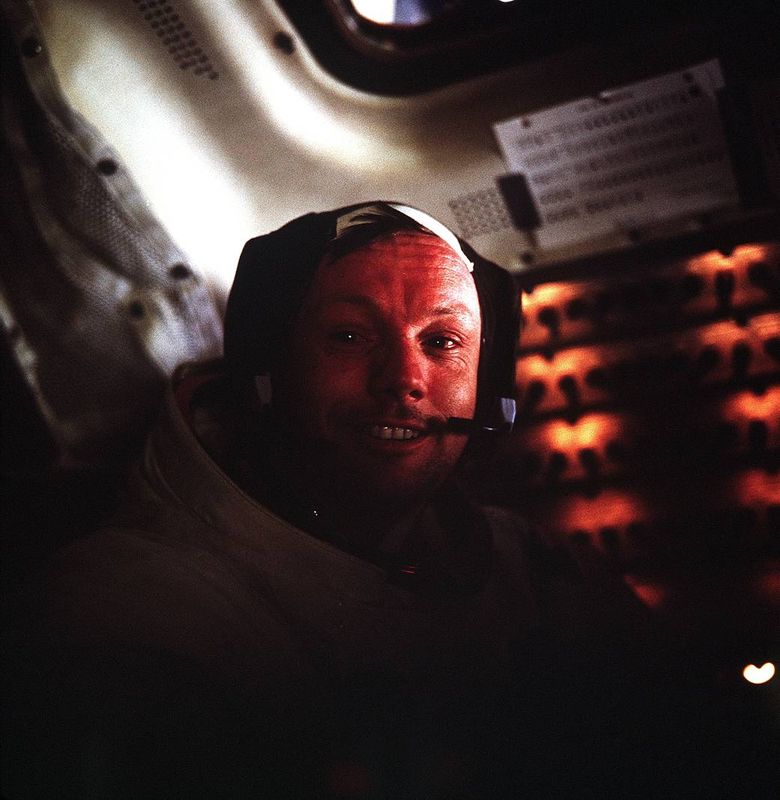
Aldrin then joined Armstrong on the moon, and the astronauts spent around two and a half hours exploring, collecting samples and taking photos. They left behind an American flag, a plaque from one of the lunar module’s legs and a patch honoring the Apollo 1 crew members, according to NASA.
Armstrong, Aldrin and command module pilot Michael Collins splashed down back on Earth on July 24, 1969, fulfilling President John F. Kennedy’s pledge to put a man on the moon and return him safely to Earth by the end of the decade.
Armstrong’s legacy
Armstrong was never the type of person to glorify himself or his accomplishments. He emphasized that the world didn’t come together to put Neil Armstrong on the moon; it came together to put a man on the moon and Armstrong just happened to be that man, according to Rex.
“I think that also anytime that people were giving him too much credit, he would redirect some of that attention to the other crew, the people who worked on the mission and the American people because it was their tax dollars that were being used to fund that mission, and he wouldn’t have been able to do that without the approval of the American people,” Rex said.
Armstrong left NASA’s Astronaut Corps later in 1969, becoming the deputy associate administrator for aeronautics at NASA headquarters. He held that job for two years before becoming a professor of engineering at the University of Cincinnati, a role he held from 1971 to 1979.
After he left UC, Armstrong spent the remaining years of his career moving between private sector jobs at aeronautic and technology companies, according to NASA.
Armstrong returned to public service in the 1980s, when he served on the National Commission on Space from 1985 to 1986 and as vice chairman of the committee investigating the Challenger disaster in 1986. He retired fully in 2002.
Throughout his life, Armstrong went to great lengths to ensure that he didn’t use his status as the first man on the moon for his own personal or financial benefit, according to Rex.
“I think a lot of people really misconstrued his reservations about personal gain from being the first person on the moon with being reclusive or being shy or anything like that,” Rex said.
Beyond all the astronomical accomplishments, Armstrong was also a husband and father. He had three children, Karen, Mark and Eric. Karen, whom Armstrong called “Muffie,” died from a brain tumor at the age of 2 in 1962. Mark and Eric, then ages 6 and 12, respectively, watched their father’s journey to the moon in July 1969.
Armstrong was married to his first wife, Janet Armstrong, from 1956 to 1994. He met Janet at Purdue University, where it was rumored she moved in the same social circles as Gene Cernan, the last man to walk on the moon in the Apollo 17 mission, according to Rex. After Janet and Neil divorced, he married his second wife, Carol Armstrong, whom he met at a golf outing.
Armstrong died in Fairfield, Ohio, on Aug. 25, 2012, at the age of 82, due to complications from a coronary bypass surgery. His family later received a $6 million settlement from Mercy Health, the health care company that performed his coronary bypass surgery, after his sons threatened the company with a wrongful-death lawsuit.
Even in death, Armstrong’s humility was on display. He opted before his death to be cremated and buried at sea to prevent his memorial or tombstone from becoming a shrine or pilgrimage site, Rex said.
Transportation and neighborhoods reporter Nathan Hart can be reached at NHart@dispatch.com, @NathanRHart on X and nathanhart.dispatch.com on Bluesky.
This article originally appeared on The Columbus Dispatch: Ohio native Neil Armstrong was an icon for humanity and a man of great humility
Reporting by Nathan Hart, Columbus Dispatch / The Columbus Dispatch
USA TODAY Network via Reuters Connect
By Nathan Hart, Columbus Dispatch | USA TODAY Network