Imagine living 250 years ago! The year is 1776. There would have been no computers, cellphones, televisions or electricity. Early Americans spent time gazing at the beautiful and dark night sky.
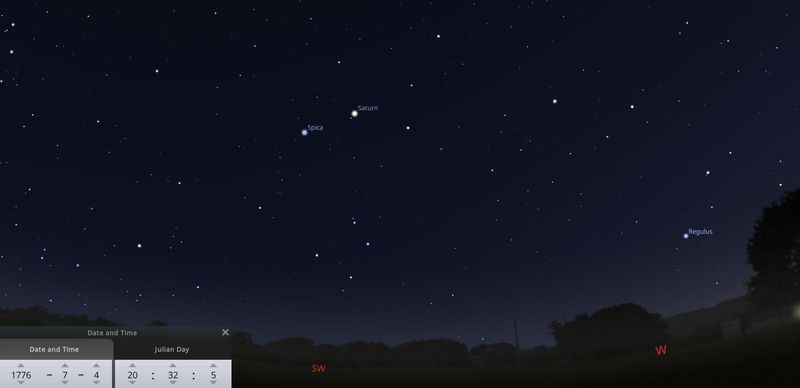
They would follow the constellations, through the seasons, to determine time. They also used stars like the North Star for navigating. At that time only five planets were known to exist; Mercury, Venus, Mars, Jupiter and Saturn. On the night of July 4, 1776, Saturn was viewable in the evening sky. The other visible planets Jupiter, Venus, Mercury and Mars were part of the daytime sky.

For celestial observations, compact spyglasses and early reflecting telescopes were used. Then scientists began to explore what was beyond our solar system. In 1776, William Herschel, astronomer and composer, constructed a powerful 12-inch Newtonian reflector telescope which led to the discovery of Uranus in 1781. By studying Uranus, astronomers determined that its orbit was affected by the pull of an unknown object. In 1846, that object was discovered to be Neptune.
The United States began to catch up with European astronomy by constructing state-of-the-art observatories. In 1843 the Cincinnati Observatory was established. It housed one of the largest telescopes in the world, at that time. The Yerkes Observatory was founded in 1897, in Wisconsin. It housed a 40-inch refracting telescope, which remains one of the largest refracting telescopes ever used.
In the 1920s, while working at California’s mount Wilson Observatory, Edwin Hubble proved the universe extends beyond the Milky Way. Pluto, which was considered the ninth planet at that time, was discovered in 1930, at the Lowell Observatory. The birth of radio astronomy came in 1932, opening new ways to see invisible light. The Cosmic Microwave Background was discovered in 1965, giving us solid proof of the Big Bang Theory. In the 1970’s NASA’s Pioneer, Mariner and Voyager provided close-up images of the planets.
The launch of NASA’s Hubble Space Telescope in 1990 deepened our understanding of stellar life, planetary formation and the universe expansion rate. NASA’s Kepler Space Telescope, launched in 2009, discovered over two thousand exoplanets. Then came the most powerful telescope, in 2021/2022, NASA’s James Webb Space Telescope (JWST). JWST looks deeper into space, further back in time, along with studying the first stars. The US holds the lead in global cosmology, not only are astronomers and scientists operating advanced observatories on the ground, but also in deep space.
More recently, the Vera Rubin Observatory opened in 2025 mapping the Milky Way and studying dark matter and dark energy. NASA’s Nancy Grace Roman Space Telescope is scheduled to launch in August and will investigate dark energy.
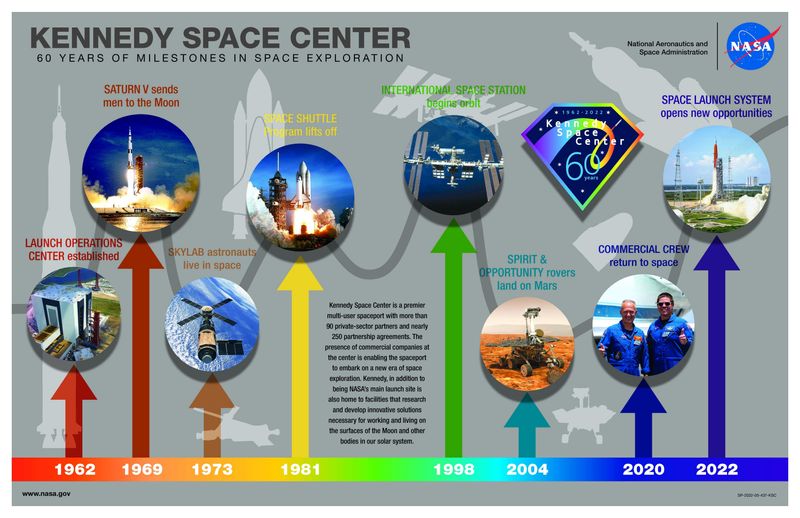
The United States is leading the world in space exploration too! We have used rovers, probes and other missions to understand more about our solar system. Finally, our extensive space programs; Mercury, Gemini, Apollo, Skylab, Space Shuttle, International Space Station, Crew Dragon and our return to the Moon mission, Artemis, keep us reaching farther and climbing higher with our advanced innovations!
Happy 250 years United States of America!
Night sky for July
Planets and the Moon:
Venus, at magnitude -4.1, continues its dazzling show in the western sky after sunset. Venus and the star Regulus, which is the brightest star in the constellation Leo, the Lion, make a close pairing one hour after sunset on July 8. They will be two degrees apart. The crescent Moon and Venus make a lovely pairing on July 17. Venus brightens to magnitude -4.3 by month’s end and will appear as a shining diamond in the western sky.
Jupiter will be very low in the west, northwestern sky after sunset, the first week in July. After that, Jupiter will be lost in the evening twilight.
Neptune, at magnitude 7.7, rises around midnight on July 1. Best time to view Neptune is around 3:00 am when it is near the Great Square of Pegasus. Neptune will be fifteen degrees south of the star Algenib in Pegasus. Neptune is also ten degrees to the upper right of Saturn. A telescope will be needed.
Saturn, at magnitude 0.7, rises at 1:00 am on July 1 and at 11:00 pm on July 31. Saturn pairs with the Moon on July 7.
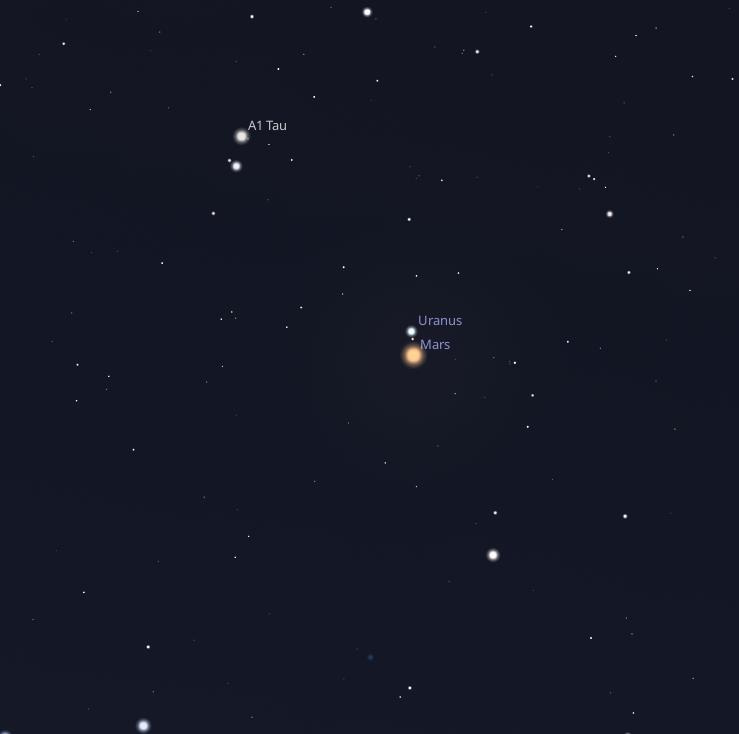
Mars and Uranus can be found in the constellation Taurus, the Bull, in the predawn sky. They make a close pairing on July 4 when the planets will be less than one degree apart. It will be best to use binoculars or a telescope. Mars will be brighter at magnitude 1.3, while Uranus is magnitude 5.8. Mars rises two and one half hours before sunrise on July 1 and three and one half hours before the Sun on July 31. Mars passes five degrees north of Aldebaran, the brightest star in Taurus, on July 12 and 13.
Mercury returns to the morning sky in late July. On July 28, Mercury, at magnitude 1.0, can be found one hour before sunrise low in the eastern sky. By July 31, it brightens to magnitude 0.5 making it slightly easier to spot. Binoculars will help.
Full Moon will be on July 29.
Night sky spotlight:
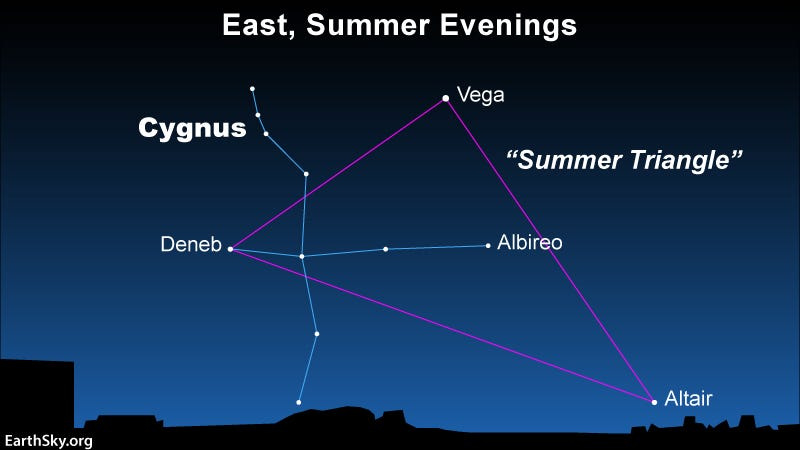
This month we spotlight a great pattern to look for on a clear summer night, the Summer Triangle, which can be found high in the eastern sky after sunset. It is made up of three bright stars that are easy to see. The three stars are Vega, Deneb and Altair. Look for a bright blue, white star which is Vega. Down and to the left is Deneb and continuing to the right is Altair. When you connect these three bright stars you have made the Summer Triangle. Now head back to Deneb, imagine this to be the tail of Cygnus, the Swan. To the right will be three stars in a line. These would be the outstretched wings. Extending from the wings would be the long neck and head of the swan. The head of Cygnus is a double star, Albireo, a great sight in a backyard telescope. Grab binoculars and scan through the Summer Triangle. You will spy a multitude of stars which are part of the summer Milky Way. Locate the star Altair. Scan about a third of the way up to Vega. You will see an upside-down star pattern that looks like a hanger. It is called the Coathanger or Brocchi’s Cluster. One of my favorites!
For further night sky details, maps and audio, visit my website www.starrytrails.com.
Visit the Hoover Price Planetarium
From Memorial Day to Labor Day, daily planetarium shows will be available Tuesdays through Sundays. Visit mckinleymuseum.org/, for show dates and times! Planetarium shows are free with Museum admission. The Planetarium is located inside the McKinley Presidential Library & Museum, 800 McKinley Monument Drive NW in Canton. For more information, please call the museum at 330-455-7043.
This article originally appeared on The Repository: How viewing the heavens has changed since 1776 | Sky Shorts
Reporting by Suzie Dills, Special to The Canton Repository / The Repository
USA TODAY Network via Reuters Connect
By Suzie Dills, Special to The Canton Repository | USA TODAY Network