When Ohio State University post-doctoral scholar Janeth Alexandra Garcia Monge suffered a stroke, she didn’t expect that an octopus would end up bringing her relief.

Monge, a physicist, was left with cognitive impairment after her stroke, which was challenging for her as someone who works with advanced math. After seeing an ad on Instagram, she sought treatment at the Columbus-based company NeuroAnimation, where she engaged in a novel form of therapy: controlling a virtual animal.
Connect with the Columbus you don’t know. Subscribe to Columbus Monthly’s weekly Top Reads newsletter.
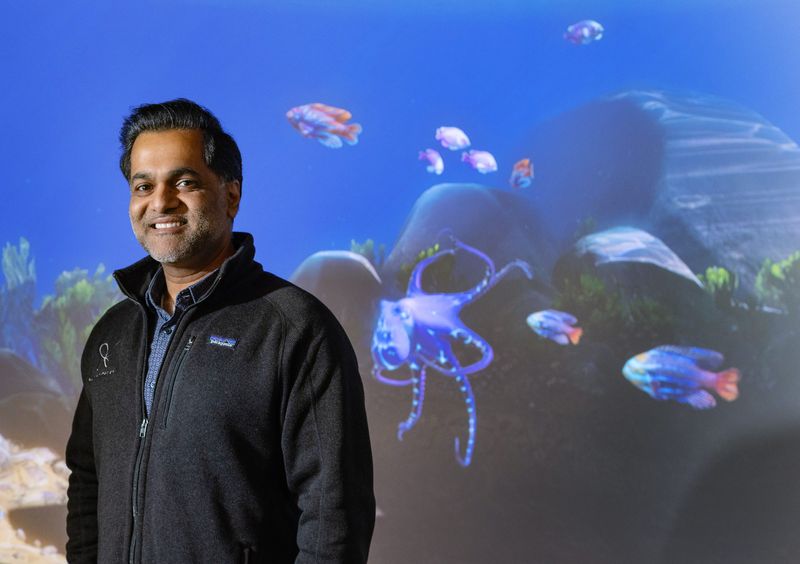
The therapy takes place in a theater at NeuroAnimation’s offices in New Albany, where clients are hooked up to a high-fidelity 12 camera system that tracks their movements. Clients undergo an hour of intensive cognitive motor movement where they control an animal, such as Kana the octopus.
“It’s not just randomly moving or playing a video game,” says Omar Ahmad, NeuroAnimation’s CEO, who holds a PhD in computer science. “It’s almost like doing surgery. It’s very conscious, complex motion planning, and it’s over an hour. It’s what we call true motor learning. After, they do an hour of consolidation, which is [where clients] try to do tasks or goals that they want to improve at.”
The therapy comes in two forms: either a three-week boot camp that is $9,000 and a total of 45 hours of therapy or a 12-week strengthening program that is $5,000 and a total of 24 hours of therapy. The program does not accept health insurance and does not require a physician’s referral.
Ahmad, who previously was director of innovative biomedical engineering at the Johns Hopkins University School of Medicine, said the seemingly simple method of activating the brain with virtual exercises has shown radical results by activating a specific part of the brain.
“It’s called the dentate gyrus of the hippocampus, and it’s also responsible for creating new neurons in the brain,” Ahmad says. “It creates new adult neuronal stem cells, and they proliferate throughout the hippocampus. And even when there’s damage in the brain, [those cells] migrate to other areas of the brain. We’ve shown brain growth in the hippocampus. What we also hypothesize is that those brain cells probably migrate to damaged areas. That’s very hard to prove, but what we do see is the effect.”
Ahmad said the technology can be used by individuals who have suffered from strokes, but it also can assist with other cognitive ailments such as dementia and Alzheimer’s. “[NeuroAnimation] clients control a dynamic animal. When you’re moving it, you’re feeling the forces of it, you’re interpreting them, you’re predicting them, you’re planning them, and that sends a cognitive load to the brain that’s super intense,” he says.
While she initially thought the process looked simple, Monge says it has been incredibly beneficial for her recovery.
“I think it was right after the second session that I started to notice differences,” Monge says. “The biggest one I noticed was driving. After the stroke, I had a lot of problems with depth perception, and when I was driving, I used to get very stressed and frustrated. I remember leaving after the second week of NeuroAnimation. I was driving and it felt so different. It was so much easier.”
Dr. David Whitt, a physician who founded Diley Medical Group, refers his patients to NeuroAnimation. He says the therapy has been instrumental in their recovery. “This therapy represents a true paradigm shift in how we may treat diseases of the brain,” Whitt says. “The therapy is noninvasive and carries essentially no risk—yet the potential benefits are extraordinary. I have seen patients with Parkinson’s disease, traumatic brain injury, autism and even major depression experience outcomes that were previously thought to be impossible.”
Monge says for her, other post-stroke therapies have been hit-or-miss, since they typically focus on physical recovery and not cognitive. “I noticed some doctors even thought, ‘You should be grateful that you are here, so you shouldn’t be complaining that you cannot do this thing,’ ” Monge says. “Of course, I’m grateful to be alive, but I wanted to keep going with my life.”
Monge says after completing the NeuroAnimation therapy, her ability to perform arithmetic has improved immensely. Her general quality of life also has improved.
“With all the frustration from my stroke, I was getting cranky, I was always mad,” she says. “With these therapies, my mood changed completely. My speech became easier, and my ideas became more fluid. It’s not like how I was before the stroke, of course, but it’s so much better, and I feel normal. Doing the therapy has been my best investment after my stroke. It was worth every penny.”
This story appears in the March 2026 issue of Columbus Monthly. Subscribe here.
This article originally appeared on Columbus Monthly: NeuroAnimation Brain Growth and Recovery Center Offers Novel Therapy
Reporting by Zach Trabitz, Columbus Monthly / Columbus Monthly
USA TODAY Network via Reuters Connect