Editor’s note: The following article was originally published by the Ohio Capital Journal and is available to us under a content-sharing agreement.
Washington County residents are raising concerns that injection wells in southeastern Ohio leaking brine waste will eventually pollute Marietta’s drinking water.

Brine waste traveled underground from the Redbird #4 injection well in Marietta to active oil and gas wells about five miles away in 2019 and pressure on those wells has increased significantly ever since.
Citizens are now concerned it’s only a matter of time until the radioactive waste infiltrates Marietta’s aquifer at the bottom of the Muskingum River Valley.
“I think eventually (brine waste) will get to the city of Marietta’s water wells,” said Bob Lane, an oil well producer in Washington County.
“I actually believe this may take a few years before you lose your water well,” he said at a recent press conference.
“I would like to see the injection company instantly put a bond, made out to the city of Marietta, for $18 million or $20 million because what are you going to do 10 years from now when you have no drinking water? You’re going to have to spend a bunch of money.”
This is a serious environmental problem, said David Jeffery, a professor at Marietta College.
“It’s clear that it’s expanding as we’re speaking,” he said.
And if nothing prevents it from happening, it will require lots of work and money to fix the city’s water.
“You’re going to have to have hundreds of geotechnical people and engineers come in and put interceptor wells in and track down every little ounce of that radioactive fluid, and it’s going to be very expensive,” Jeffery said.
“That’s going to cost tens or even hundreds of millions of dollars to try to make sure that those fluids do not reach our aquifers or the surface.”
What is an injection well?
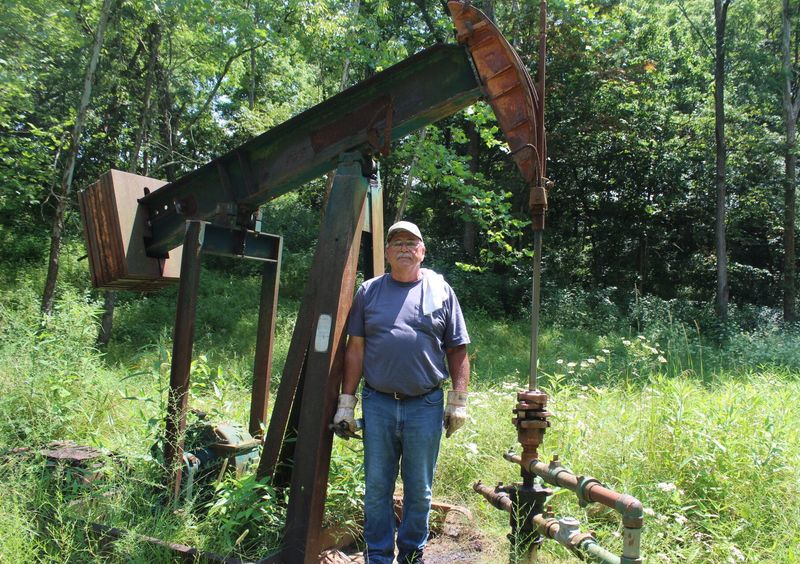
An injection well is a pipe in the ground that takes the waste left over from fracturing operations.
A conventional well is a vertical pipe in the ground and most of them were drilled anywhere from 150 years ago to a few decades ago. Most abandoned wells are conventional wells.
Ohio has more than 20,000 documented orphan wells, but there’s likely thousands more.
Horizontal wells are now being drilled, which can extract more gas.
Injection wells have been pumping more waste into the ground at higher pressure since 2010 when the U.S. shale boom started, said Buckeye Environmental Network Appalachian Organizer Bev Reed.
“The brine waste fluid is pumped into geological layers thousands of feet deep, where it’s supposed to be disposed of, never to interact with the surface in any way, ever,” Reed said.
“However, we are seeing that this has not been the case, especially in southeastern Ohio.”
Brine waste fluid is radioactive, carrying radioactive components including radon gas, radium, other isotopes of uranium and thorium.
“We do not want (brine waste) anywhere near the surface,” Jeffery said.
He said he couldn’t imagine a more clearly failed business concept.
“The intention of this business is to pump the fluids down into a formation, and they’re supposed to stay there forever,” Jeffery said.
“The problem with these formations in southern Ohio is that they have very low porosity and permeability, especially these deep formations that are down below.”
Some of the fractures are letting the toxic fluids travel upwards.
“You’re trying to push more fluids into an area that is already under high pressure and already has non-compressible fluids in it,” Jeffery said.
“The problem is that there’s no room for the fluids down in that layer. This stuff is coming up through these fractures because that’s the easiest way out.”
When an injection well floods out, the brine waste flows to the next one, Jeffery said.
“Little by little the (brine waste) is going to be coming up these fractures … as quickly as they can pump that stuff in, ruining everybody’s well,” he said.
There are 227 active Class II injection wells in Ohio, according to ODNR.
Washington County receives the most amount of brine waste into Class II injection wells in Ohio and about half of it comes from out-of-state, Reed said.
“Ohio has become the dumping ground for this toxic radioactive waste stream,” Reed said. “The Marietta and Warren Township areas are particularly vulnerable due to the close proximity from the injection wells to the drinking water aquifers for thousands of people.”
Redbird injection well
Back in 2019, Washington County oil producers noticed their wells were flooded with fluid and stopped producing gas and oil. Twenty-eight production wells that had been active for decades stopped working within weeks.
The well owners correctly suspected the excess fluid was injected brine waste that had leaked from a nearby injection well.
The Ohio Department of Natural Resources Division of Oil and Gas Resource Management did an investigation in 2020 that confirmed brine waste from the Redbird #4 well in Marietta migrated and leaked into nearby oil and gas wells.
ODNR has identified seven injection wells where fluids have migrated underground since 2019, ODNR spokesperson Andy Chow said in an email.
“Six of these wells were suspended by the division,” Chow said. “The owner of the seventh well modified the well to address the issue before the division’s investigation concluded.”
“The division relies on evidence observed at production wells near an injection well to determine when migration outside a permitted injection zone or beyond an approved area of review occurred.”
An abandoned well in Veto Lake — less than a mile from Redbird— blew out in 2021.
ODNR passed new rules overseeing Class II injection wells in 2022.
Buckeye Environmental Network filed a lawsuit against ODNR last year, claiming the state department of natural resources improperly approved two injection wells near Marietta using outdated regulations. The case is in the Tenth District Court of Appeals.
Pressure increasing
Bob Wilson of Wilson Energy LLC was one of those who initially noticed the increase in brine waste in his oil and gas wells.
“I noticed the gas falling off on all the wells,” he said. “Water just kept coming, and I was losing three or four wells a week, so I called ODNR, and I told them that I believe that injection water was infiltrating my wells.”
Three of Wilson’s oil and gas wells near the Redbird wells have continued to increase in pressure readings since 2020, especially within the past several months.
One of his wells about three mile and a half miles northeast of Redbird has increased 1,800% from September 2023 to last month, he said.
“Oil and gas wells basically lose pressure over time, so there’s something unnatural going on there,” Jeffery said.
Wilson owns about 170 oil and gas wells, but 50 of them are no longer producing — something he attributes to the brine waste migration underground.
“My wells can’t be repaired,” he said. “The damage they’ve done in Washington County can’t be repaired. … I get up and go to work every day and lose money.”
Some of Wilson’s wells are 60 years old and he said they should have been able to produce for another 40-50 years.
Of the 17 injection wells in Washington County, eight have had serious problems, according to Buckeye Environmental Network.
Washington County water concerns
The future of Marietta’s drinking water is the biggest concern for Bob Anderson, another local oil well producer who has drilled more than 75 wells.
“I’ve got two great-grandchildren now under the age of three years old, and every time I look at their faces, I think of this,” he said. “What are we leaving you?”
Ohio state Rep. Tristan Rader, D-Lakewood, said he gets more scared the more he learns about the brine waste migration.
“Clearly we are at the precipice of an emergency,” he said. “We have water aquifers that are being threatened as we speak, as we sit here.”
Buckeye Environmental Network is calling on the state department of natural resources to stop injection operations in Washington, Athens, Noble counties and monitor for changes after injection has stopped.
“At the request of the ODNR Division of Oil and Gas Resources Management, operations have stopped at four class II disposal injection wells in Washington County,” Chow said.
“On July 1 and 2, the owners of the wells agreed to voluntarily cease operations after the division notified them that their class II disposal injection wells were suspected to be causing impacts to other nearby wells that produce oil and gas. … While the class II disposal injection wells are voluntarily shut down, the well owners and the division will work towards a plan to address the issues.”
Buckeye Environmental Network is also calling on ODNR to investigate oil and gas waste brine migration across southeastern Ohio, apply consistent pressure monitoring and reporting standards to wells with a history of migration concerns, and test private water wells within at least five miles of any injection well suspected of migration.
“The division already applies consistent pressure monitoring and reporting standards to these wells,” Chow said. “The division is working on a contract to have a third-party consultant conduct a study of the private water wells near the impacted production wells in Washington County.”
This article originally appeared on The Repository: Marietta residents worry drinking water could become contaminated
Reporting by Megan Henry, Ohio Capital Journal / The Repository
USA TODAY Network via Reuters Connect
By Megan Henry, Ohio Capital Journal | USA TODAY Network