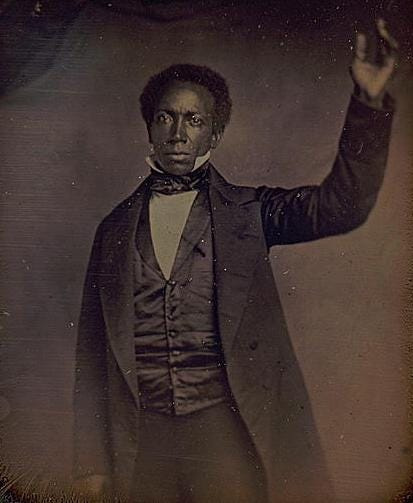
In March 1845, Newark-born Edward James Roye sold his business and property in Terre Haute, Indiana. The property he owned in Newark was sold two months later. It is believed that his wife died this year, and he set his sights on taking his children with him to begin a new life abroad.

In May 1845, he reportedly enrolled at Otterbein University, but the school has no record of his enrollment that year. However, the General Catalogue of Oberlin College, published in 1908, has a record of Edward J. Roy, without the “e” on the end of Roye, from Evansville, Iowa. He enrolled in the 1846-1847 school year. There is no Evansville, Iowa, but there is an Evansville, Indiana. The difficulty is that Roye reported himself as leaving for Liberia in May 1846. Perhaps he enrolled in the 1846-1847 school year before leaving, or maybe this isn’t the same man at all.
The question of why Roye moved to Liberia was answered in a letter he sent to the Wabash Courier newspaper in Terre Haute. It was published July 6, 1850, four years after arriving in Liberia. The letter leaves no doubt that he was a well-educated man.
“It is due to many good people of the U.S. of all parties, naturally inquiring whose many virtues are known to be real and not ostensible alone, but particularly due to those of Newark, O., my natal city, and those of this place to narrate briefly such things only as would be objects of enquiry. In the spring of 1846, I purchased a stock of goods and embarked with them bound for Liberia; in consonance with the resolve made in my early youth to seek, and to live, and to die under African government. But as I had purposed in my heart, free from restraint or influence on the part of others, to go to such a country. I had avowed the intention not to put up with any kind of African country, and to leave it and seek another if that sought measure of health, of prosperity, of happiness, and of the prospects of forming an asylum, free from tyranny of every form and wedded to religious and political independence, should not be full both equally and satisfactorily apparent as the lot of all.
“I found a fixed home in Liberia, But I did not at first like the country, because I had heard so many exaggerated reports of the malignant character of the African fever, and because I did not like the Colonization Society to have anything to do with its government, and because at the time I went it was most always raining; the better time to go there in. There are but two seasons, wet and dry, six months each. But after taking time to see all, I found that what was not as I wished could be made so. But as I had taken my goods there, it was necessary to neither sacrifice time nor goods, of course not life, to save either. I am sure if I had been empty-handed, I would have returned to go elsewhere and have given the country a horrible name. But how to take care of life was of the first importance. Then occurred to me the principle of philosophy which allows no effects without causes adequate to produce them. Then I conceived the causes of acclimation to be simply the changes of country and living, and the radical differences of both; in which causes, I believed, might be directed as to modify effects. I therefore in opposition to the advice of Doctors and people (who unanimously said that living on African produced things, in Africa, was more congenial and conducive to health,) resolved to live on such things alone as I had been accustomed to, until the country’s changes of water and air had had time to effect their portion of the acclimation and thus by degrees to advance. The result was that my son and I made a miraculous escape from the fever; my daughter’s life was lost by maltreatment of medicine by the nurse.”
Doug Stout is the local history coordinator for the Licking County Library. You may contact him at 740-349-5571 or dstout@lickingcountylibrary.org.
This article originally appeared on Newark Advocate: Licking County history: Edward Roye left for Liberia in 1846 but never forgot Newark
Reporting by Doug Stout / Newark Advocate
USA TODAY Network via Reuters Connect