Imagine caring for 600 newborns in a lifetime. Some were the size of your finger, others weighed twice as much as you did. Sometimes, you relied on cell phones and radios to communicate. Other times, you put your trust in your colleagues, just as the animals put their trust in you – drinking from bottles you offered, matching your heartbeat, taking steps for the first time.
This was reality for Dawn Strasser, Cincinnati Zoo & Botanical Garden’s former head keeper of neonates, or baby animals. She retired in June, after a career spanning 45 years, 600 babies and 80 species. She led a chapter of a national nonprofit. She paved the way for female zookeepers. She even taught Fiona the hippo how to breathe properly. But if you ask her how she stumbled into baby animal care, the answer is simple.

“I just fell into it naturally,” Strasser said. “It’s just – I don’t know – just a love.”
From junior zoologist to head keeper
Strasser’s career began when she was 12 and took junior zoologist classes. Since no license was needed at the time, Strasser said she would take home orphaned rabbits, raccoons and foxes. Then, at 16, she went with the team to Tsavo, Kenya, to collect insects for a new insectarium.
Strasser was hired as a zoo seasonal worker right out of high school. Soon she was balancing work with college classes at Mount St. Joseph and service in the Air National Guard. When the opportunity to transfer to the nursery full time came around, she took it. And stayed there for the rest of her career.
The first baby Strasser remembers holding was Rwanda, a lowland gorilla who needed nutrients through IV infusion. In the early days of her career, Strasser said there was more breeding, less workers. The nursery was always “full of babies,” and there would be months of 12-hour shifts with no days off.
“It would exhaust you, but for me, the reward was when they would go on and breed and take care of their own − that’s when I knew I did my job correctly,” she said. “It’s not just putting a bottle in their mouth and making them survive. It’s them having a fulfilled life, whatever that might be.”
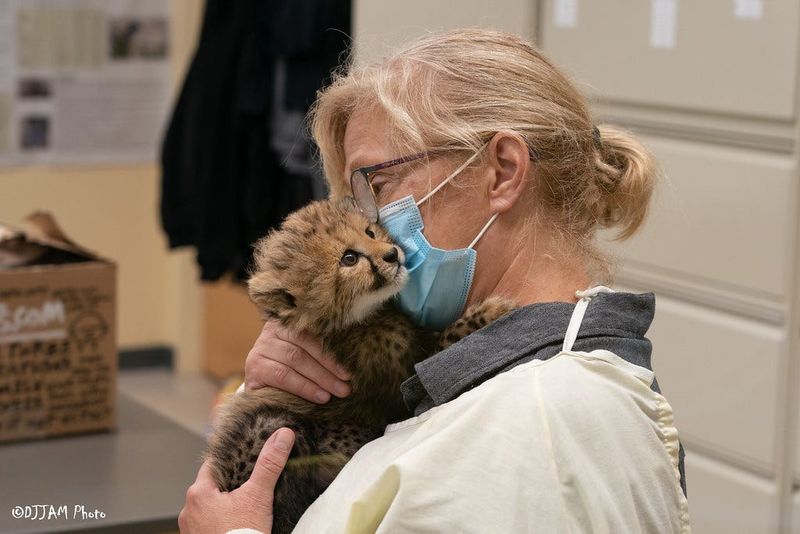
Over the decades, Strasser has worked with baby mammals as small as the roughly 2-gram feather-tail glider and as large as the 200-pound elephant. She doesn’t have a favorite species, she said, but she has special babies that touched her heart, like Red, a cheetah cub that needed a feeding tube plug. When patients from Cincinnati Children’s visited the zoo, they related to the animal’s health struggles.
“They’d see his (plug) and they’d start crying and they’d show me theirs,” Strasser said. “So, I’m like, ‘Aw, you have matching plugs.’ The public really relates to the babies when they have illnesses.”
Strasser taught Fiona to breathe
In January 2017, an internet sensation was born at the Cincinnati Zoo. According to Michelle Curley, the zoo’s communications director, the star wouldn’t have survived without help from Strasser.
On a three-way call, Strasser asked Curley to help talk about her experience working with Fiona, a hippo born six weeks premature. “I’d be happy to, but I do think you should brag, because you know, she is alive in large part because of you, so you can own that,” Curley said.
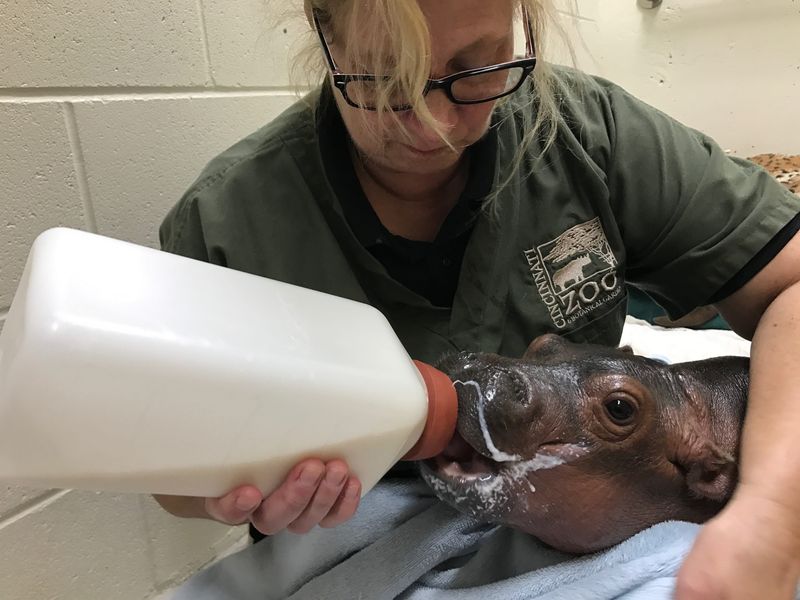
Fiona didn’t look like a hippo at first, Strasser said, she looked like a potato, a “brown and wet, bloppy thing.” She was just 29 pounds, compared to the normal range of 55 to 120 pounds for newborn hippos. She struggled to regulate her breathing patterns, often holding her breath and passing out.
“I started holding her on my chest, and then she started breathing with me, so then she was starting to regulate her own oxygen better,” Strasser said. “As I was breathing in, she would breathe in.”
It took 10 days, but Fiona’s breathing became regular, and she was even able to hold a bottle of formula in her mouth on her own.
A pioneer of animal care
When Strasser started working at the zoo, there were just four other women on staff. Many tasks, like caring for big cats, elephants and other large species, were off limits.
“We worked birds and insects and Children’s Zoo in the nursery, and that was it,” Strasser said. “Then we started branching out from there.”
Strasser said she and her female colleagues developed a work smarter, not harder attitude. In 1987, when a pair of walruses came to the zoo, they started caring for them and never looked back.
“You survived and you held your own and you didn’t take guff from anybody,” Strasser said. “Back then they called you feisty, because you just stood on your own two feet and survived. It was a lot different.”
Current zoo workers say Strasser developed a reputation over the years for wanting things to be precise. Cleaning tools had to go back exactly where they came from, nothing could be off. When Michelle Kuchle, senior nighthunters keeper, first started working under Strasser around a decade ago, she said she was nervous, but she gained a skill that has followed her throughout her career.
“I found she was just very straightforward,” Kuchle said. “She had a very organized way of doing things and she was very blunt … but the more that you talked to her, the more she said oh, well this is why we do it, because when you’re working with babies, you have to be so diligent in looking at their behavior because they’re so little. You want to be able to notice when anything sticks out different. So she said if you train your brain to see things in a specific order and then one thing stands out that’s off, you’re more likely to pick it up.”
No one will be hired to fill Strasser’s role, Curley said. Instead, the responsibilities will be shared across animal teams.
As her career spanned an evolution of zoo medicine, Strasser worked to increase resources in Cincinnati. She founded the city’s chapter of the American Association of Zoo Keepers, a nationwide network that works to advance animal care, welfare and conservation. Throughout the years, the chapter has hosted workshops and fundraisers, like dog training and bowling for rhinos.
Jennifer Gainer, the zoo’s curator of birds and African animals, said Strasser even has a farm that she tends to after long days of work.
“She dedicates her whole life to the zoo, but then she goes home and just continues the work with her dogs and her horses and her cows,” Gainer said. “She’s just nonstop animals all day, every day.”
While Strasser has now retired from the Cincinnati Zoo, she’s not done helping animals. She said she’s starting a consulting business, working with nonprofits and continuing to care for baby animals in non-AZA facilities. She’d like to travel more – Argentina, Nepal and Thailand are a few of the countries on her list – to work with other animal caretakers to rehabilitate wild animals.
“Her legacy is just insane,” Gainer said. “We’re losing a piece of zoo history. But happy for her to go on to a new adventure. She’s already got big plans.”
This article originally appeared on Cincinnati Enquirer: How a zookeeper’s wild legacy changed animal care in Cincinnati
Reporting by Carly Gist, Cincinnati Enquirer / Cincinnati Enquirer
USA TODAY Network via Reuters Connect
By Carly Gist, Cincinnati Enquirer | USA TODAY Network