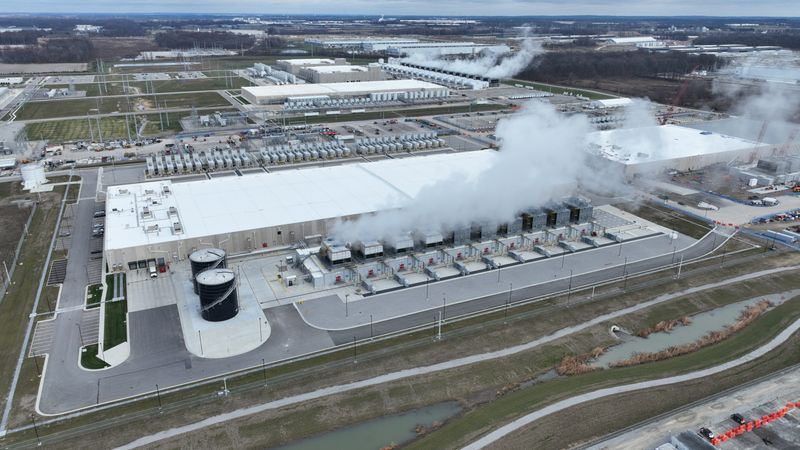
Electricity prices in the Buckeye State are skyrocketing – but how much can be attributed to Ohio’s data center boom is a matter of debate.

From February 2025 to February 2026, Ohioans’ electricity bills rose 22%, according to data from the U.S. Energy Information Administration. That’s second only to Virginia, which boasts the largest concentration of data centers in the world.
Ohio already has over 230 data centers − sixth most in the country − and more construction is likely on the horizon. But many residents, community leaders and politicians are pushing back as concerns about water waste, property taxes, land use and, of course, spiking electric bills, grow.
Data centers and their supporters maintain they aren’t to blame, at least not in full, for the price jumps burning holes in Ohioans’ pockets as other costs of living also rise. But pro-consumer and anti-data center groups say data centers are stressing the electric grid beyond its supply and need to step up to pay their fair share of costs shouldered by residential consumers.
How could data centers spike my electric bill?
Ohio is part of PJM Interconnection, a regional transmission organization whose grid serves 65 million people across 13 states, including Virginia. PJM has faced a big disparity in supply and demand in recent years, largely due to the rapid growth of data centers and aging infrastructure, according to some industry experts. In the long term, that’s not expected to get much better and has significantly contributed to rising bills.
The disparity is especially difficult for Ohio, a deregulated state for electricity. The 1999 deregulation was intended to encourage competition by letting Ohioans choose their electricity supplier instead of paying a utility company’s standard rate.
It also limited electricity generation in the state. By law, utility companies can deliver power, but they can’t generate their own. That means that while Ohio has some power plants, it imports most of its energy from outside the state, namely the PJM grid.
This is where an increased demand on the grid, like a data center, can show up in your bill. Ohioans’ electric bill is composed of three parts: generation, or the production of electricity; transmission, or the moving of that electricity over long distances; and distribution, or the poles and wires that bring that electricity to homes and business.
In Ohio, utilities don’t make money off of generation, so they aren’t responsible when generation costs go up. But residents still get “pass through” charges on their bill. What utility companies are allowed to profit off of in Ohio are transmission and distribution, or what it takes to get that electricity to consumers.
But just like the grid is stressed for supply, delivery systems like poles and wires are stressed and take maintenance. So those costs rise, too.
“Data centers are not like any other customer we’ve ever seen in our lifetime,” said Maureen Willis, Ohio Consumers’ Counsel and agency director. “They have immense power needs. If you took data centers out of the equation and you looked at the demand for electricity in Ohio, you’d see it’s probably flat or almost declining. With the data centers, all we see is this huge increase.”
A typical data center powering artificial intelligence uses as much electricity as 100,000 households, according to the International Energy Agency (IEA), which studies the global energy sector. The largest data centers now under construction will consume far more, the organization says.
Most of the energy costs associated with data centers stay local, said Matt Schilling, spokesperson for the Public Utilities Commission of Ohio. That means an AEP Ohio customer’s electric bill in Columbus will be more impacted by a data center in Central Ohio than a Duke Energy customer in Cincinnati. But all Ohio electricity users share the same power grid, so residents ‒ no matter where they live ‒ aren’t completely shielded from rising costs.
Electric bills are expected to go up because of rising generation rates in June. Under Ohio law, electric companies can’t profit off those rate increases.
In April, AEP Ohio customers saw a $7.90 per 1,000 kilowatt hours per month jump in their bill to pay for a different kind of rate increase ‒ for rising transmission costs ‒ and has had multiple rate increases in the last several years. Duke Energy requested a rate increase for distribution charges in March, which the Public Utilities Commission of Ohio has not yet ruled upon.
While aging infrastructure and extreme weather necessitating more heating and cooling factor into these spikes, some industry experts still point to data centers as the key culprit.
What’s being done to curb data centers’ impact?
Data centers and ballooning bills have brought more public attention and outrage to Ohio utility costs, but underlying problems have plagued the industry for years, one grassroots group said.
Columbus Stand Up, which advocates for utility reform, began hearing from residents about rising electricity costs in 2023.
“People were starting to tell us in these community conversations that their bills were hitting $600, $700 a month, and they’re in apartments,” said Morgan Harper, co-founder of the group. “They’ve done all the things – they turned off the heat, they put on more sweaters, they installed solar, and nothing’s working.”
Harper said increased power demand from data centers has exacerbated statewide utility problems that were already there: not enough electricity options for consumers, a lack of government oversight and relentless rate increases.
Groups seeking more transparency and fairness have led to some potential solutions.
In July 2025, the Public Utilities Commission of Ohio approved a data center tariff that was first proposed by AEP Ohio, the major electric utility serving Central Ohio. The tariff mandates that new, large data centers within AEP Ohio’s coverage area pay 85% of their contracted power capacity regardless of how much they actually use.
It is currently being challenged in the Ohio Supreme Court by tech companies and the Ohio Manufacturer’s Association.
The tariff is supported by the Ohio Consumers’ Counsel, which advocates for customers in utility proceedings. The agency would like to go one step further: a statewide tariff that would affect electric companies in all parts of Ohio.
“This comes down to fairness and that the customers who drive the costs pay for it,” Willis said.
Another potential solution would be requiring data centers to generate their own electricity, lessening their impact on the grid. Willis said the agency supports this idea, as long as it’s a new source of generation that won’t put other customers at risk.
Harper said she was skeptical of these potential solutions because they still require proper oversight to work.
“These are some of the most powerful corporations in the world,” she said. “If we don’t have a government that’s ready to embrace its power and hold them accountable, then I don’t think we can trust a lot of these deals and the promises they’re making.”
Supporters says data centers are used as ‘scapegoat’
But those who want to see data centers thrive push back on the notion that data centers are driving up consumers’ electric bills.
The Data Center coalition frequently points to a study commissioned by the Virginia legislature to tout benefits of data centers, such as jobs and tax revenue. The study acknowledges that data centers “consume substantially more energy than other types of commercial or industrial operations,” but claims that at the time of the study, data centers were paying their fair share in Virginia.
The Ohio Manufacturer’s Association, or OMA, has been a stalwart defender of the data center growth in central Ohio. In an email, OMA, which advocates for the state’s manufacturing industry, said “Ohio should welcome growth, investment and new industries, including data centers.”
Data centers, the organization says, are being used as a “scapegoat” for utility companies while they inflate energy load forecasts and increase rates.
Energy rate increases are determined by projections, which OMA takes deep umbrage with. Utilities present data to the PUCO predicting how much it will cost to deliver energy to customers based on the year before to justify a rate increase. If the math checks out to the commission, the rate increase is typically approved.
“Existing customers carry the risk when those forecasts outrun reality,” Ryan Augsburger, president of OMA, said in an email. “That is not sound policy. If the demand is real, prove it. If it is speculative, it should not be driving costs for everyone else.”
OMA recently praised a decision from the Public Utilities Commission that determined AEP Ohio overstated energy usage by certain consumer groups in a previous estimate. A PUCO spokesperson told The Columbus Dispatch that overcounting and undercounting is typical when dealing with forecasts, so corrections aren’t unusual for these assessments.
Still, the process has been criticized as opaque by OMA and those that don’t always agree with them. Ohio Consumers’ Counsel has long called for more transparency in how rates are determined between the commission and utilities.
How to lower your electric bill in Ohio
The Ohio Consumers’ Counsel has a list of energy-saving tips to help lower your electric bill by up to 30%. These vary from where to put your refrigerator to when to stop charging your devices. Read them here.
Have questions about data centers in Ohio? Tell us
This article originally appeared on Cincinnati Enquirer: Electric bills are rising in Ohio. But are data centers to blame?
Reporting by Samantha Hendrickson and Victoria Moorwood, Cincinnati Enquirer / Cincinnati Enquirer
USA TODAY Network via Reuters Connect