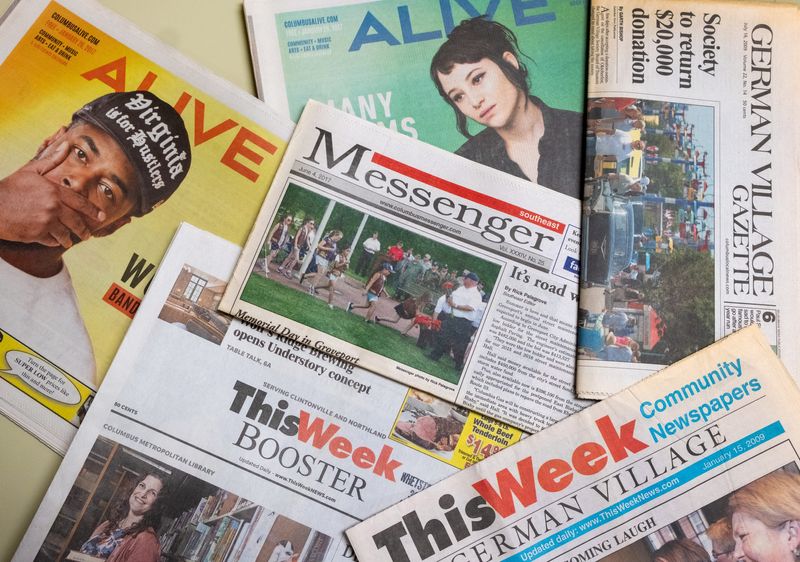
After more than 50 years in the newspaper business, the Columbus Messenger chain went out with a whimper, not a bang. Four days after publishing what would become its last edition, the weekly chain’s publisher and owner, Phil Daubel, posted a note on the group’s website April 10.

“The current economic climate and the changing nature of the newspaper industry, including how people get their news and how advertisers reach their customers, has adversely impacted our ability to continue publishing,” wrote Daubel. “The decreasing advertising revenue and our accompanying rising expenses make it no longer economically feasible for our newspapers to continue.”
Connect with the Columbus you don’t know. Subscribe to Columbus Monthly’s weekly Top Reads newsletter.
Daubel’s decision marked the demise of longstanding weekly papers in Grove City, Groveport, Madison County, Canal Winchester and on Columbus’ West Side. And it also meant the disappearance of weekly newspapers across the region. The move followed the choice by corporate parent Gannett Inc. in 2023 to shutter more than a dozen local papers operating under the ThisWeek banner; the company’s 2022 cancellation of the alt-weekly Columbus Alive; and the shuttering of the Suburban News Publications chain of weeklies by its new owner, The Columbus Dispatch, in 2011. (Transparency: Columbus Monthly and The Dispatch now are part of Gannett.)
As of 2025, the African-American News Journal in Columbus and Dayton also has ceased publication.
At this moment, general circulation newspapers in Central Ohio have reached a new nadir. A print media market that, a generation ago, supported a trio of alternative papers, two competing weekly newspaper chains with more than three dozen titles between them, and a fat daily newspaper, now has dwindled to just the daily Dispatch, which is printed six days a week and doing more journalism than ever with a smaller staff.
Chris Bournea, a longtime ThisWeek reporter who began his career at the city’s once-prominent Black weekly The Call and Post, said the lack of journalists covering local issues is apparent to his old sources. “When I run into city council members or mayors that I used to cover, they say, ‘We miss being held accountable,’ he says. ‘I think it’s really sad; there’s definitely a void, and people still have an appetite for local news.’”
This funeral dirge for local news is being heard across the country, according to Tim Franklin, director of the Local News Initiative at the Medill School of Journalism at Northwestern University. “It fits in with what’s been happening nationally. We have been tracing the loss of what amounts to two and a half newspapers a week,” Franklin says. “The nation has lost a third of its newspapers in the last 20 years, and it’s a trend we don’t see slowing at all.”
The traditional local news model may be fading, but one man in Columbus fights on. Cliff Wiltshire is publisher of the Clintonville Spotlight, a free monthly print publication serving greater Clintonville since 2017. The longtime editor and reporter for Suburban News Publications is the last man standing when it comes to a hyperlocal newspaper in print with monthly editions now in Clintonville and Worthington. (Columbus Underground, and Matter News, a local arts-oriented digital publication, are online-only.)
Wiltshire said he decided to return to the journalism business because the former readers of what had been called the (Clintonville) Booster kept telling him how much they missed it. “I thought I would give it one year, and if people were really done with print, that would be it,” Wiltshire says. “But it has just kept getting traction in the community.”
While Wiltshire represents the old-school model, a new model for hyperlocal journalism might be emerging. Nonprofit news organization Signal Ohio operates digital-only newsrooms in Akron, Cleveland and Cincinnati. Plans for a Columbus newsroom are in the works. Signal is joined by Richland Source, a digital news group in the Mansfield area with local sports and schools coverage reaching into neighboring Ashland and Knox counties.
The Source has turned to a paywall, old-fashioned ads and an in-house marketing agency to build a sustainable bottom line. Northwestern’s Franklin calls it one of the best examples in the country of how digital-only hyperlocal news providers can flourish.
While Franklin sees a new local news model evolving, the impact of closing newspapers like the Messenger chain is no less dire. “We are talking about losing a business that acts as the glue that binds a community together and provides a public service,” he says. “It’s a serious problem.”
This story appeared in the July 2025 issue of Columbus Monthly. Subscribe here.
This article originally appeared on Columbus Monthly: Decline at the Doorstep as Messenger Closes: The Changing Face of Print Media in Columbus
Reporting by Aaron Marshall / Columbus Monthly
USA TODAY Network via Reuters Connect