This story was updated to accurately reflect where unknown service lines are located.

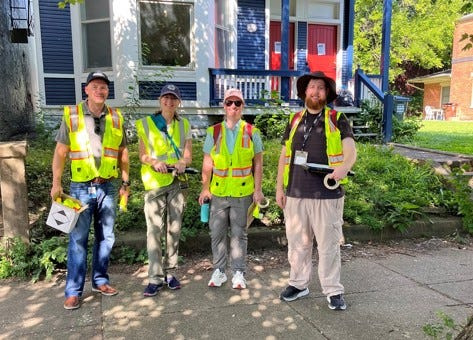
COVINGTON, KY. – Workers in yellow vests have started making their way to thousands of Covington homes this week in search of lead pipes.
The effort is part of the U.S. Environmental Protection Agency’s Get the Lead Out Initiative aimed at eliminating lead pipes in water systems throughout the country. A similar effort to ID and replace lead water pipes at 35,000 properties in Cincinnati was launched last year.
“For us, one thing that’s important to make note of is that when water leaves our treatment plants it does not have lead,” Sara Sgantas, communications and public outreach manager at the Northern Kentucky Water District, said.
The district’s plants, which serve about 300,000 people primarily in Kenton and Campbell counties, ensure water safety standards. But old public and private water service lines could still pose health risks for people. That’s why the water district is teaming with the EPA to inventory roughly 19,000 private service lines with unknown statuses.
In Covington, that involves going door-to-door to either inspect pipes or convince people to send photos of their pipes to the water district.
Sgantas said identifying even a rough number of lead pipes will help officials understand the scope of the issue and could lead to money to address the problem.
“If we have a better understanding of where… that helps us apply for funding for grants,” Sgantas said.
Here’s what you need to know about the water district’s efforts:
Who’s coming to my home and when?
The water district hopes to make it to 2,000-3,000 homes in Covington this week. Then, they’ll likely make more rounds in September and November.
If they make it to your home, it’s because the composition of your pipes is unknown.
The workers will wear yellow vests, carry identification indicating they are with the water district, and likely wear water district apparel. They’ll also be in marked vehicles.
Workers will be able to provide more information about the pipe identification program and may ask to see your water pipes.
Sgantas said the workers will never ask for money or personal information and residents don’t have to permit workers into their homes.
If you’re unsure whether someone’s credentials are legitimate, call the Northern Kentucky Water District at 859-578-9898.
How do I report my pipes on my own?
If you aren’t home when workers visit or feel uncomfortable letting strangers into your home, you can participate in the process online.
You can learn how to identify and report water lines on the water district’s website. Or you can find out the status of your pipes on the water district’s service line material inventory map online.
You can also schedule an appointment for workers to check your line status by calling 859-578-9898.
Why should I report my pipes?
The Northern Kentucky Water District has preventative measures to prevent water from eroding old pipes. For instance, the water plants adjust water pH levels and add nonharmful chemicals that essentially coat pipes to prevent lead from leeching into water.
But lead can still make it into water if pipes are disturbed, like due to construction in the area.
In children, exposure to lead can cause lowered IQ, damage to the brain and nervous system, learning or behavioral difficulties, and more, according to the EPA.
In adults, effects include reproductive, memory and concentration problems.
This article originally appeared on Cincinnati Enquirer: 19,000 water pipes need to be checked for lead. You can help.
Reporting by Jolene Almendarez, Cincinnati Enquirer / Cincinnati Enquirer
USA TODAY Network via Reuters Connect