It had been a springtime evening of celebration and promotion of the arts, during which Jim Arter shared time with his longtime friend, mentor and fellow artist Ray Hanley.
“I’d seen him earlier that evening at the Art for Life benefit for the Columbus AIDS Task Force at Columbus College of Art & Design,” recalled Arter. “He looked great and was very upbeat, hoping they’d sell a lot of art and make a lot of money.”

Within hours, Hanley, the head of the Greater Columbus Arts Council, would be gone, after falling from the terrace of a Downtown condominium.
Arter awoke the next morning to a phone call telling him that Hanley had fallen from the fifth-story Miranova condo of Loann Crane overlooking downtown Columbus, the city he loved and promoted. He had been staying with his friend, Crane, a philanthropist, arts patron, and former GCAC president, when he lost balance atop an elevated platform near a railing, said Dr. Rob Crane, Crane’s son.
Dr. Crane, founder and president of Preventing Tobacco Addiction, recalled Hanley as “a powerful, passionate and incredibly effective advocate for the arts,” who “knew everyone and talked to everyone.”
Arter and Crane both had known Hanley for many years before the April 16, 2006 accident. And both say his legacy remains.
“It was a privilege to know him. His fierce advocacy changed the entire canvass of how we support and engage arts in Columbus,” said Crane.
“He so embraced this city and all the arts… the symphony, ballet, the opera. He saw this as a way to make the city grow and bring all people together,” said Arter. “Ray was a visionary. He had gone to acting school and studied visual arts. He could get along equally with the mothers and parents and children and movers and shakers in the business world.”
A Dispatch story the day after his death described how he had forged a national reputation “for a variety of pioneering initiatives, including the Columbus Arts Stabilization Project,” which built on an $800,000 challenge grant from the National Endowment for the Arts (NEA) to help local arts groups stem cash-flow problems, retire deficits and build cash reserves.
The NEA has in recent years been financially gutted under President Donald Trump’s 2026 budget.
Asked what Hanley might think about those cuts, the proposed Kennedy Center rebuilding (including Trump-centric branding) and dismantling of diversity, equity and inclusion programs, Arter said he’d consider them “catastrophic.”
“He would still see the advantage for the community. He would not be sitting back quietly as he sees these attacks. Ray knew that celebrating the arts is a major part of DEI. He rolled his sleeves up and got involved,” Arter said.
His charismatic, yet non-judgmental approach allowed him to broker deals, create programs and scholarships and raise funds, Arter recalled.
Hanley was the adopted son of parents in Tenafly, N.J. He attended St. Francis Xavier High School in Manhattan, Quincy College in Illinois and graduate school at Catholic University in Washington, according to Dispatch reporting after his death.
He had worked as an actor, stage manager, theater producer and was the first managing director of Pittsburgh Public Theater. He also worked for arts organizations in Florida and had operated his own arts consulting firm.
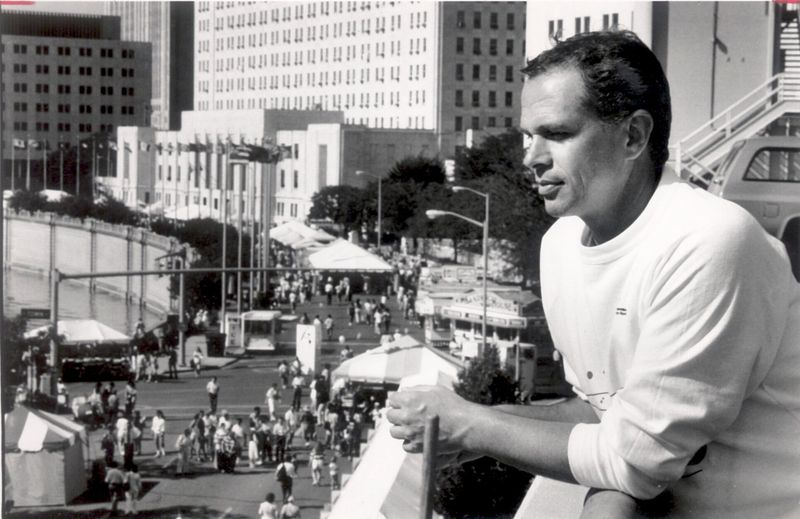
Those who knew him say that his greatest legacy was the Greater Columbus Arts Festival.
Begun in 1962 at the Ohio Statehouse, its popularity grew and it moved to the Scioto Riverfront in 1982. When Hanley became president of the arts council in 1985, he pushed to make the festival bigger and better.
“His approach was drawing people together and finding similarities … that they all should benefit,” said Arter of not only residents, but arts organizations. “He cross-pollinated the arts institutions and got them to see that they’re one big family.”
And he had a special focus on children and school arts programs.
“He knew that the children would be the artists of the future whether they participated or just bought a ticket for an event. ‘It starts a fire early,’ ” he recalled Hanley saying. “He believed so strongly in young people, he pushed for the Americorps and similar programs. That seed he planted just kept rippling out.”
At 78, Arter is a painter, sculptor and resident of Olde Town East and still a strong advocate for arts funding. And part of what he learned from Hanley still lingers.
“He could go toe to toe with anyone, speak his mind and when it was done go down to Rigsby’s (in the Short North) and buy them a drink.
“He was a high IQ person and able to look at all angles. It was a natural gift for him … a talent for seeking common ground, while at the same time keeping his ground. We need people like Ray Hanley more than ever,” Arter said.
Growth and development reporter Dean Narciso can be reached at dnarciso@dispatch.com.
This article originally appeared on The Columbus Dispatch: Columbus lost an arts ‘visionary’ after fatal Downtown condo fall in 2006
Reporting by Dean Narciso, Columbus Dispatch / The Columbus Dispatch
USA TODAY Network via Reuters Connect
By Dean Narciso, Columbus Dispatch | USA TODAY Network