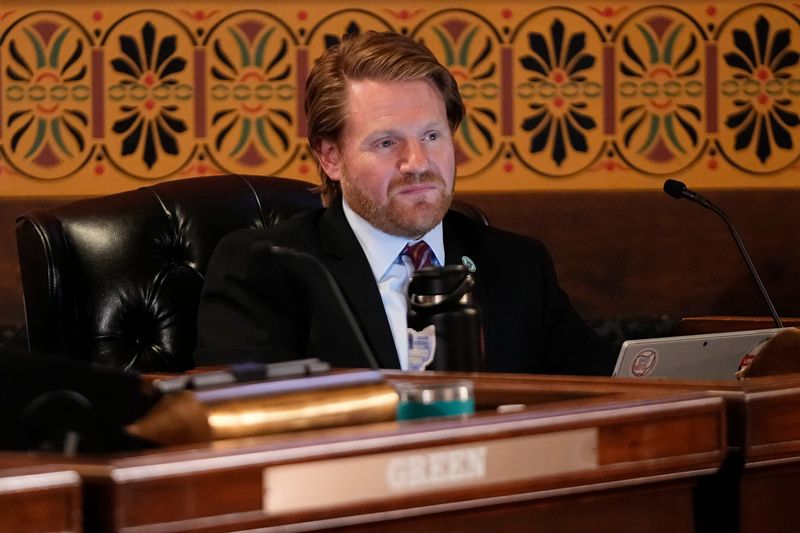
Columbus City Council President Pro Tempore Rob Dorans thinks that if a large private project gets city investment, it should have to pay construction workers fair wages.
The city is already required to pay construction workers on public projects at least the prevailing wage set by the state, which includes set pay and benefits. An ordinance proposed by Dorans would extend this requirement to private projects receiving at least $500,000 in investment from the city, including incentives like tax abatements.

“If in fact we’re going to put city investment into this, it’s also important for us to consider what the city is getting out of it,” Dorans said of private projects. He also said well-paying construction jobs contribute to the city’s income tax revenue and help make the construction trade a viable career, preserving a skilled trade workforce locally.
Dorans advocates for construction workers’ unions in his other job as the chief counsel for ACT (Affiliated Construction Trades) Ohio.
Dorans introduced the prevailing wage draft legislation at a Finance & Governance Committee hearing on June 11, along with companion legislation. The second proposal would require projects getting at least $500,000 from the city to meet with the city’s Office of Diversity and Inclusion.
That proposal stops short of requiring projects to commit to anything related to hiring diverse workers. The draft legislation only requires all recipients to meet with the Office of Diversity and Inclusion about possible workforce development partnerships and hiring local residents.
Dorans said the companion legislation grew out of a roundtable conversation between the city and workforce development partners during Black History Month. But in finalizing the proposal, Dorans was concerned about directives hostile to diversity programs coming from President Donald Trump’s administration.
“The Office of Diversity and Inclusion is trying to be extremely thoughtful about how they do their work, given the new legal and regulatory environment with a very, very extreme Trump administration looking for any ways to attack cities that care about diversity in their hiring practices,” Dorans said. “What we have here, the legislation before us, is something that hopefully gets people in a room.”
A prevailing wage requirement for construction workers
Federal, state and local public projects already must pay prevailing wages.
The Ohio Department of Commerce sets the prevailing wage by county for different construction jobs, like roofers, plumbers, etc. The prevailing wage encompasses pay but also benefits like retirement, health and overtime. The state often ties the prevailing wage to local union rates.
The new prevailing wage requirement for some private projects, if passed, would be enforced by the city’s Labor Commission, which would investigate complaints. Noncompliance could result in being barred from working with the city for up to three years.
Cincinnati passed a similar policy in 2016.
Dorans said he would like to put these two proposals before the council for a vote before the end of 2025 and have at least one more committee hearing on the topic.
Only one person testified at the council hearing, a proponent of the prevailing wage requirement.
“Passage of the legislation will raise local standards for workers,” said Dorsey Hager, executive secretary-treasurer at the Columbus/Central Ohio Building & Construction Trades Council. He said this legislation would also reduce income inequality.
“This ensures that all workers can provide for their families and retire with dignity and respect at the end of their career without being a financial burden on our local government, and that helps everyone in our community,” Hager said.
There is one key exemption to the prevailing wage requirement being proposed: nearly all housing construction that receives city incentives. Councilmember Otto Beatty III said he was glad to see this exemption because the city is trying to bolster affordable housing construction.
During the hearing, Beatty asked why a prevailing wage requirement needs to be put into the city code and can’t be negotiated for each project.
In the past, the Department of Development wasn’t able to negotiate a prevailing wage requirement despite some projects receiving millions of dollars from the city, Dorans said. Dorans has voted against backing some of those projects, like putting $54.6 million in city dollars toward the North Market expansion and the adjacent Merchant Building tower.
Dorans told The Dispatch he’s heard that some contractors on the tower project may have not paid the prevailing wage, but it’s difficult to substantiate.
Rockbridge, the developers of The Merchant Building, did not respond to a request for comment.
That project is one of the most high-profile projects getting city dollars but Columbus also gives out smaller amounts in the form of tax abatements and grants regularly.
Dorans gave three examples of the most recent private projects the city gave incentives to in 2025 that would have been covered by these proposed policies if they’d been in place:
Government and Politics Reporter Jordan Laird can be reached at jlaird@dispatch.com. Follow her on X, Instagram and Bluesky at @LairdWrites.
This article originally appeared on The Columbus Dispatch: Columbus could require projects getting city investment to pay construction workers fairly
Reporting by Jordan Laird, Columbus Dispatch / The Columbus Dispatch
USA TODAY Network via Reuters Connect