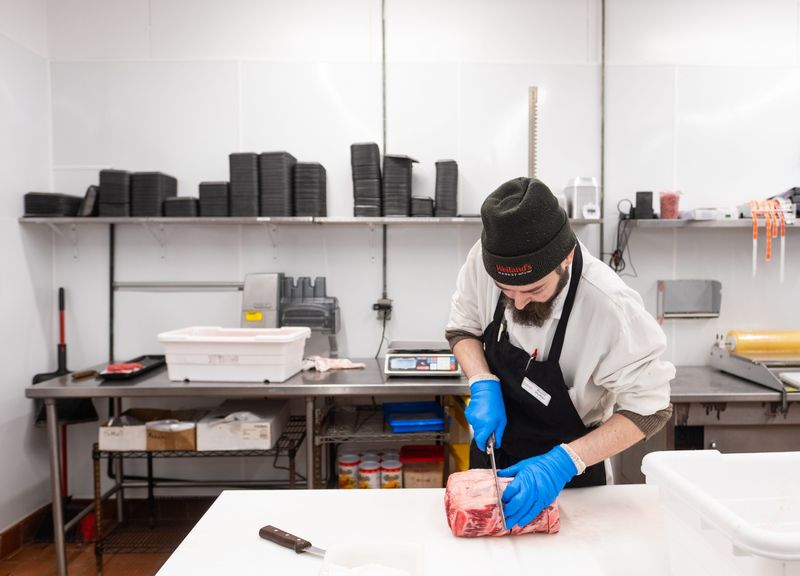
In this deeply personal essay, the author shares his experiences on the journey out of addiction and the success he later found. Daniel Phillips became co-owner of Weiland’s Market April 1, 2024.

I think the reason I was initially drawn to meat cutting, or the reason I still feel so happy when cutting meat, is that everything has a definition, a boundary. If you’re looking at a side of beef, the first through fifth ribs are the chuck. From the sixth rib down is the ribeye. You can put a saw right in between the fifth and sixth ribs, and you know cutting there creates two distinct and differently priced cuts of meat. I don’t know who decided this, but we don’t need to worry about that. It has been decided.
Connect with the Columbus you don’t know. Subscribe to Columbus Monthly’s weekly Top Reads newsletter.
Similarly, when the ribcage ends, the big piece of meat that was a ribeye is now suddenly and most definitely a strip loin. You always have one ribeye and one strip that look almost identical because that’s the point where you separate the two cuts. It doesn’t matter how alike they look or taste: You have crossed over into something that has been one thing and is now another.
What a clean concept. The designated point having been reached, a line is drawn. Something ends and something else begins. We get very few of those.
I don’t remember the official last time I stuck a needle into my own arm, or if it was loaded with meth or heroin. It exists. There was a last time, and it was 15ish years ago. It was, procedurally, the same as any other time I did it. There was no epiphany, no great awakening, no rock bottom that I hit and then declared to the universe that I must change, setting off a chain of events where I conquered my demons and began to live the life I always was meant to live. It was more pathetic and cold and slow than all that.
If you or anyone you love ever gets clean, don’t anybody think there is any beauty or glamour in crawling your way back into living a normal life. Or that you wake up one day as a changed person, never to go back. I relapsed several times before getting clean the last time. Every time I got clean, I thought it was forever; every time I went back out, I thought that was forever, too. It’s more of just a long reconditioning. You have to learn again what it means to eat meals regularly, pay bills, take out the trash, hold down a job, and probably most importantly, you have to learn again how to maintain relationships. You have to be accountable to people, and love them, and respect their love for you. That is hard.
My experiences have made me both more and less understanding and sympathetic toward people dealing with drug addiction. On the one hand, I’m sympathetic, way deep down. I’m even in a position to help them in certain ways. On the other hand, I know how tricky they can be: They lie and steal. That’s not a judgment; that is fact. When you have nothing, and the only thing that can dispossess you of the abject misery you’re feeling is $20, you will do just about anything to get it. For that reason, my sympathy and compassion ends about 6 feet outside my front door. If you are living with a junkie, my best advice is to kick them out. They need it. I did a fair bit of sleeping outside in the cold, in the freezing rain, wet and miserable. I was kicked out of every place I called home, and if I hadn’t been, I don’t know that I ever would have gotten clean.
I never used to want to talk about my past. When I started at Weiland’s Market in 2014, I didn’t talk to anyone about it. It felt nice to just blend in with all the “normal” people and not think about where I had been or what I had done. As I started to gain more stability and success in life and work my way up at Weiland’s, it began to feel important to own that part of my life. I could look at people and say, “I was a low-down piece of shit, and I had nothing. Now I’m doing OK. If I can do it, I promise you can, too.”
Shortly after I got clean for the first (not the last) time, someone I knew overdosed and died. A woman who knew both of us told me, “He wasn’t like you. He was never going to get clean.” If there’s anything I want people to understand—people who are using and people who aren’t—it’s that there is no difference between me and that person. Not on the inside, not really. The people you see struggling with drugs, the ones out there doing bad things, the ones who haven’t bathed in a month and have track marks up and down their arms—they still have a chance. There’s a person in there who is drowning. They might not make it out. But they still have a chance.
The way I choose to help people, whether it’s an employee or someone on the street, is by being open about where I’ve been, so they see it can get better. It isn’t promised, but it can. I tell them that I had top dentures by the time I was 27 because my teeth were destroyed by drugs. I tell them I slept outside in nasty weather. I tell them I stole. I tell them how hungry I was. How I know what true, deep hunger is—a hunger most people can’t even imagine. I know the true value of food, that’s how hungry I was. I tell them I’m the same as them. I tell them I want them to get their act together, because life can be so good. Anyone can do it. It’s hard, it’s really hard, but they can indeed do it.
I like setting the meat case because I start at one end and work my way to the other. I like it because there is a specific way to cut everything, and I cut it that way. When I’m done, the case is set and it looks beautiful, and everything is exact, and it’s clean.
This story appeared in the June 2026 issue of Columbus Monthly. Subscribe here.
This article originally appeared on Columbus Monthly: Clean: The Point Where Life Ruled By Addiction Stops and Another Begins
Reporting by Daniel Phillips, Columbus Monthly / Columbus Monthly
USA TODAY Network via Reuters Connect