Watching the Cincinnati Zoo’s two Guam kingfishers on exhibit, you’d never guess that the rare species would have vanished from its homeland.
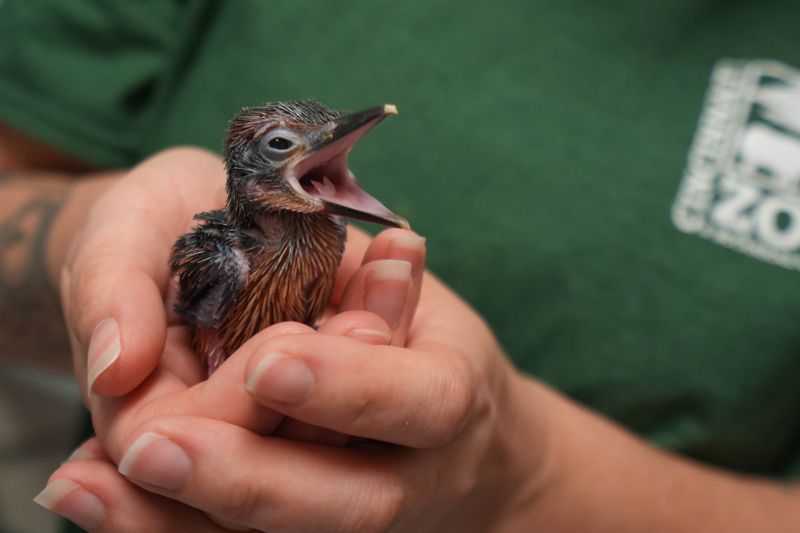
The birds are “mean in every aspect of their nature,” according to senior aviculturist Aimee Owen. Good hunters that mark their territory and hold your gaze, daring you to act first. Even the babies, who haven’t learned to fly yet, are aggressive. Quarantined in the zoo’s nursery, they bark at Owen with a loud, raspy call.

But this innate assertiveness doesn’t make them a threat. It makes them a strong candidate for translocation, Owen said, and the breeding effort at the Cincinnati Zoo & Botanical Garden may help the birds return to the wild.
For decades, the zoo has taken part in a global collaboration dedicated to recovering the Guam kingfisher, known as Sihek in the indigenous CHamoru language. The species has been classified as extinct in the wild since the 1980s, after the invasive brown tree snake – which was likely accidentally transported to Guam in ship cargo after World War II – wiped them out.
Biologists in Guam were able to rescue 29 of the birds and distributed them among Association of Zoos & Aquariums institutions, including the Cincinnati Zoo. Decades of breeding later, the zoo currently has 17 of the small, colorful creatures. Some will become candidates for the second round of the Sihek Recovery Program. In 2024, the program moved nine kingfishers to Palmyra Atoll National Wildlife Refuge, an island in the central Pacific Ocean owned by The Nature Conservancy, known as TNC.
“If we’re gonna do it with anybody, it better be kingfishers,” Owen said. “Their instinct just kicks in.”
Why are kingfishers moving to Palmyra? Will they be monitored?
Many years of evaluations went into selecting a site for the kingfishers to be released. Palmyra Atoll, which sits roughly 1,000 miles south of Hawaii, was selected because it is a protected, restored forest with plenty of prey and no forest birds for kingfishers to compete with, said Caitlin Andrews, bird conservation scientist at TNC and Zoological Society of London.
When kingfishers first move to the island, they’re equipped with “backpacks,” or small radio transmitters that fit over their wings. Andrews, who leads Palmyra’s kingfisher field team, said various designs were tested years before release to ensure “the birds could carry them safely and comfortably.” The team will use the monitors for roughly three months to track their health and activity.
Andrews said researchers hope to learn as much as possible because the species has not been observed in the wild for nearly four decades. The long-term goal is to move the birds back home to Guam, but it’s unclear when that will happen.
“Unfortunately, because snakes are still in Guam, that’s not a suitable location for them just yet, but Palmyra provides a really great first step on that journey home to Guam, and a really ideal safe haven for the species,” she said.
Which birds will be selected for release? How are they preparing?
As of July 1, nearly 30 Guam kingfisher chicks have hatched in the AZA population, but only nine will be moved to the island at one time. The last cohort, sent in 2024, included three from the Cincinnati Zoo.
It’s unknown at this time how many kingfishers will leave Cincinnati, but the six chicks in the zoo’s nursery could be strong candidates, Owen said. Pairs will be selected by AZA leaders and population managers based on genetics, age, health and sex to maintain diversity as they rewild.
Andrews said managers must balance the needs of the zoo population that sustained the species for decades with the growing population on Palmyra.
“We need both of these populations thriving in order for the species to keep progressing toward recovery on Guam,” Andrews said.
Since there are five males and four females on Palmyra, the new group will consist of four males and five females, providing a mate for the island’s lone male. Andrews said the project is also looking for younger birds, as they are typically more adaptable.
The Cincinnati Zoo, as well as other partners, have placed their chicks under quarantine conditions to ensure the birds are healthy enough for the transition and to prevent bringing new diseases to Palmyra. Owen said the sexes of the zoo’s chicks are currently unknown, but since there is a push to get more females into the population, the zoo is not putting their female kingfishers on exhibit.
When will the kingfishers move to Palmyra? What is their outlook?
Andrews said organizers hope to move the birds between October and January.
Owen said she hopes the zoo’s involvement can expose people – especially young children – to the importance of conserving the world’s ecosystems.
Although biologists often expect only half of translocated animals to survive, all nine kingfishers released on Palmyra are thriving. They’ve laid eggs – the first in roughly 40 years – but the parents’ young ages prevented them from hatching, Andrews said. Now, two years later, the Cincinnati Zoo and TNC teams hope to see the original cohort successfully reproduce, the new ones pair up quickly and two groups get along.
“There’s a lot of unknowns in introducing nine new birds, so we’re really excited to see what happens when we have a mix of ages out there, and a mix of birds that have had two years to settle in and birds that are just arriving,” Andrews said.
For now, the zoo’s chicks have marked their territory, claiming branches in their cages. Owen and the other zoo staff are gradually becoming more hands-off, allowing the birds to eat on their own, so they can grow into the independent creatures expected to thrive on Palmyra.
This article originally appeared on Cincinnati Enquirer: Cincinnati Zoo prepares once-extinct ‘mean’ birds for the wild
Reporting by Carly Gist, Cincinnati Enquirer / Cincinnati Enquirer
USA TODAY Network via Reuters Connect
By Carly Gist, Cincinnati Enquirer | USA TODAY Network