Last of a two-part series. Read Part 1 at https://shorturl.at/6Gkl8
Welcome back to the show! Last week, we told you how Ravenna actor Al Hodge became a 1930s superstar in the lead role of “The Green Hornet” on national radio.

He rocketed to even greater heights in 1950s television.
‘Captain Video’ and beyond
Before Captain Kirk and Luke Skywalker, there was Captain Video.
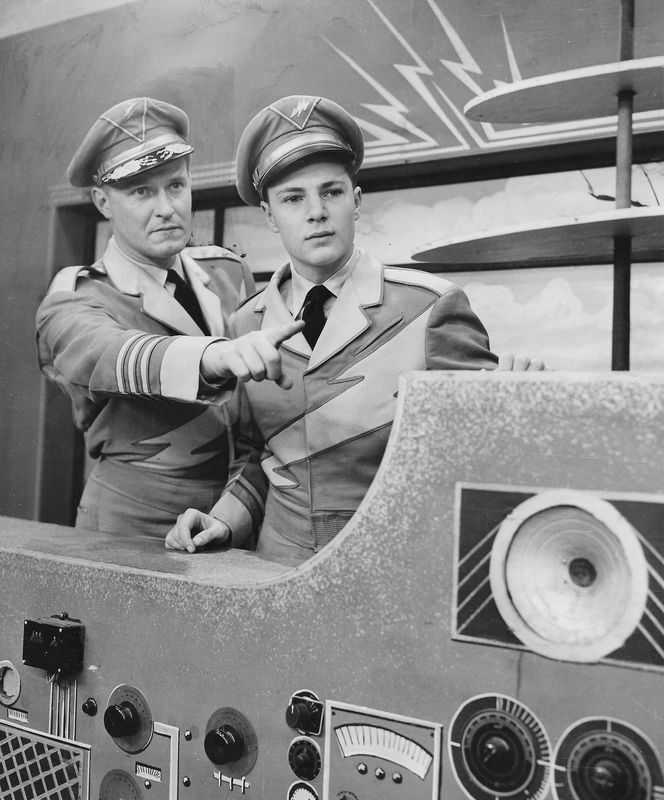
“Captain Video and His Video Rangers” was a sci-fi adventure series that premiered June 27, 1949, on the DuMont Television Network.
Set in the 22nd century, the black-and-white program was about a space guardian who battled evil and injustice throughout the universe.
When original star Richard Coogan left the program after 17 months, 38-year-old Hodge auditioned for the part and landed the replacement role.
He debuted Dec. 15, 1950.
“Captain Video! Master of space!” the narrator exclaimed. “Hero of science! Captain of the Video Rangers! Operating from his secret mountain headquarters on the planet Earth, Captain Video rallies men of good will everywhere. As he rockets from planet to planet, let us follow the champion of justice, truth and freedom throughout the universe!”
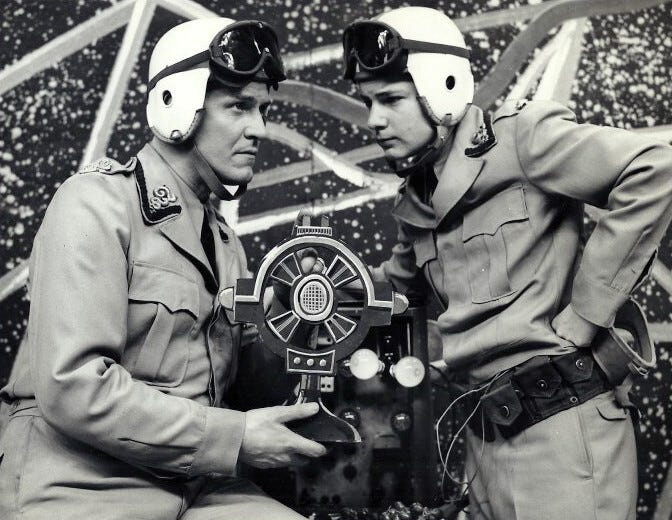
As Captain Video, Hodge co-starred five days a week with teenager Don Hastings, the Video Ranger, who had been on the half-hour show since its inception. In Cleveland, the series aired at 7 p.m. on WXEL (Channel 9).
The actors spent about six hours a day on rehearsal. They didn’t even get their scripts until the morning of the show.
The cast taped cards all over the set in an effort to remember their lines.
If Hastings lost track of where they were in the script, he could count on Hodge for help.
“Captain, do you have a plan?” he ad-libbed.
The unflappable Hodge interjected some scientific-sounding gibberish.
“Throw out the interlocks!” he might say.
Then they got back on track.
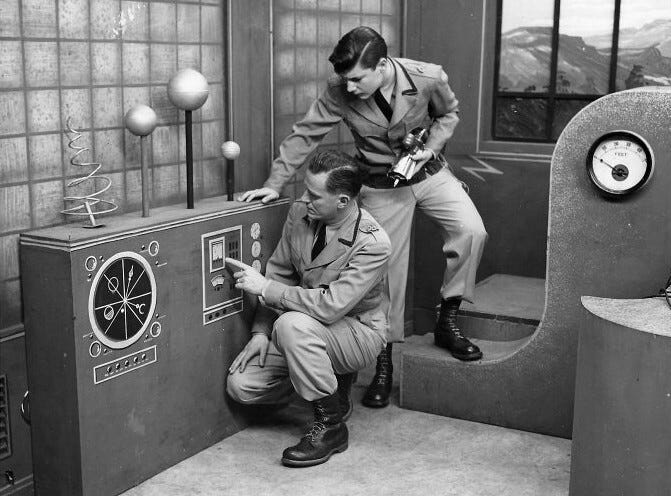
“Captain Video” had a prop budget of $25 a week. The Galaxy, the heroes’ spaceship, was made of cardboard and had painted features.
The production often borrowed items from the Wanamaker’s store below the New York studio.
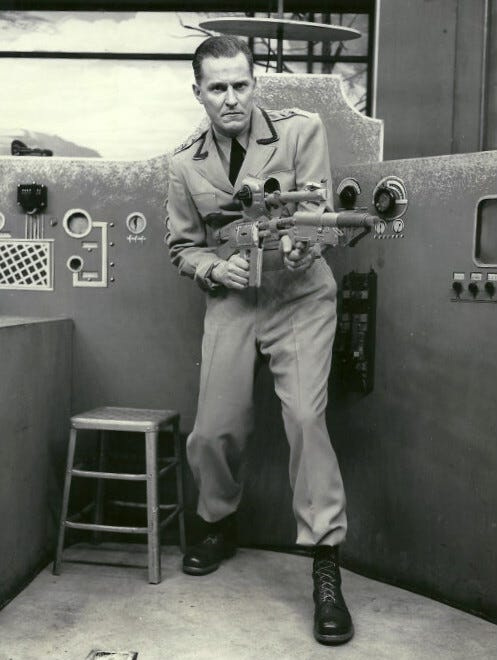
The captain wielded such sci-fi gadgets as an opticon scillometer, a cosmic ray vibrator, a remote tele-carrier and an atomic rifle.
Villains included Dr. Pauli, Tobor, Nargola and Hing Foo Sung. Future Hollywood stars Ernestine Borgnine, Tony Randall and Jack Klugman had early roles.
More than 125 TV stations carried the show. Millions of children watched breathlessly at home.
The show churned out all kinds of merchandise, including toy guns, space helmets, board games, comic books, phonograph records, solar goggles and cereal premiums. One of the most popular items was a decoder ring with a secret compartment.
Kids joined the Video Ranger Club and took an oath: “We, as official Video Rangers, hereby promise to abide by the Ranger code and to support forever the cause of freedom, truth and justice throughout the universe.”
Hodge initially earned $300 a week (about $4,000 today) and eventually peaked at $600 ($7,300 today).
In November 1951, he returned to Ravenna as a conquering hero, spending Thanksgiving at the East Cedar Avenue home of his parents Jessie and Al Hodge Sr. Children camped outside to catch a glimpse. Hodge occasionally ventured outside to sign autographs.
His proud father posted a Captain Video photo at his dry-cleaning business.
Personal appearances
Hodge traveled about 50,000 miles a year to make personal appearances, creating traffic jams wherever he went. He served as grand marshal of parades, cut the ribbon at store openings and spoke at school commencements. He actually earned more money at public outings than he did on the show.
In 1953, he and co-star Hastings appeared in costume as celebrity guests at the All-American Soap Box Derby in Akron. A year later, he returned to Akron as a celebrity at the VFW national marble tournament at Goodyear Hall.
“I’ll be making a personal appearance, say, in a Memphis department store, and a group of 7-year-olds will corner me with, ‘Hey, just yesterday you were stranded on an asteroid. What are you doing here now?’ ” Hodge told an interviewer.
In 1954, he testified before the Senate Juvenile Delinquency Subcommittee, a panel investigating whether TV shows helped increase crime among youths.
Spectators chuckled when the senators referred to Hodge as “Captain.”
He described the show as a “wholesome adventure program.” Nobody ever got killed, he said. Not even dastardly villains.
“We don’t use capital punishment,” he testified. “We confine our criminals in rehabilitation centers on the planet Ganymede.”
Anyway, it wouldn’t be much of a show if it didn’t have bad guys, he concluded.
“You have to have villains in a hero program or there’s not any use for a hero,” Hodge said.
He appeared in more than 1,100 episodes of “Captain Video” before DuMont canceled the show April 1, 1955. The network folded a year later.
Few episodes survive today. The original films were destroyed for their chemical content — about 7 cents a pound.
Life after ‘Captain Video’
Hodge had vanquished countless villains, but there was one adversary that he couldn’t defeat: typecasting. The actor found it difficult to find roles after starring in the sci-fi show.
“It’s a terrible thing,” he told the Beacon Journal in a 1958 interview. “I can get in to see TV producers who were once unavailable to me, but they all tell me the same old story. When I go after dramatic parts, they say my ‘Captain Video’ identification would destroy character illusion. When I look for jobs to do commercials, they say, ‘Whoever heard of Captain Video selling cigarettes?’ ”
He landed small parts in such TV series as “Naked City,” “The Phil Silvers Show,” “Hawaiian Eye” and “Alfred Hitchcock Presents,” but the roles dried up by the early 1960s.
The actor didn’t receive any residuals from his earlier work, so he did whatever he could to make money. He voiced industrial films, sold real estate, worked in an employment agency and guarded a jewelry store.
People recognized him all the time.
“Captain!” they exclaimed as Hodge passed.
Alone in a New York hotel
The thrice-married actor lived alone for years in the George Washington Hotel on Lexington Avenue on the East Side of New York City.
He smoked too much and drank too much.
In 1978, New York producer Irwin Schiff announced that Hodge would appear in a Cliff Robertson movie titled “The Killing Season.”
“I am tickled to be back,” Hodge told a reporter.
The movie failed to materialize.
The former actor subsisted on $63 a week in Social Security checks.
The end came March 19, 1979, when hotel workers found Hodge dead in his room. He was 66. A coroner’s report listed the cause as heart failure related to emphysema and acute bronchitis.
Hodge’s room was filled with memorabilia from “The Green Hornet” and “Captain Video,” including photos, articles and trophies. Suitcases were stuffed with fan letters that he had saved for decades.
“He was on his last legs here,” hotel manager Ronald Conboy told United Press International. “A guy’s at the top of his profession and then suddenly he ends up in the George Washington Hotel.”
Mourners included his daughter, Diane Johnson; his mother, Jessie Hodge; and legions of fans.
Hodge was buried at Kensico Cemetery in Valhalla, New York. The Actors Fund of America and the American Federation of Television and Radio Artists paid the bill.
In 1990, Ravenna High School inducted the 1930 graduate into its hall of fame with these words:
“For all of Ravenna, Al Hodge, our own Captain Video, will always remain as one of our stars in the universe.”
Mark J. Price can be reached at mprice@thebeaconjournal.com
This article originally appeared on Akron Beacon Journal: Captain Video had secret lair in Ravenna | Local history
Reporting by Mark J. Price, Akron Beacon Journal / Akron Beacon Journal
USA TODAY Network via Reuters Connect