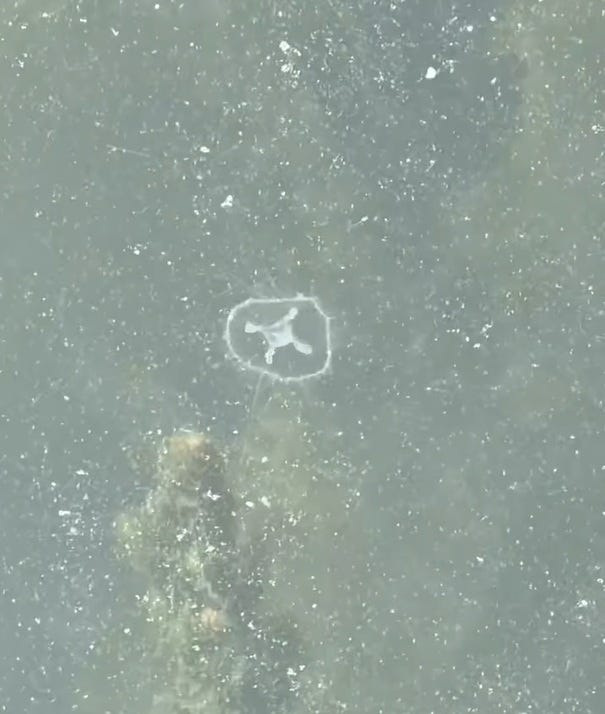
A freshwater jellyfish originally from Asia is roughly the size of a penny and is a rare sight in the Great Lakes.
Most of the time, they’re stuck to the bottom of the lake as polyps, according to the Pennsylvania Department of Environmental Protection. But occasionally they grow into the traditional jellyfish form, free to bob about in the water.

And they’ve been spotted at least twice in recent weeks in Lake Erie, as far apart as Put-in-Bay in the west and Erie, Pennsylvania, in the east.
Will they sting? Are they an invasive species? Here’s what to know.
Are there jellyfish in Lake Erie?
Staff at Stone Laboratory, part of the Ohio State University at Put-in-Bay on South Bass Island in Lake Erie, posted a sighting on social media Aug. 11. On Facebook, the lab states that the jellyfish had been spotted multiple times during the previous weekend.
They were also seen at the eastern end of Lake Erie, along Presque Isle, a peninsula jutting into the lake from Erie, Pennsylvania. The Pennsylvania Department of Environmental Protection posted on Facebook that an intern caught one on camera right off the dock in the marina.
What are Craspedacusta sowerbii jellyfish seen in Lake Erie?
The jellyfish, scientific name Craspedacusta sowerbii, are native to the Yangtze River valley in China, according to the U.S. Geological Survey (USGS) nonindigenous aquatic species website. They were first documented in the United States in 1880, and have been recorded in 44 states and the District of Columbia. They are now found on all continents, according to the University of Michigan Museum of Zoology.
The jellyfish were first recorded in Ohio in 1933 and have been found in lakes and rivers across the state, per the USGS.
They reproduce sexually and asexually, though sexual reproduction in this species is rare, according to the University of Michican. They typically reproduce by budding, with one polyp forming another. Some polyps create a bud for the adult medusa form — the traditional jellyfish shape — which detaches as its own organism.
Are the jellyfish in Lake Erie invasive?
Despite being a non-native species in North America, they are not considered invasive, according to Stone Laboratory. The USGS reports that the jellyfish are not considered an important predator of small fish or fish eggs.
Where can the freshwater jellyfish be found?
These freshwater jellyfish favor calm water and have been found in lakes, reservoirs, man-made impoundments, water-filled gravel pits, rock quarries, algae-filled ponds and rivers, according to the University of Michigan.
They tend to lie on the bottom of shallow waters, conserving energy to capture food or escape predators.
What do the jellyfish look like?
These jellyfish range from greenish to white in color and range in size from 5 to 22 mm in diameter, per the University of Michigan. They are 99% water and lack a head, skeleton and specialized internal organs for respiration and excretion.
Adults have the shape of a small bell, typical of most jellyfish. They have between three and seven tentacles with eyespots at the end of each. Shorter tentacles are for feeding and longer ones guide swimming.
Do freshwater jellyfish sting? Is it safe to swim in Lake Erie?
While these jellyfish do possess stinging cells, they are unable to penetrate human skin, according to the University of Michigan.
What do freshwater jellyfish eat?
The jellyfish primarily feed on zooplankton, which range in size from 0.2 to 2.0 mm in size. They use the stinging cells on their tentacles to paralyze prey before scooping it into their mouths, per the University of Michigan.
This article originally appeared on The Repository: Are there jellyfish in Lake Erie? Rare non-native freshwater species spotted. Here’s where
Reporting by Chad Murphy, Canton Repository / The Repository
USA TODAY Network via Reuters Connect