Brian and Lisa Riegel’s Powell home in the Scioto Bluff neighborhood is a seamless blend of design finesse and personality.

The open living room-dining-room-kitchen, just off the entry room, is as visually appealing as it is inviting—but a closer inspection starts to reveal stories of the couple’s life and history, hidden in plain sight.
Connect with the Columbus you don’t know. Subscribe to Columbus Monthly’s weekly Top Reads newsletter.
A large window with a handsome black trim overlooks their corner lot on a hill and invites in plenty of natural light, while cream walls and vaulted ceilings brighten it further.
The color palette is simple and grounded, allowing more eclectic pieces to shine without overwhelming. Brian is an artist who creates sculptures out of musical instruments, and his work can be seen on display throughout the home, like the bookcase he made from Lisa’s grandmother’s baby grand piano. Such works act as feature pieces without overtaking a room.
The kitchen and dining room introduce warmth with a heavy focus on wood, which holds some of those hidden stories.
The bistro table nestled against a bay window offering a river view in the backyard is made from a butcher’s block that once lived in a grocery store owned and operated by Lisa’s grandfather in Canal Winchester. The dining table also holds memories—its wood dates from the 1940s from Brian’s grandmother’s farm, which later was turned into a table by the person who makes tables for Cameron Mitchell Restaurants, Lisa says.
The Riegels purchased the home in 2013 after it had been on the market for only a day.
The 5,800-square-foot (including the basement), five-bedroom, four-bathroom home was built by Bob Webb Homes in 1994.
“We knew it was well-built,” says Lisa. The couple started on renovations that they say remain ongoing. “We have a whole laundry list,” she adds, including renovating their son’s room once he graduates from college and moving Brian’s studio.
The initial renovations, though, included reconfiguring the kitchen—a project led by Lisa. “We worked together, but the kitchen was her plan for functionality,” says Brian. For example, all the family’s spices are hidden in a bottom cabinet.
Across from the kitchen is an informal living room and fireplace, and beyond that is a sunroom. Also on the main floor are the primary bedroom and bathroom, connected by a walk-in closet. The bedroom is bright yet intimate and cozy—a deliberate downsizing from the original. The bathroom sports a deep standalone bathtub for Brian, and steam shower for Lisa.
Through a hallway off the kitchen are the other bedrooms, including their son’s and daughter’s rooms when visiting home. Lisa is an author, speaker and the president and CEO of Educational Partnerships Institute, and she records podcasts from her home office, also on the first floor.
Brian’s studio is accessible through the garage, where their cat, Little Mama, naps on storage shelves repurposed from the kitchen renovation. The artist’s space showcases his works-in-progress as well as the shiny brass of his materials. Many clients bring him sentimental instruments that no longer work, which he reconfigures into sculptures. Music stores also give him discarded instruments, some of which he repairs. Brian used to be an art teacher at Worthington Kilbourne High School, and he keeps a piece gifted to him by a former student on display.
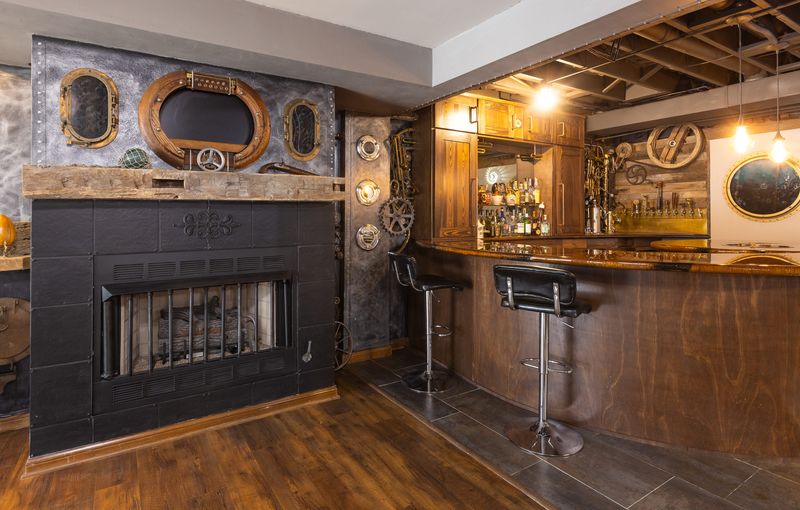
While the main floor is captivating, the Riegels’ basement is awe-inducing. Inspired by Jules Verne’s 19th century novel 20,000 Leagues Under the Sea, the basement includes a lounge, pool table, Brian’s office, a game room and, most notably, a nautilus-inspired bar.
Science fiction, steampunk and underwater aesthetics combine with Brian’s artistic flair for a fantastical result.
The bar is shaped like a nautilus shell—inspired by The Nautilus, the submarine piloted by Captain Nemo in Verne’s sci-fi saga, and Brian’s own creative imprint.
“We’re in a basement, and I’ve always loved the steampunk aesthetic and thought that would be cool, like a submarine,” he says. “And I’ve always loved the nautilus shape. It’s something that’s repeated throughout the universe everywhere, the spiral.” The bar top is made from 4,200 pieces of flexi ply—two pieces of plywood with rubber in between, which lets them bend. Brian hired someone to build it and did the coloring himself.
Nearby wall lights give off a nautical pattern, and the TV above the fireplace is designed like a porthole. Brian also has a musket and sword belonging to an ancestor on display nearby. The pool table in the center of the room is rigged up with lights and other artistic additions, courtesy of Brian.
His lower-level office sports several of his sculptures as well as an impressive wall of comic books Brian has been collecting since he was 5 years old.
“It’s a very relaxing house,” says Lisa. “It’s homey, but it’s not cluttered. There are plenty of spaces to sit and reflect.”
This story appeared in the June 2026 issue of Columbus Monthly. Subscribe here.
This article originally appeared on Columbus Monthly: An Artist’s and Author’s Powell Home Hides a Steampunk Bar
Reporting by Lucy Clark, Columbus Monthly / Columbus Monthly
USA TODAY Network via Reuters Connect
By Lucy Clark, Columbus Monthly | USA TODAY Network