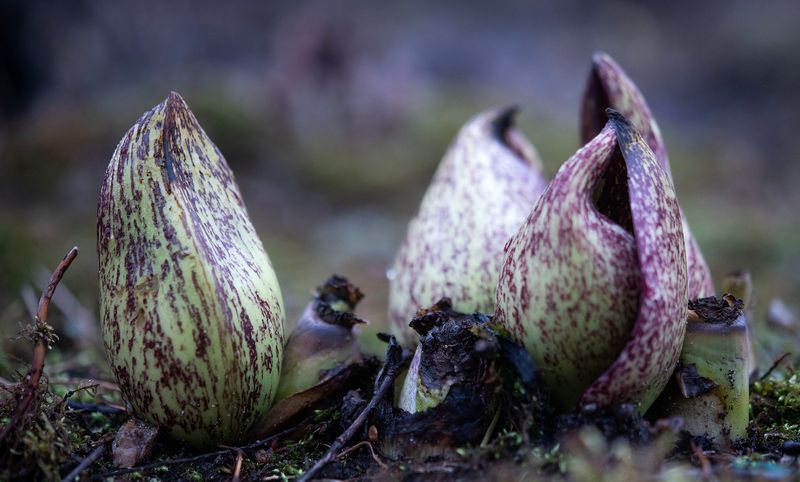
Early Spring in the woodlands a brave young plant, called Skunk Cabbage, Symplocarpus foetidus, is poking through the frozen ground looking for the sunshine.
Named for a skunk like odor it gives off, Skunk Cabbage has the unique ability to generate its own heat (thermogenesis). It’s believed that this feature attracts pollinators which are in short supply in the early spring.

Locals will find Eastern Skunk Cabbage, that is native to our area, but it grows as far north as Nova Scotia, to North Carolina in the south and to Minnesota in the west.
The first part of the plant emerging from the ground is the stalk with flower buds. This happens in late winter or early Spring.
When a dark, hood-like spathe starts growing around the flower. The spathe is a modified leaf which almost completely surrounds the flower to protect it. It is usually a deep maroon or purple, often splotchy, and will grow 6 to 8 inches tall.
The spathe has a generous opening for pollinators to enter. Since Skunk Cabbage does not self-pollinate, small insects are needed to carry pollen from flower to flower.
Despite its foul odor, other insects such as flies, gnats, bees, and beetles may visit the flower which is warmer than the air around it. When black bears and snapping turtles come out of hibernation, they often try the early spring leaves. But beware, this plant is toxic to humans, dogs, and cats.
Cornell Cooperative Extension Oneida County answers home and garden questions which can be emailed to homeandgarden@cornell.edu or call 315-736-3394, press 1 and ext. 333. Leave your question, name, and phone number. Questions are answered on weekdays, 8 a.m. to 4 p.m. Also, visit our website at cceoneida.com or phone 315-736-3394, press 1 and then ext.100.
This article originally appeared on Observer-Dispatch: Skunk cabbage will make an appearance in early spring
Reporting by Linda Sturtevant / Observer-Dispatch
USA TODAY Network via Reuters Connect