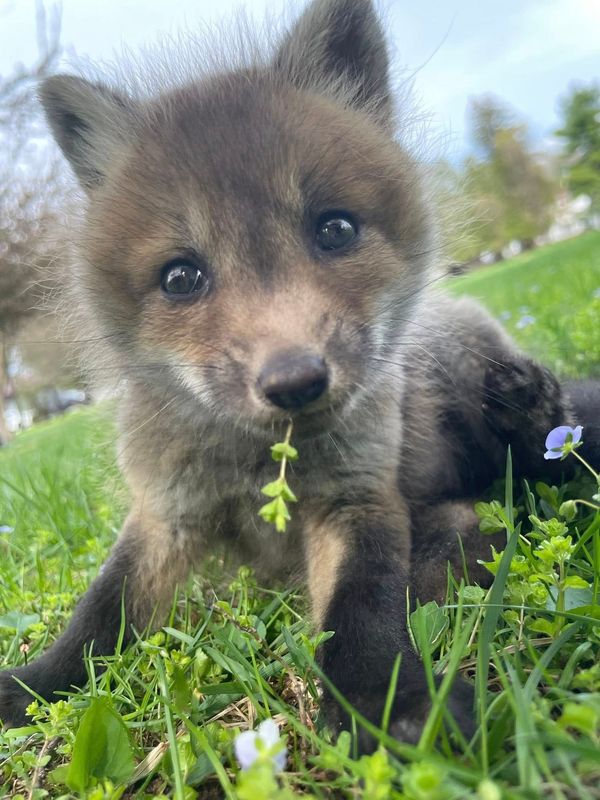
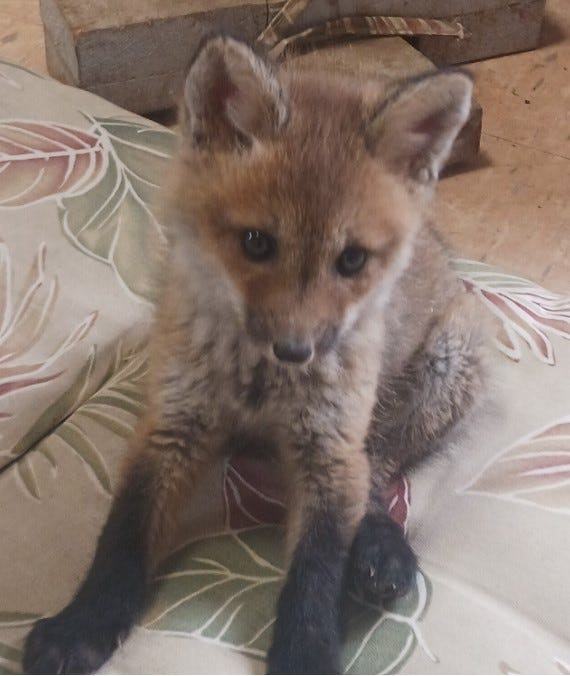
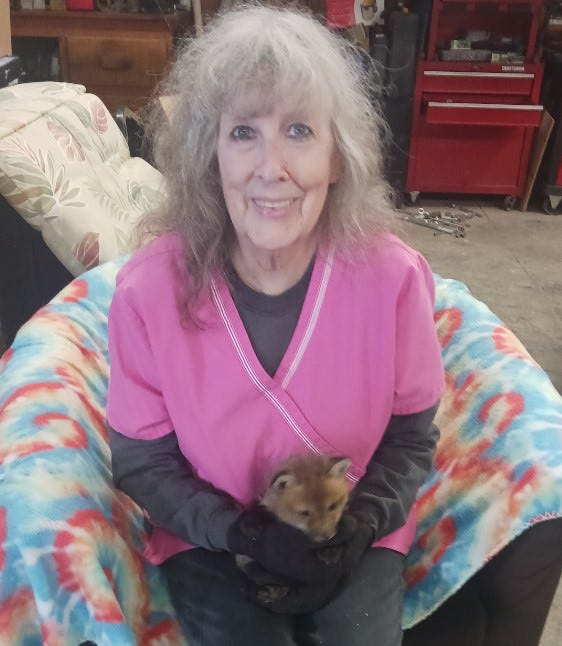
Felix, so named by Isabella Cusworth, the 16-year-old granddaughter of Judy Cusworth, founder and president of Woodhaven Wildlife Center in Chadwicks, is a baby red fox found just over a month ago, abandoned and alone in a local field.
Cusworth estimates the fox kit was about four weeks old when she found her way to the local rescue.

“She wouldn’t have made it through the night,” mused Cusworth, noting that, at her size in an open field, she was certain to have been found by a predator before she would perish from lack of food or water.
Felix the Kit
Felix appears to be a red fox.
“Red foxes have a white tip on their tails,” explained Cusworth. “Gray foxes have a black tip.”
“She’s got a lot of energy,” said Cusworth over the kit’s mewing and scratching as she sensed humans near her enclosure.
Observing Felix early in her stay has led Cusworth to question how much sight she has, as well as how much hearing. She suspects both are compromised.
Cusworth, who has rescued, rehabbed and/or raised to release-hood many baby foxes before, points out several behaviors unique just to Felix.
“She only runs in circles; not straight lines or corners,” said Cusworth as Felix raced in what dog lovers commonly refer to as “puppy zooms.”
“And look,” Cusworth exclaimed as she referred to the fox kit racing around the kitchen floor,” she only runs counterclockwise, never clockwise.”
Cusworth noted the kit walks normally, just only runs counterclockwise.
“Very strange,” said Cusworth, who wondered if it might be related to what way her vision maybe impaired.
“She throws temper tantrums when she’s hungry,” shared Cusworth, describing the little kit laying her head back, hissing, growling, screaming and other noises.
“I’ll tell you what,” effused Cusworth, “you don’t want to be in the room when she’s mad!”
Said Cusworth, “I’ve never seen that before.”
Raising Felix
Felix was able to eat soft, canned cat food when she arrived.
As an omnivore, Felix will graduate to eating a combination of fruits, vegetables, and small rodents. Cusworth has a supply of frozen mice to feed animals in rehab such as Felix, also hawks, owls, etc.
“You can’t let them eat real mice yet,” said Cusworth, “you don’t know where they’ve been.”
Observing Felix early in her stay has led Cusworth to question how much sight she has, as well as how much hearing. She suspects both are compromised.
When Cusworth did start to open a can of cat food, perhaps it was the smell that got Felix’s attention. She transitioned from her tantrum to visibly trembling, her whole body tense, and spontaneously peed on the floor. She continued to shake when the bowl of food was placed in front of her, almost crying as she desperately rushed to devour every bit.
Felix is currently the only fox in the pole barn. Cusworth explained that foxes have been evolving to lean into domestication and bonding with humans. She equally assured that, if given a choice between people or other foxes, Felix would certainly choose her own kind.
“If she is blind, we want her to be humanized,” said Cusworth, who noted that, in that case, she could not be released into the wild and would instead likely live in a zoo or serve an educational purpose of some kind where she would regularly engage with human beings.
Woodhaven Wildlife Center serves as refuge, rehab for rescued wild animals for over 35 years
Cusworth founded Woodhaven Wildlife Center on her 150-acre, mostly wooded property in 1990. She shared there was no one animal she found and fostered back to health that led her to make this her mission, just her love of wildlife and living among it and them.
Cusworth has converted an old pole barn into her indoor rehabilitation space – it includes cages and crates, a kitchen, and various climbing spaces for different species.
On the land bordering the Pole Barn, there are outdoor enclosures where many animals transition so that elements of their natural habitat – such as two ground holes for the woodchucks, which aerates the soil – can be introduced as they grow older, before their “release date.”
For the birds
Cusworth shared that, in the winter, 150 to 200 Mallards come to feed.
“You could go broke just feeding them,” Cusworth said.
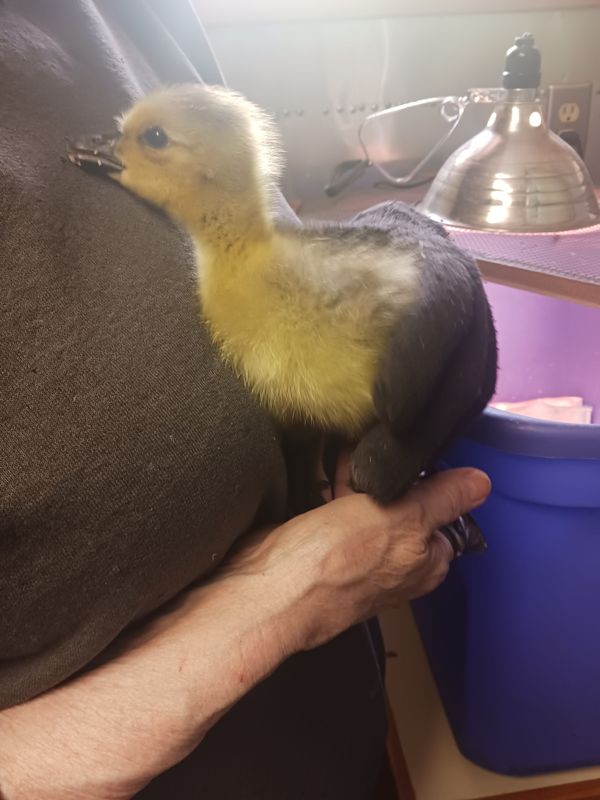
She also had a lone Canada Gosling.
She shared that, once a Canada Goose is separated from its family, it’s separated for good.
“It was all by itself,” said Cusworth, “just lost.”
She provides refuge for Herons and even Diving Ducks (though she noted they don’t see a lot of them).
She shared that she recently got a red-headed duck. Had to look it up on the internet, as she’d never seen one before.
She suspected unseasonable winds and storms pushed it off its traditional route, which may begin to happen more often as climate change shifts weather patterns.
Cusworth noted that this species of duck need to take off from water; if they land on the ground, they are unable to fly.
In the middle of the pole barn in a large, elevated enclosure is an adolescent rooster. Cusworth was called by a local church who found him abandoned in the back of their property on Easter Sunday. Her partner – in every way – Vinnie, a U.S. Marine Corps veteran, named him Gunnie, short for Gunner.
He was center stage as he craves attention. He began crowing when Cusworth removed Felix the baby fox from her crate … Cusworth noted he gets jealous when she holds the other animals. She placed Felix back for a moment and took Gunner out to hold him for a bit. Gunnie leaned into her happily.
What’s next for Felix?
All the while that Cusworth shared all things “Felix” as she has been getting to know her, but for a few short breaks, the baby Fox showed no signs of slowing her playtime speed.
“If she does get tired and you sit in a chair with her, she’ll curl up and fall asleep in your lap,” who added the caveat is not necessarily recommended.
“Unless she is blind, then, she needs to be socialized,” said Cusworth, who noted that – in that case – there was really no point in seeking to introduce her into a group of other foxes.
Cusworth assured that as Felix grows just a bit older, she will take her to Cornell, where they have the technology to identify her age and evaluate her vision and hearing, as well as her overall health, which will determine whether she is a candidate to be released into the wild.
Proclaimed Cusworth, smiling at the fox kit’s capacity to run and play. After a pause and with a warm smile … “She’s got a lot of life in her!”
This article originally appeared on Observer-Dispatch: Rescued baby fox grows up at Chadwicks Wildlife Rescue
Reporting by Cara Dolan Berry, Utica Observer Dispatch / Observer-Dispatch
USA TODAY Network via Reuters Connect