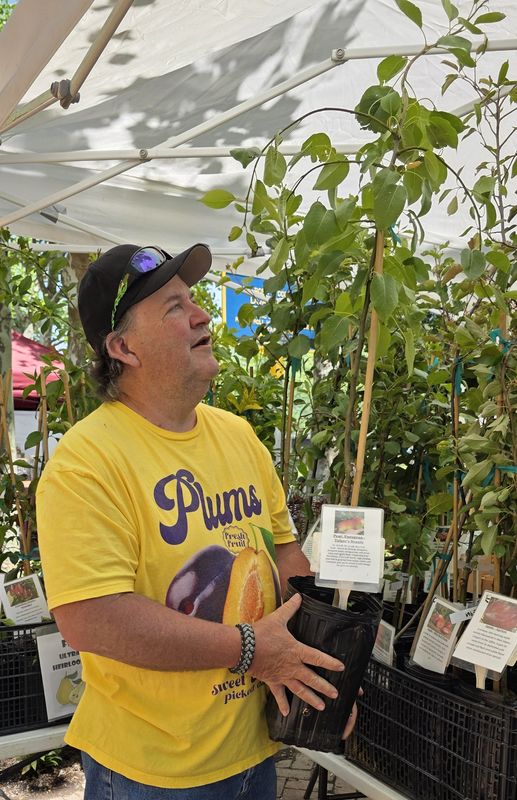
At the Ort Family Farm/Ort Gardens market stand, one first sees a large array of fruit trees, fresh fruit, jams, herbal teas, catnip and kitty toys as well as herb plants, berry bushes, plus much more. Looking beyond the plants, one finds that there are two farm businesses here.
There is Ort Family Farm with Roger, Maria, and Tanner Ort. There also is Ort Gardens with Shona Ort. Both farms are collocated in nearby Bradford, NY. Today we will feature Ort Family Farm. In our next article on our Farm Market vendors, we will feature Ort Gardens.

Roger, Maria and Tanner are ready to share their knowledge helping you pick out the best plant for you. They have an incredible love of plants, plant diversity and of saving genetics for use today and in the future. The joy that shows through when talking about their plants is infectious. They make it easy to guide you in how and where to put some of these common and unique plants in your own orchard or garden.
But which ones to choose? That’s where a conversation with Roger highlights his vast knowledge of plants honed by years of education, experience, and employment at Cornell Cooperative Extension offices.
Ort Family Farm is made up of two components. First is Roger Ort with over 45 years of Horticulture knowledge and orchard experience. Second is Maria with her jams, jellies, dried herbs, herbal teas, catnip toys, and so many other items. Two of Rogers’ sons, Tanner and Dane, also help out on the farm and at the markets.
Let’s start our adventure into Ort Family Farm by getting to know Roger and the passion he has for his trees. Today we will focus on Roger and Maria.
Roger and Maria started out with a greenhouse operation in Pennsylvania.
“We grew herbs and delivered them through[out] Virginia, Washington D.C., Pennsylvania, and New York. We had seven greenhouses and many employees back then,” Roger recalled. “We actually scaled back when we moved to New York. It’s just us and the kids [now]. It’s a little more peaceful. It’s like coming back to your roots a little bit.”
Scaling back has brought Roger and his family many opportunities such as working fulltime at the Cornell Cooperative Extension (CCE) and pursuing his love of saving genetic diversity in orchard trees.
“I retired in 21/22 after 13 years at Extension [CCE]. During those years I planted the orchard,” Roger said. “[My] Extension connection helps me get to know the new insects and the new diseases that are coming down the pike because Extension is all about educating the newest stuff that’s happening. Also, when you’re educating the public, you’re educating yourself.”
Roger loves his orchards.
“I have a really nice apricot orchard out back, about 26 varieties. We are always trying new fruit varieties,” he said. “I think we have 1,200 fruit trees and three acres of berry varieties. Some of them are quite unusual. I specialize in heirloom and heritage breeds. I test out some of these older varieties.
“We have the pawpaw orchard, the persimmon orchard, the mulberry orchard, the apricot orchard; other orchards are plum, apple, pear, some cherries, peaches, service berries, cornelian cherries, and other small trees. The three acres of berries are all the rare berry varieties: honeyberries, seaberries, juneberries, any raspberry and blackberry imaginable, currants, gooseberries, a few blueberries, elderberry, and quince. I have expanded the quince.
“We have the older heirloom varieties. In this orchard we have 300 feet of Russian, Crimean, Turkey, and some American varieties, probably about 25 varieties. I think in pears we have 150 varieties planted out for trial. I also have Beach plum and this year we will have the largest crop ever. With plums I am probably at over 100 varieties of Japanese, American, European, and Chickasaw that I am trialing. I like to trial and see what does the best. With apples I am probably close to almost 200 varieties.”
Roger is very passionate about his stewardship of living genetics.
“I have been grafting trees slowly over the years. I went into the orchard business originally for scion production,” he said.
Scion wood is a young healthy piece of a fruit tree that is grafted on to hardy root stock. It is necessary for propagating fruit varieties.
“A lot of the antique varieties that I have saved I want to make sure are offered to people who are getting started in the future orchard business. My model is a little more scion wood than fruit production. I sell scion more than I sell fruit. But when I get a good fruit harvest, that’s great.”
Maria adds value to these fruits by making jams and jellies.
“Some years with freezing and bad temperatures I don’t have a fruit crop, but I always have a scion crop so long as the tree grew from last year. Scion sales are where I’m going to keep old varieties from going extinct,” Roger said. “A lot of the guys that have the older varieties are maybe up in their 80’s and 90’s and won’t be with us forever. Those trees will pass too, just like the lost varieties of livestock, they will just go extinct. I try to keep as many alive as I can.
“The varieties are all very diverse in the sense that this one is an old eating variety or this one we can keep for months in the cooler, or maybe an old cider variety is coming back with all the new cideries that we have. Here are some old varieties that were really popular in England and makes good cider. Every variety has its use.
“The key with fruit heirloom trees is very similar to heirloom varieties of livestock in that genetic diversity needs to be kept in case you need to breed that gene back in. It may be a cold hardiness or another gene; once it’s gone you never get it back again.”
Roger believes strongly in maintaining the gene pool of heirloom varieties so that they can be bred with other heirloom varieties or back into newer varieties to help strengthen the plant. People like Roger are stewards of living history. Every time we enjoy food, we are also enjoying the benefits of Roger and others who help make our food system stronger and more resilient.
One might ask why a farmer does what he does. For Roger, “it is nice to have the family that helps work on the farm. I think it’s rewarding in the sense that you have something to pass along to the next generation because it’s your family. Also, I think it’s really cool when we are keeping an old heirloom variety planted and growing, the breeds we are keeping alive at least for our generation we kept passing something along. I like unusual fruit too.”
Unusual fruit is a specialty here, especially in his berry selections that can be found at his stand from July through October. During fruit season, ask Roger or Maria about how to make the most of their fruit, whether it is fresh eating, adding to a meal or making jams or jellies.
Ort Family Farm stand can be found at the Corning Farmers Market and at many other markets. Ask the Orts about other markets locations or find them on Facebook. Join us at the Corning Farm Market in Riverfront Centennial Park every Thursday from 10 a.m. to 2 p.m. until the last Thursday in October.
This article originally appeared on The Leader: Ort Family Farm preserves fruit tree genetics at Steuben County farm
Reporting by Renee Jacobson, Special to The Leader / The Leader
USA TODAY Network via Reuters Connect
By Renee Jacobson, Special to The Leader | USA TODAY Network