As New York considers reparations for its Black residents in the coming years, a new report delves into why the state should make amends.
The New York Civil Liberties Union (NYCLU) and Legal Defense Fund (LDF) released a report on Tuesday, July 14, that examines the impact slavery has had on New York and how it continues to affect Black New Yorkers.

The report, “The Other New York: The Legacy of Slavery and the Case for Reparations Now,” looks at the state’s history of discriminatory housing policies and redlining, environmental racism, police violence and mass incarceration, underfunded and segregated schools and voter suppression.
It comes around two-and-a-half years before the state’s Community Commission on Reparations Remedies is expected to provide reparations recommendations to the governor and state Legislature.
Authors Lanessa Chaplin and David Wheaton say the report is a way to educate all New Yorkers about why Black New Yorkers need reparations, which repair historic and ongoing harms by acknowledging them, ensuring the wrongs won’t happen again, restoring the affected group to its original state, compensating for the harm and providing healing services.
“The information is not new, right,” Chaplin, director of the NYCLU’s Racial Justice Center, told the USA TODAY Network.
“The data is out there. We kind of understand how Black New Yorkers are treated differently with a lack of access to opportunity, or a lack of access to wealth or resources. And what we really wanted to do was compile all that information,” Chaplin added, “and deep dive into this broad scheme of why Black New Yorkers are specifically trailing so far behind when it comes to almost every level of opportunity across New York state.”
Here’s what the report reveals.
How close is New York to providing reparations to Black New Yorkers?
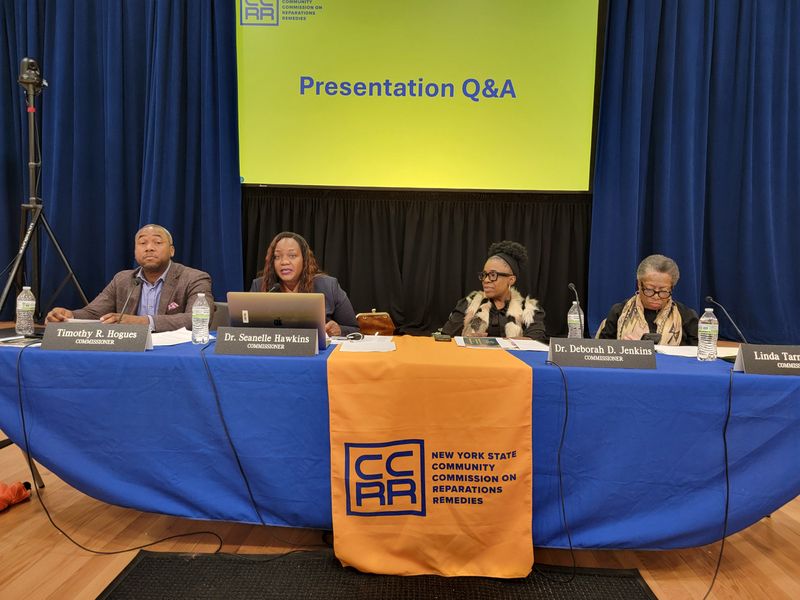
Chaplin and Wheaton also say this report is a tool for the state’s reparations commission, which has been tasked with examining the legacy of slavery, subsequent discrimination against people of African descent and the impact these forces continue to have in the present day.
The commission, which was approved by New York Gov. Kathy Hochul in December 2023 after being approved by the state Legislature earlier that same year, is made up of nine members and has held 20 public hearings across the state since 2024. It is expected to release its final report and recommendations in January 2029, which are non-binding.
“We hope to have influence on that report,” Chaplin said. “We really hope this can help guide what the committee is thinking about suggesting and having them think about it in a way that’s comprehensive … and we want to make sure that when the commission submits their report to the public, we hope that they have the most and best information available to them to help move operations forward.”
How some of New York’s highways have deepened the state’s racial gap
A physical barrier to equity among all New Yorkers that still exists today are highways constructed across the state, the report outlines.
In the 1950s and 1960s, highways like the Inner Loop in Rochester, I-81 in Syracuse, the Kensington Expressway in Buffalo and I-87 in Albany intentionally tore through Black neighborhoods, displacing families and creating environmental hazards for those left in its wake.
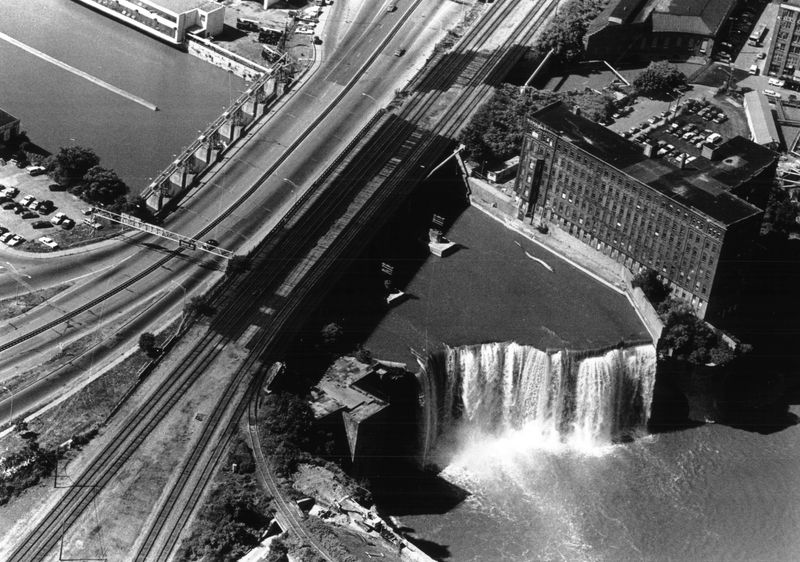
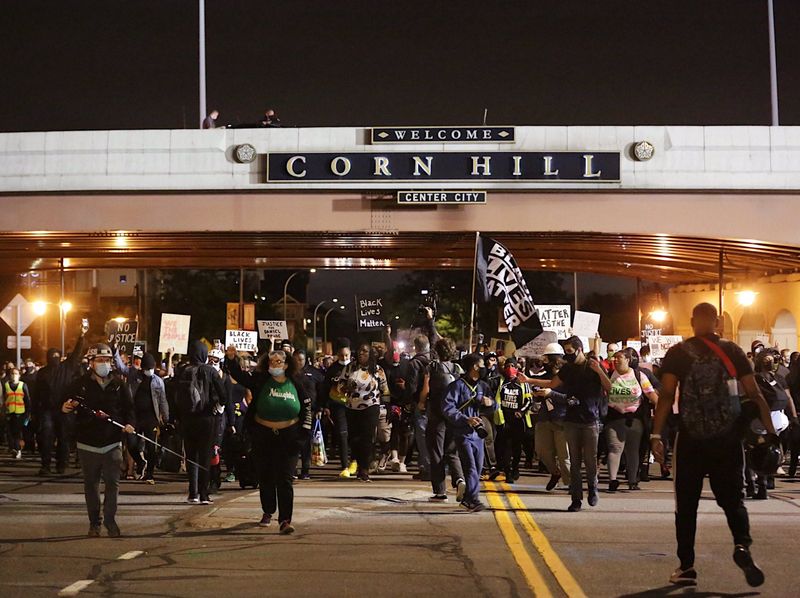
Rochester’s segregated, predominantly Black and redlined Corn Hill neighborhood was split by the construction of Route 490 in 1972 after being designated a “slum” by the city, the report states. As a result, the neighborhood has been designated an environmental justice disadvantaged neighborhood, or a community facing disproportionate environmental burdens, due to its proximity to the highway as well as landfills and incinerators.
In other cities across the state, more than 1,300 families were displaced in Syracuse and the Buffalo neighborhood split by the Route 33 now has some of the worst health outcomes in the nation and continues to have the lowest property values in the city.
But the authors of the report say the state has a chance to make things right.
“New York has a historic opportunity to undo the damage caused by mid-20th century highway construction, which tore through Black and working-class neighborhoods, displaced families, drained wealth, and left behind pollution and poor health outcomes,” the report states.
“Now, with aging infrastructure and federal investment on the table, the state can choose restoration over repetition,” the report added.
NY’s reliance on funding schools with local property taxes hurts Black students
A school’s proximity to highways, along with other contaminants, also continues to over-expose Black students in New York to hazardous air pollution. It reveals a larger issue, though, as the report says Black students continue to attend “chronically underfunded schools,” one of the sources of their exposure to “environmental hazards and crumbling infrastructure.”
The persistence of that problem stems from the state’s reliance on local property taxes to fund school districts, according to the report, because it harms students in majority-Black districts since it forces all districts to depend on the surrounding neighborhood’s wealth.
And while a ruling by the Campaign for Fiscal Equity in 2003 found the state’s funding system to be “partially unconstitutional” and required the use of the Foundation Aid formula, a more equitable funding mechanism, it took two decades for the state to fully fund its public schools under the new formula.
As a result, by 2018, New York owed $2.6 billion to 25 high-need, majority-minority districts across the state, the report revealed, and the spending gap between underfunded districts and wealthy white districts grew to more than $10,000 per student.
“Wealthier, whiter local neighborhood schools benefit from generational wealth, increased property values, local government investments, and a larger tax base,” the report says. “In contrast, many school districts in historically redlined areas, often zoned for industrial use, have significantly lower home values and therefore bring very little tax revenue.”
State spending on policing neighborhoods exceeds that of mental health, youth services
New York state spends nearly three times more on over-policing neighborhoods than it does on providing neighborhoods with the services they need, according to the report. In 2019, the state spent $18.2 billion on policing, jails, prisons, probation and parole, but only $6.2 billion on mental health, public health, recreation and youth and elder services.
It has had a trickle-down effect, as the report says aggressive policing of Black neighborhoods often leads to police killings of Black New Yorkers, which point to a larger pattern of racialized police violence. Two significant cases in New York in recent years grabbed national attention — the choking death of Eric Garner by the New York City Police Department in 2014 and Daniel Prude’s death at the hands of Rochester police six years later in 2020.
Black New Yorkers also account for around 40% of all misdemeanor and felony convictions in the state despite making up only 14% of the state’s population, and they’re also more likely to be convicted of a crime they didn’t commit, the report says.
“The failure of the criminal legal system to address police violence echoes the history of slave patrols operating without consequence,” the report states. “It shields misconduct and entrenches racist practices passed down through generations of policing.”
Why reparations are important for Black New Yorkers
The effects of slavery can be found in all parts of the state and in many different aspects of day-to-day life, both Chaplin and Wheaton pointed out.
“It’s also going to be really, really important for New Yorkers to understand that we don’t get here by accident,” Chaplin said. “We get here because there is a history and purpose behind the design of the system that we are living in right now.”
New York wouldn’t be the first to provide reparations for Black people. In 2022, Evanston, Illinois became the first U.S. city to implement a housing assistance reparations program for its Black residents and a year later, the state of Washington created a similar program for its first-time homebuyers impacted by state-sanctioned racial housing discrimination, the report details.
“Hopefully folks can see in each pocket of the whole state how the idea of reparations can energize them into doing something about this,” Wheaton added. “When the commission does release their recommendations, it is going to be up to the people to really energize their lawmakers to get around these reparation solutions.”
And while the authors of the report say they hope some legislative changes will happen as a result of its release, they intentionally did not provide specific recommendations for reparations in their report, saying they believe the suggestions “should come from the people.”
“Supporting reparations is about more than compensation; it is about acknowledging harm, restoring dignity and creating pathways for communities to thrive,” the report says. “It is time for all New Yorkers to rally behind this initiative, not only to repair the past but to build a stronger, fairer future for everyone. When Black communities thrive, all of New York thrives.”
Emily Barnes covers state government for the USA TODAY Network-New York with a focus on how policy and laws impact New Yorkers’ taxes, communities and jobs. Follow her on Instagram or X @byemilybarnes. Get in touch at ebarnes@usatodayco.com.
This article originally appeared on Rockland/Westchester Journal News: NYCLU report pushes for reparations for Black New Yorkers | Exclusive
Reporting by Emily Barnes, New York State Team / Rockland/Westchester Journal News
USA TODAY Network via Reuters Connect
By Emily Barnes, New York State Team | USA TODAY Network