Several local lawmakers are working across the aisle to help Mohawk Valley residents deal with the rising costs of energy.
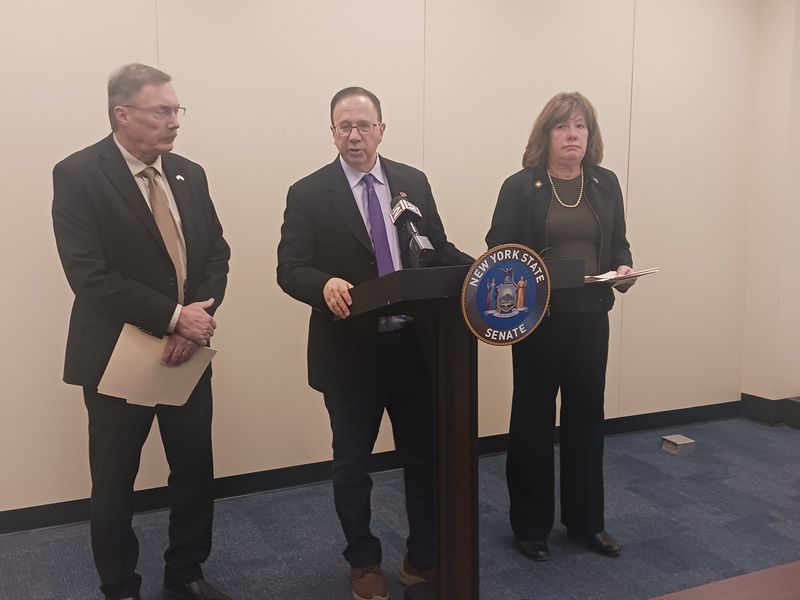
New York State Senator Joseph Griffo, R-Rome, Assemblyman Brian Miller, R-New Hartford, and Assemblywoman Marianne Buttenschon, D-Marcy, gathered at the Oneida County Office Building in Utica on Jan. 23 to announce a bi-partisan proposal to provide “immediate and long-term” relief toto New Yorkers burdened by “skyrocketing energy costs.”

The leaders emphasized that current rate hikes approved by the New York State Public Service Commission were – Buttenschon summed in a word – “excessive,” with many constituents seeing their electric bills double.
“It’s going to be 25 degrees below zero tomorrow,” emphasized Miller. “This has to be done now!”
Mohawk valley residents appeal to leaders to address doubling utility bills
Griffo shared examples of conscientious constituents in Herkimer County who have changed nothing about they way they use electricity, yet saw their bill double this month, while a Deerfield resident in Oneida County, also doing nothing different in the way of usage, saw the household’s electric bill double from $300 to $600 for one month.
Miller shared that not only is he getting flooded with calls regarding utility rate spikes at his district and Albany office, he’s now getting calls at home at night.
“Last night I received a call from an elderly couple who were talking about are we going to buy groceries, are we going to pay our utility bills or are we going to buy medicine? What are we going to do?”
Buttenschon echoed that this what her office is hearing, as well.
The leaders pointed the discussion in the direction of what they can do about it.
“I have cosponsored legislation as the senator had brought forward that talks about the PSC coming to the legislative bodies before they put an increase forward so that we can review it,” said Buttenschon. Griffo spoke as if directly to constituents.
“We are working together. We hear you. We’re experiencing this, too, so we understand,” said Griffo to their collective constituents. “We are going to fight for the people in our districts.”
Causes of utility rate hikes
Griffo shared that Utility companies are citing three primary causes for the rate hikes:
Griffo offered three alternative reasons of his own for the rate hikes:
The senator noted that delivery of service represents 60% of New York state utility bills.
“It doesn’t make sense, costs are too high,” said Griffo, “making it difficult for people to afford to live here.”
Proposals lawmakers are pursuing
The Mohawk Valley lawmakers unveiled the following proposals they plan to pursue with a repeated and palpable urgency.
The first is returning unused funds from the New York State Clean Energy Fund – which was established to support the state’s clean energy transition through targeted investments in innovation – to ratepayers.
Griffo noted monies from the fund are currently “unused, uncommitted at this time.”
“We’re suggesting those funds should be used for utility cost relief, “said Griffo.
Next is establishing a one-year utility bill tax and surcharge holiday and a two-year green energy tax holiday.
Next is to increase oversight and improve transparency by holding legislative hearings and conducting audits of utility companies.
Buttenschon called for both audits of and investigations into the utility company rate hikes.
Griffo called for both audits of and investigations into rate hikes causing all sectors of Mohawk Valley residents and businesses to see utility bills spike, sometimes doubling.
“I’ve drafted a letter to the state comptroller,” said Buttenschon, “requesting an investigation into these delivery charges.”
Next is granting the New York State Public Service Commission (PSC) – a non-partisan body of up to seven members – appointed by the governor and approved by the NY State Senate – who vote on whether or not to approve rate increases proposed by utility providers – “the ability to revisit and reconsider rate-increase approvals in order to address cost-of-living issues.
The lawmakers also look to protect consumers’ right to choose by allowing ratepayers to decline the installation of “smart meters” without being held liable for fees.
Next is examining the impact of smart meters to identify any correlation between them and the rising rates, as well as any discrepancies.
Griffo queried, “are smart meters doing what they are supposed to be doing?”
The lawmakers lastly proposed creating the “Ratepayer Relief Act” in order to drill down to the “true cost” of the CLCPA mandates and provide relief in that amount to ratepayers, as well as to cut existing taxes.
“We need a Ratepayer Relief Act in cooperation with PSC,” said Griffo, who noted such a law could “really make a difference” for residents of the State of New York.
CLCPA repeatedly cast as foil in the energy cost increases
The CLCPA set a goal for the State of New York to achieve 100 percent carbon-free electricity by 2040 and 70 percent of electricity from renewable sources by 2030.
“The CLCPA is a problem,” stated Griffo, who calls the law as is “unreasonable and unrealistic.”
“I’m not opposed to clean energy,” clarified Griffo, “just do it in a realistic way.”
Buttenschon agreed with a recent pause on funding clean energy sources such as wind and solar, noting a return from solar in her district was only 18%. Miller thought that was a conservative estimate and it was likely closer to less than 10%.
“Let’s get back to CLCPA,” said Miller. “It was legislated by people who aren’t technical about issues that are technical.”
Miller also reminded that the state’s energy grid is outdated, not having seen an upgrade in over 30 years.
He called for “significant funding to upgrade the power grid.”
“This needs to happen across the nation,” said Miller.
State leaders unanimous that energy portfolio diversification is key
Buttenschon agreed with Griffo’s emphasis on the need for a diversified energy portfolio. He chided that, yes, that should include fossil fuels and noted movement on public sentiment around nuclear power constituting “clean energy.”
“The state cannot rely on just one sector,” said Griffo.
What are utility companies proposing?
Buttenschon said utility companies have proposed a pool of $5M to offset rising rates in Oneida County. Then she did some math out loud, estimating about 40,000 households and businesses, and noting that was likely conservative, as there are about 25,000 in Utica alone.
The assemblywoman calculated that this would equate to relief in the amount of $5 per month per ratepayer.
“This doesn’t do it,” said Buttenschon. “It’s not going to work.”
Miller expanded to say that National Grid is proposing energy efficiency programs to lower costs.
“These things take time,” said Miller. “The crisis is here today.”
This article originally appeared on Observer-Dispatch: Mohawk Valley lawmakers propose action to address rising utility costs
Reporting by Cara Dolan Berry, Utica Observer Dispatch / Observer-Dispatch
USA TODAY Network via Reuters Connect