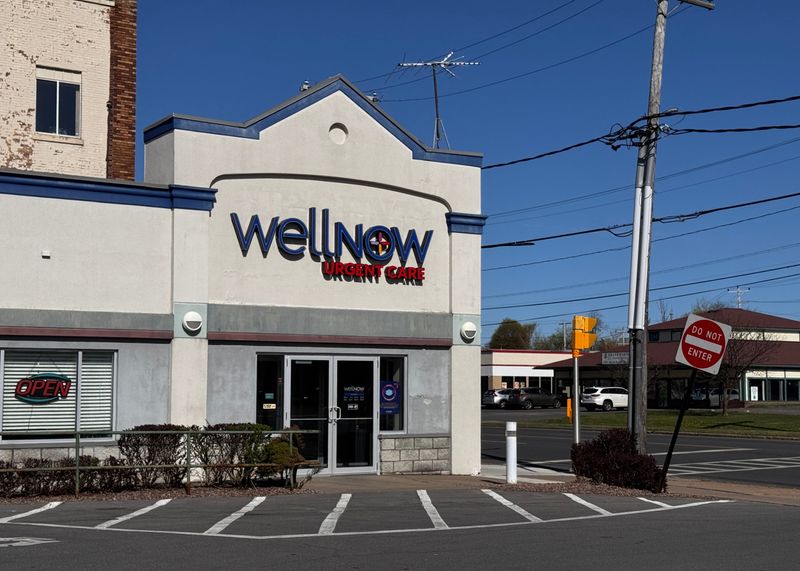
Are all the urgent care centers now dotting the Oneida County landscape good for your health?
And, do they help or hurt the overall health care system?

Those are big questions given the rapid growth of urgent care centers. There were 14,382 urgent care center nationally in July, 2023, about twice as many as in 2014, according to the Urgent Care Association.
More than 78% of the population lives within a 10-minute drive of an urgent care center, according to the association.
New York had 650 urgent care centers in 2019 and 842 by June, 2023, association statistics show.
That rapid growth got Stephen Wu and Eliane Barker, both economics professors at Hamilton College in Clinton, thinking.
“The proliferation of UCCs raises important questions for the healthcare industry, policy makers, and individual patients,” they wrote in a peer-reviewed study, “Health effects of urgent care center entry: The case of WellNow,” published in the journal Economics and Human Biology in May. “In particular, how might the penetration of urgent care centers impact usage of other types of health care, particularly visits to hospitals? And how might UCC entry affect patient health?”
Studying the growth of WellNow Urgent Care
They decided to address those questions close to home.
WellNow Urgent Care opened its first center in Big Flats in 2012 and now has more than 200 locations in seven states, the study notes.
So they studied the growth of WellNow in upstate New York and its impact on individuals’ health and on hospital emergency rooms.
But the study was conducted independently without funding from WellNow. No conflicts of interest were reported by the researchers.
Locally, WellNow has centers in Rome, Oneida, Herkimer, New Hartford and at two locations in Utica, but those aren’t the only local urgent care centers.
Slocum-Dickson Medical Group in New Hartford also runs an urgent care center. The Mohawk Valley Health Center has an urgent care center on its Faxton Campus. And Oneida Health has two QuickCare locations, in Oneida and in Camden.
Urgent care centers offer medical care for illnesses and injuries that aren’t life- or disability-threatening, requiring emergency room care. The centers offer evening and weekend hours, and do not require appointments.
Study findings
When a WellNow center opens in a community, there are improvements to residents’ health and to the functioning of emergency services, the study found.
Here are the researchers’ conclusions:
“Our research shows that urgent care centers like WellNow can improve both individual well-being and health care access,” Wu said in a statement. “These centers play an important role in helping patients receive more timely care while reducing pressure on hospitals.”
Annual checkups are important because they are associated with better preventive care and long-term health outcomes, Wu said. And that may reduce the strain on primary care providers as well as on emergency rooms, he said.
“The combination of improved health outcomes and better access to timely medical care suggests that UCC entry can greatly improve individual welfare,” the study notes.
“The study found that the presence of urgent care centers also increases the likelihood that individuals receive routine annual checkups. This is associated with improved preventive care and long-term health outcomes and may be influenced by reduced strain on primary care providers following the opening of these facilities.”
Separate 2025 survey data from WellNow Urgent Care underscores the access barriers many families continue to face. The survey found that 65% of mothers say cost determines whether they seek care, while 57% report their primary care provider is unavailable outside standard business hours.
These gaps can leave families delaying care or turning to emergency rooms. The survey also found that 70% of mothers report urgent care as their first choice when primary care is unavailable, and 71% report making financial sacrifices, such as skipping rent or groceries, to afford medical care.
Together, the findings suggest that expanding access to timely, lower-cost care, including through urgent care providers such as WellNow, can improve health outcomes while easing pressure on the broader health care system.
Other studies
There have been many other studies on the impact of urgent care centers and many have reached similar conclusions.
A systemic review of the research, published in the journal Cureus in April, 2025, considered 12 studies that met researchers’ criteria for inclusion.
Th researchers determined, based on those studies, that that urgent care centers “significantly” reduce ER visits, especially for non-urgent cases, which leads to shorter wait times in ERs and improves health care efficiency. The existence of urgent care centers was also associated with higher patient satisfaction, according to the review.
Their research also suggests that overall health care spending is lower because of the reduction in unnecessary ER visits, according to the article.
But the authors suggested more research into long-term patient outcomes and strategies for better integrating urgent care centers into the larger health care system.
Not all good outcomes though
Not all research has found good outcomes from urgent care centers, though. For example, a study published in the Journal of Health Economics in May, 2023, based on data from 2006 to 2016, determined that Medicare costs go up after an urgent care center opens with an average per capital annual Medicare spending increase of up to $268 for each beneficiary living in the same Zip code as the center.
The researchers also determined that the opening of an urgent care center leads to longer hospital stays and that increased spending on hospital car accounts for half of that total increase in Medicare spending. It is possible, the authors noted, that urgent care enters raise costs by steering patients to hospitals.
This article originally appeared on Observer-Dispatch: Is the rapid growth of local urgent care centers good for you?
Reporting by Amy Neff Roth, Utica Observer Dispatch / Observer-Dispatch
USA TODAY Network via Reuters Connect