These are tough times for private colleges and universities with three closing in upstate New York over the past two years: Cazenovia College, Wells College in Aurora and the College of Saint Rose in Albany.
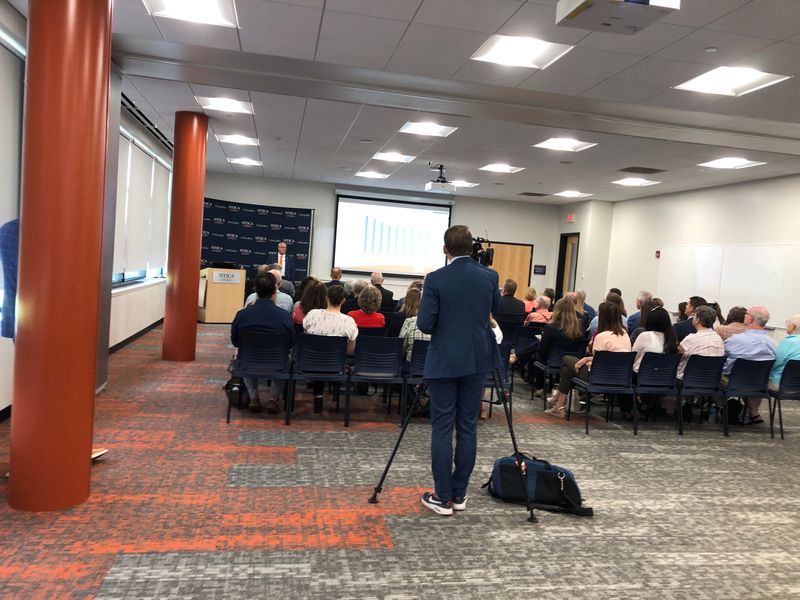
But, Utica University is going to survive and thrive because it has a plan to move forward through its own challenges, President Todd Pfannestiel promised his audience and viewers during a live streamed outlining that multi-pronged plan on the morning of July 1.

“Utica University is acting from a position of strength to preserve and propel our founding promise to provide a career-driven education that meets the evolving needs of students and the regional economy,” he said. “We are investing in our future. Aligning our structure and programs with clear market signals and student demand ensures Utica University will be a vibrant educational and economic cornerstone of the Mohawk Valley for generations to come.”
UU’s plan is based on data and will make sure that its degree programs match student interests and the needs of local employers, he said. Its focus will be on the 20 core programs in which 95% of its students are enrolled — including health care, cybersecurity, criminal justice, business, construction management and other STEM and professional fields.
Students, he said, want to be job ready when they graduate.
The plan comes with some pain, including cutting out some majors with few enrollments, cutting faculty to the right size for current enrollment, cutting staff and finding other ways to cut other expenses.
Challenges
Pfannestiel shared some numbers that reflect some of the challenges the college is facing:
Implementation
Work to implement the plan has already begun.
The university announced earlier in the morning that it was implementing a clause in its faculty collective bargaining agreement to begin the process of reducing the size of the faculty, Pfannestiel said.
But changes will come slowly with careful consideration and lots of conversations, Pfannestiel promised. Discussions with faculty about the more than 50 undergraduate degree programs will start at the beginning of September, for example, but no decisions on cutting majors will be made for about nine months, he said.
Any student enrolled in majors chosen to be sunsetted, including freshman who will start at the college this fall, will, however, be given enough time to complete their studies before the major disappears, Pfannestiel promised.
The college already announced in 2023 that it would start sunsetting 12 undergraduate majors, although courses in those subjects and in some cases minors are still available.
Reaction
Patrice Hallock, dean of Health Professions and Education, felt excitement after hearing Pfannestiel speak, she said, because the university if moving forward in a challenging environment.
She noted that enrollment has shrunk and that operating expenses have not shrunk commensurately.
“We need to match our resources with our student body,” she said.
And Hallock seconded Pfannestiel’s declaration that UU must continue to teach a strong liberal arts curriculum because STEM majors also need skills learned through the liberal arts. Students in nursing need chemistry and biology, of course, and physical therapy students need physics, she said.
But health care students also need to understand the human experience and the social experience, she said. And they need to think about ethics. And classes like psychology, anthropology and philosophy help them do that, Hallock said.
Rest of the plan
Here are other elements of UU’s plan to reorganize:
“Do we have the determination to accomplish this? Yes, we do,” Pfannestiel said, pointing to a photo of students at graduation. “It’s for them.”
Another new challenge
Post-COVID-19 pandemic, UU has also found another challenge, dealing with the toll the pandemic took on students entering the college in the past four years, Pfannestiel said.
“They didn’t have the socialization you would normally expect in an 18-year old,” he remarked.
And learning also took a toll. Students are ready for college, but many still need some help with basic skills,
Pfannestiel said. UU is working to help them catch up on both fronts, he said.
Progress
The university has already seen some progress in its numbers problems.
The incoming freshman class has 525 students, up from 490 in the year that just ended. The sweet spot for UU is probably around 550 freshman, Pfannestiel said.
It can’t adequately support the 600 or 650 freshman it used to have, he said.
Finances are looking up, too. Final numbers aren’t yet in for the fiscal year that ended May 31, but the deficit will definitely be less than $500,000, Pfannestiel said.
The budget for that year included some one-year cuts to salaries and other benefits to keep expenses down, he said.
And projections for the next three years show the university moving back into the black, he said. The 2025-2026 budget projects total expenses of $74 million versus total revenues of $75.5 million.
Creating the plan
Brainstorming for the plan began among leadership in January and February, Pfannestiel said. Then in March, he hosted three “very long” dinners with 12 faculty members and 12 community business leaders to talk about aligning the college’s education with the needs of local businesses.
From these conversations, the plan developed and the plan will save the university, he said.
“This university has been here for 75 years and it’s going to be here for another 75 years,” Pfannestiel said. “But I need your help.”
This article originally appeared on Observer-Dispatch: How will Utica University change to meet its challenges? Its administration has a plan
Reporting by Amy Neff Roth, Utica Observer Dispatch / Observer-Dispatch
USA TODAY Network via Reuters Connect