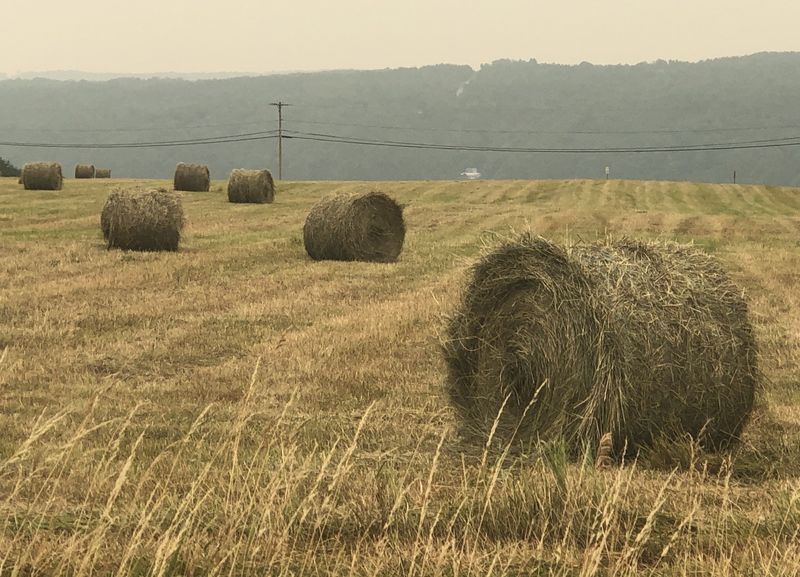
For the third straight day, smoke from Canadian wildfires is expected to keep skies hazy across parts of western New York. However, forecasters say air quality should gradually improve heading into the weekend.
The New York State Department of Environmental Conservation has issued an Air Quality Health Advisory for seven western New York counties through midnight Friday, July 17.

Air quality expected to improve Friday, with bigger changes Saturday
“Conditions are improving,” National Weather Service Buffalo meteorologist Heather Kenyon said. “The poor air quality is improving but is still unhealthy for sensitive groups.”
Hazy skies are expected to linger Friday, though visibility should improve compared with earlier this week. Kenyon said it’s unclear whether skies will resemble Wednesday’s orange-yellow haze or Thursday’s brighter, but smoky, conditions.
More noticeable improvement is expected Saturday as scattered showers move across western New York. Rain should help clear lingering smoke from the atmosphere, although forecasters are also monitoring the potential for strong to severe thunderstorms Saturday afternoon.
Where will air quality be the worst Friday?
The highest concentrations of wildfire smoke are expected across parts of western New York.
Seven counties remain under an Air Quality Health Advisory through midnight Friday:
The advisory includes communities such as Buffalo, Niagara Falls, Batavia, Jamestown and Olean.
Forecast Air Quality Index (AQI) values could exceed 150, which falls into the “unhealthy” category.
What is an air quality alert?
Air Quality Health Advisories are issued when pollution reaches levels that may pose health risks.
The current advisory is for fine particulate matter (PM2.5) from Canadian wildfire smoke. These microscopic particles can penetrate deep into the lungs and bloodstream, increasing the risk of coughing, throat irritation, shortness of breath and more serious heart and lung problems.
Who should take extra precautions?
The New York State Department of Health says those most at risk include:
Anyone experiencing worsening breathing problems or other symptoms should contact a health care provider.
How to protect yourself
University of Rochester Medical Center pulmonologist Dr. Daniel Croft recommends:
When to seek medical care
If you or someone else develops severe symptoms, including wheezing, chest pain or significant shortness of breath, Croft recommends moving to a clean, air-conditioned environment immediately and seeking medical attention.
“Get the person into a clean environment, such as a home, library or other air-conditioned building,” Croft said. “If they’re having an extreme reaction, seek medical care right away.”
How to check the air quality where you live
Current AQI readings and forecasts are available at AirNow.gov, where you can search by ZIP code or city. Air quality can change throughout the day as smoke shifts with changing winds.
What do AQI levels mean?
This article originally appeared on Rochester Democrat and Chronicle: How long will wildfire smoke last in NY? Air quality alert extended
Reporting by Victoria E. Freile, New York Connect Team / Rochester Democrat and Chronicle
USA TODAY Network via Reuters Connect
By Victoria E. Freile, New York Connect Team | USA TODAY Network