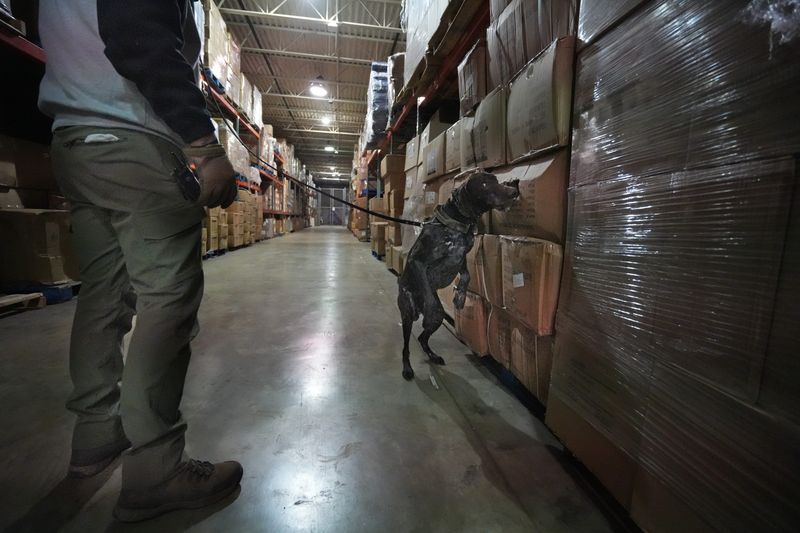
Contraband sniffing dogs was an idea born out of the COVID-19 pandemic, but after seeing its results, the Oneida County Sheriff’s Office wants to make it a fixture.
Oneida County Sheriff Robert Maciol said problems were arising in prisons and correctional facilities all across the country around 2019 as the country went into lockdown.

“We were facing the problem of contraband coming into our correctional facility,” Maciol said.
Contraband could be anything, from tobacco and marijuana, to narcotics and more.
“It was a huge problem,” Maciol continued. And we were looking for a way to get the situation under control, because jails across the country were experiencing overdoses and deaths from overdosing.”
Thinking outside the box led to the suggestion of using a drug dog for anyone and anything entering the Oneida County Correctional Facility. For New York state correctional facilities under the Department of Corrections and Community Supervision, K9 officers are an integral part of drug interdiction efforts.
A look at K9 officers in state prison system
According to a DOCCS (Department of Corrections and Community Supervision) officials in a statement, correctional facilities under DOCCS has 33 canine team deployed across the state, with seven more to be added by the end of the year.
“These investigators and their K9 partners play a critical role in detecting drugs, weapons, and other illegal items that threaten the safety and security of our facilities,” DOCCS officials said in a statement. “In 2024, canine operations led to 395 visitor arrests, while in 2025, there were 218, underscoring the effectiveness of these teams and the important role they play in maintaining safe correctional facilities across the state.”
K9 Bo joins the force
This led to Bo joining the force.
One of the many K-9 officers serving Oneida County Corrections, Bo joined the sheriff’s office in 2019 after being born in the Netherlands. He was purchased from Shallow Creek Kennels in Pennsylvania, trained here in narcotics detection, and assigned to the correctional facility.
“We looked at a German shorthair pointer, because of their keen sense of smell and the fact they’re extremely intelligent,” Maciol explained.
Correction Officer Merzuc Hozanavic became Bo’s handler after Bo was trained and certified. Bo had several different jobs and became a regular fixture at the correctional facility.
“Bo’s first and foremost job was at visitation, because that’s where most of the contraband was coming from,” Maciol explained. “We had signs made, so visitors were well aware that there was a drug-detecting dog in the facility. Bo would greet visitors and walk around the visitation area, but there were multiple instances when Bo would detect something.”
Additionally, Bo was in the mailroom and would be one of the first ones to make sure there wasn’t anything coming in for inmates. And, when Hozanavic was on duty at the corrections facility, he would have Bo with him
The duo found substances on several occasions while making rounds, officials said.
Bo passed away following a cancer diagnosis in early May.
What happens next?
When asked if the Oneida County Correctional Facility was going to get a new drug detecting dog to replace Bo, Maciol said options were being explored.
A drug detecting dog can cost around $10,000 and the Oneida County Sheriff’s Office welcomed three new dogs to the force thanks to donations from local businesses.
“Many of our recent dogs have been purchased thanks to local business, but there is also grant funding out there for K9 officers. But we definitely have plans in place because Bo’s work was very effective,” Maciol said.
This article originally appeared on Observer-Dispatch: Drug sniffing dogs effective at Oneida County Correctional Facility
Reporting by Casey Pritchard, Utica Observer Dispatch / Observer-Dispatch
USA TODAY Network via Reuters Connect