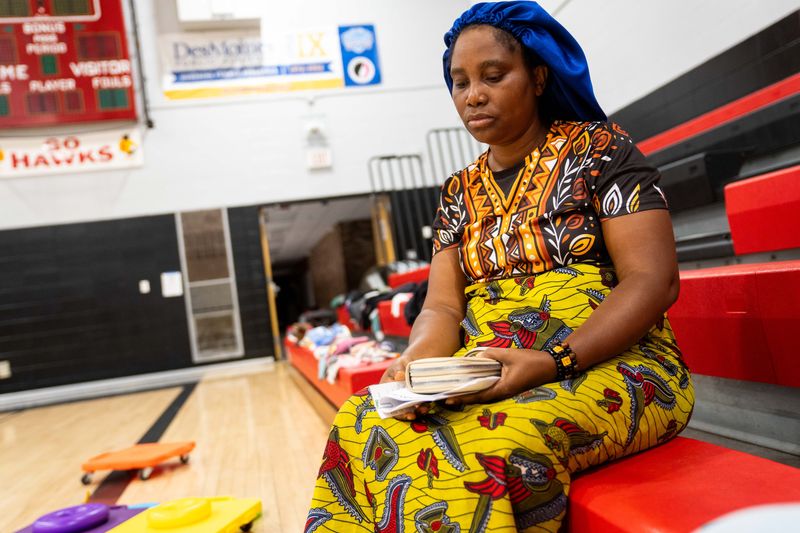
Eight years after Fourmile Creek flooded his Parkside East apartment and sent him to sleep on a cot inside Hoyt Middle School, Stanislaus Sesay was back in the same room, displaced again from the same Des Moines apartment complex.
Sesay, 39, lives on the second floor of Parkside East’s Building D with his wife, Decontee Harmer, 38, and their four children, ages 3, 8, 17 and 20. On the morning of July 3, he said, someone knocked hard on the door.

“They were just shouting everywhere, saying, ‘You guys have to move out, move out,'” Harmer said.
It was around 7 a.m. The children were scared. Their oldest daughter kept asking where they were going.
“She was asking too many questions, and I had to look at her and tell her, ‘I have no idea; we just have to leave,'” Harmer said.
Heavy rain Thursday night and Friday morning overwhelmed Fourmile Creek, pushing water onto roads in northeast and east Des Moines and forcing evacuations at Parkside East Apartments, 3560 E. Douglas Ave., just east of the creek.
Taylor House hospice center, in the 3400 block of East Douglas Avenue, was also evacuated, with five patients moved to Methodist West Hospital in West Des Moines.
At the Fourmile Creek gauge at Easton Boulevard, the creek peaked Friday afternoon at about 16 feet, 10 inches, according to the National Weather Service. Flood stage there is 12.5 feet, meaning the creek rose roughly 4.5 feet above the level where flooding begins.
The flooding at Parkside East affected 144 families, according to Conlin Properties, which manages the complex. Thirty-two families lived in first-floor units that sustained significant damage. They will not be able to return to their apartments.
Residents on the second and third floors are expected to be displaced at least through the end of July while the buildings are cleaned and repaired.
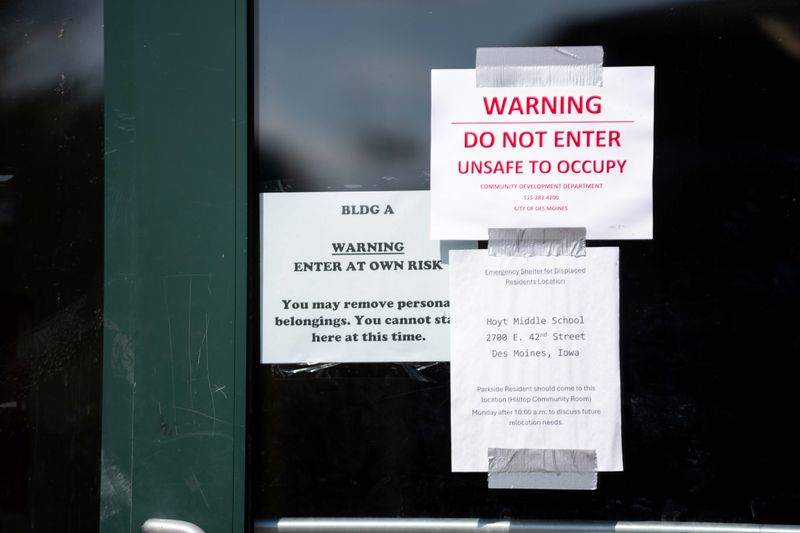
The American Red Cross opened a shelter for Parkside East residents at Hoyt Middle School, offering meals and personal hygiene items to residents who needed to sleep there.
The flood threat stretched beyond Fourmile Creek. The National Weather Service in Des Moines extended a flood warning Monday, July 6, for Jasper, Marion and Polk counties.
At the South Skunk River at Colfax, where moderate flooding occurred, the river was at 19.5 feet at 1:45 p.m. Monday, up slightly from 19.35 feet a day earlier. Flood stage is 18 feet.
At current levels, water affects the earthen levee west of town near the sewage disposal area. No evacuations are planned for Colfax because the river had reached the highest level it was expected to rise, Jasper County Emergency Management Director Jamey Robinson said.
The river’s height cut off access to the city’s fairgrounds and levee. If the river rises to 20 feet, it could cut off access to Iowa Highway 14 around Jasper County.
At Parkside East, the latest flooding revives an older question
Fourmile Creek has flooded this area before.
In 2018, about 9 inches of rain pummeled Des Moines over two hours, forcing emergency evacuations and damaging nearly 1,800 homes in the city. Fourmile Creek set a record that year when it crested at about 17.4 feet.
After the 2018 flood, Des Moines bought out dozens of flood-damaged homes citywide, including at least 50 in the Fourmile Creek neighborhood. Those buyouts were part of a long-term, multi-jurisdictional plan, estimated at $62 million, to purchase properties in the Fourmile neighborhood that sit in the 100-year and 500-year floodplain and are prone to repeated damage.
Parkside East Apartment, though also flooded in 2018, is among all that remains in the surrounding area, along with Taylor House hospice.
Now, residents are asking why low-income families were still living in first-floor apartments along the same creek corridor that officials had already identified as dangerous enough to move people and property away.
Sesay, who fled war in Liberia before coming to Iowa, said being forced out of his apartment for a second time has left him feeling displaced all over again.
“I feel like I’m a refugee; I’m displaced,” he said. “I feel frustrated because this isn’t the first time. The city should have taken appropriate steps; there should have been no one in the apartments downstairs.”
Still, he said he feels fortunate. He lived upstairs. His apartment was not destroyed the way first-floor units were, including that of his wife’s aunt, Edith Duncan.
Duncan, 63, also moved to Iowa from Liberia after fleeing war. She said she woke up when Harmer knocked on her door. When she stepped out of bed, she stepped right into flood water in her apartment.
She had to help her daughter, who uses a wheelchair, leave the apartment. A golf cart carried them away from the flooding.
Later, as she sat at Hoyt Middle School, she wondered where she was supposed to go.
“Where do I put my stuff, where do I go? I don’t know,” Duncan said.
Video she shared with the Register shows her carpets caked with mud and extensive water damage to her wood floors and furniture.
At Hilltop, families look for somewhere to go
By Monday, some displaced Parkside East families were at Hilltop Apartments Community Center, where Conlin Properties staff had said they would help residents look for new homes.
Angela Faux, 44, lived on the second floor of Building C with her three children. Her oldest, Arrianna Cruz, is 15. Her other two children are younger than 10.
They are looking for another place now. But if they cannot find one, Faux said, they may have to move back into their Parkside apartment after it is repaired and cleaned, about a month from now. Conlin has said the timeline is subject to change.
Arrianna went to the apartment two days in a row to get things out.
The evacuation was fast, she said. Someone knocked on their door at 7 a.m., then came back again around 7:30, saying they needed to evacuate. Everyone was asleep in the house when they were told to leave.
“The second time that they knocked on the door, I went to my house to help my mom get things packed. It wasn’t five minutes later, and the next thing I know, the water is already going to the parking lot. It happened so quickly,” Arrianna said.
Water came in quickly. Arrianna went to the back of Building E and saw water rushing in. The gazebo there was almost entirely underwater.
“It was a whole crazy impact,” Arrianna said.
Arrianna walked through the floodwater holding the youngest child, who is 1 year old, and the water was above her ankles.
“I had to walk all the way through it. When cars were going past, the water just kept moving along the apartments. I had to walk through water on the sidewalk. It was just really crazy,” Arrianna said.
Des Moines Public Schools was at the community center to help get children registered with the new schools they will attend after they relocate because of the flooding.
IMPACT Community Action Partnership was also there. The organization said the best way to help right now is through financial donations because IMPACT does not have much space at its food pantries to store physical donations, and families are in the process of moving, so they also do not have a place to put donated items.
A Red Cross truck was outside the community center. Inside, community members had water bottles and snacks.
Gov. Kim Reynolds issued a disaster proclamation on Monday for Jasper, Osceola, Polk, and Story Counties in response to the weekend’s severe weather. The proclamation activates the Iowa Individual Assistance Grant Program, which provides up to $7,000 for households with incomes up to 200% of the federal poverty level.
At Parkside, the cleanup had begun
At Parkside East, the cleanup was underway Monday.
A loud hum came from machines hooked up to the doors and windows of first-floor apartments. They sounded like giant fans. Several restoration companies were present.
The smell of standing water hit as walking into the parking lot.
Mountains of trash bags were heaped near dumpsters or in giant metal containers. Outside some apartments, household furniture and other items sat on balconies, including children’s toys and desk chairs. A sparse few people were there with their families, moving items into cars.
Conlin Properties advised first-floor residents to retrieve their belongings from their units by 5 p.m. July 8.
Those living on the first floor must vacate. For residents on the second and third floors who do not want to wait for repairs to be completed, their leases can be terminated, but that is not required.
First-floor residents will receive their full deposits as well as July rent or any other prepaid rent. First-floor families in impacted buildings will also receive $600 each, and impacted second- and third-floor families will receive $200 each.
The funds come from a $30,000 donation to IMPACT Community Action Partnership from the Conlin Foundation, according to the company.
But several residents said the help does not come close to covering what they lost.
‘I don’t have anything’
Princess Harmer, 41, lived on the first floor of Building A.
She said she has lost everything. She has worn the same clothes since leaving her apartment. She did not take any shoes with her.
“This is what I took from my house, only the clothes on my back and the clothes on my children,” Harmer said. “I don’t have anything; my kids have nothing.”
She said she had been told first-floor families would receive a $600 Visa gift card. She said she needs to replace her clothes, her children’s clothes and furniture.
“I went back there to see, everything is water everywhere; it’s a lot of mud in the house, on the clothes, in the bathroom. It’s really bad,” she said.
A single mother, Harmer said she does not know how she will move. She said she has only been given three days to take her belongings out of the apartment before whatever remains is thrown away. She does not know where she would store anything or how she would move it.
“They had time to do something about it, but they don’t care,” Harmer said. “That is just frustrating a lot of people.”
Harmer said no one told her that her home was in a flood-prone area or that it had flooded before.
Diane Franckel, who is from Haiti, lives on the second floor. Franckel came to Iowa in 2023 after fleeing violence. She has four children, ages 19, 13, 9 and 18 months.
“It was very scary, very scary,” she said to a Register reporter in French.
Franckel said she will have to move.
“I can’t stay in a place that is unsafe for my children; I cannot bear this happening again. I need to be a responsible mother,” Franckel said. “I don’t know where I’ll go, but I will.”
Nick El Hajj is a reporter at the Register. He can be reached at nelhajj@registermedia.com.
Isabelle Foland is a communities reporter for the Register. Reach her at ifoland@registermedia.com.
Veronica Meiss is a news intern for the Des Moines Register. You can contact Meiss at vmeiss@gannett.com.
This article originally appeared on Des Moines Register: ‘Where do I go?’ Flood-evacuated Iowa families gripped by uncertainty
Reporting by Nick El Hajj, Isabelle Foland and Veronica Meiss, Des Moines Register / Des Moines Register
USA TODAY Network via Reuters Connect




By Nick El Hajj, Isabelle Foland and Veronica Meiss, Des Moines Register | USA TODAY Network