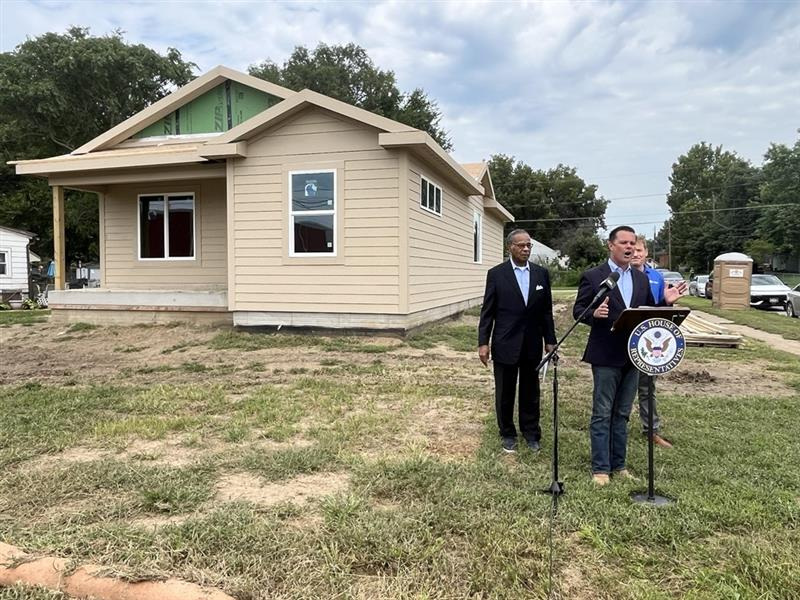
Landmark housing affordability legislation supported by Iowa’s U.S. House lawmakers has cleared the chamber with provisions led by U.S. Rep. Zach Nunn geared toward rural housing.
House lawmakers voted 396-13 on May 20 to pass the 21st Century ROAD to Housing Act, a bipartisan measure that looks to tackle the nation’s housing shortage and affordability woes by curbing housing costs, expanding the housing supply and boosting access to homeownership.

The bill expands loans to build housing, prods local governments to relax permitting rules, expands manufactured housing and limits corporate investors’ ownership of single-family homes.
Another version of the legislation cleared the Senate in March. Both chambers will need to agree on the final package before it can go to President Donald Trump’s desk to be signed into law.
If enacted, the proposal would be the most significant federal housing measure in decades. It comes ahead of a competitive midterm election cycle, where Republicans face mounting pressure to deliver fixes on affordability — a top concern for voters.
In an interview May 21, Nunn touted his bipartisan efforts to advance the legislation. The Ankeny Republican, who is running for reelection in south-central Iowa’s 3rd Congressional District, said the bill represented “generational change for anyone who gets into a home” while the nation grapples with a severe housing shortage and a dwindling pipeline of future homebuyers.
“This isn’t a red or blue issue,” Nunn said. “This is a ‘let’s help American’ issue.”
U.S. Rep. Mariannette Miller-Meeks, a Republican seeking reelection in southeastern Iowa’s 1st Congressional District, called the bill “an important step toward restoring the American Dream.”
“For too many Iowa families, the dream of owning a home has felt increasingly out of reach because of years of rising costs, inflation, restrictive regulations and a lack of available housing,” Miller-Meeks said in a statement. “This legislation takes meaningful action to cut unnecessary red tape, increase housing supply, lower rent and make it easier for working families to achieve homeownership.”
Rural housing would get a boost
The legislation included Nunn’s Rural Housing Service Reform Act, the latest iteration of a yearslong effort to improve federal rural housing programs and boost rural communities’ housing stock.
That contained provisions to offer U.S. Department of Agriculture-financed affordable rental housing to spur construction; modernize USDA technology and staffing to accelerate applications, improve oversight and prevent fraud in the system; and expand home repair grants and financing for rural households to help maintain aging housing stock.
Rep. Emanuel Cleaver, D-Missouri, who joined Nunn last summer during the Iowa State Fair to unveil the bill, said America has “a crisis” with more than one-third of rural rental units being at least 55 years old.
“We desperately need to maintain what we have and then we have to try to encourage new housing, both in terms of rental units and single-family homes, but we can’t forget rental units because everybody’s not going to be able to afford to go out now and buy home, especially with interest rates going up,” Cleaver said.
“… We’ve got to make certain that people who would like to live in rural America after they get out of college, after they get out of school, have the ability to do so with decent affordable housing.”
Nunn said the bill removes “outdated laws and restrictions” to bring down housing costs, such as a requirement that every manufactured home be built on a heavy-duty metal frame to ensure it could be transported, even though most are placed on permanent foundations and are never moved again.
“This is a good not only pathway for folks to get into their first home,” Nunn said. “It’s also a smart pathway for folks who are looking maybe at the last home they’re going to be in as well.”
Bill cracks down on Wall Street investors buying up homes
The bill would place limits on large Wall Street investment firms buying up single-family homes — an issue that has gained traction since a Trump executive order directed federal agencies to restrict corporate home purchases to ease affordability constraints on homeowners.
Compared with the Senate’s proposal, the House advanced softer restrictions facing corporate investors.
The Senate bill would ban investors and companies from buying single-family homes if they already own at least 350 and target “build-to-rent” homes by requiring developers to sell those homes within seven years.
The House measure keeps the Senate’s limits on institutional investors’ home purchases, but ditched the requirement that investors sell “build-to-rent” properties.
Nunn said the House fought against the Senate’s language and didn’t want to hinder local home rehabilitation programs and other affordable rental housing efforts and, calling the upper chamber’s provision “a little slapdash.”
“I think we exceeded the president’s intent of not having Wall Street buy Middle America, but we also didn’t take away affordable real properties for Middle America either,” Nunn said.
Marissa Payne covers the Iowa Statehouse and politics for the Register. Reach her by email at mjpayne@registermedia.com. Follow her on X at @marissajpayne.
This article originally appeared on Des Moines Register: US House clears housing affordability bill with Nunn’s rural measures
Reporting by Marissa Payne, Des Moines Register / Des Moines Register
USA TODAY Network via Reuters Connect