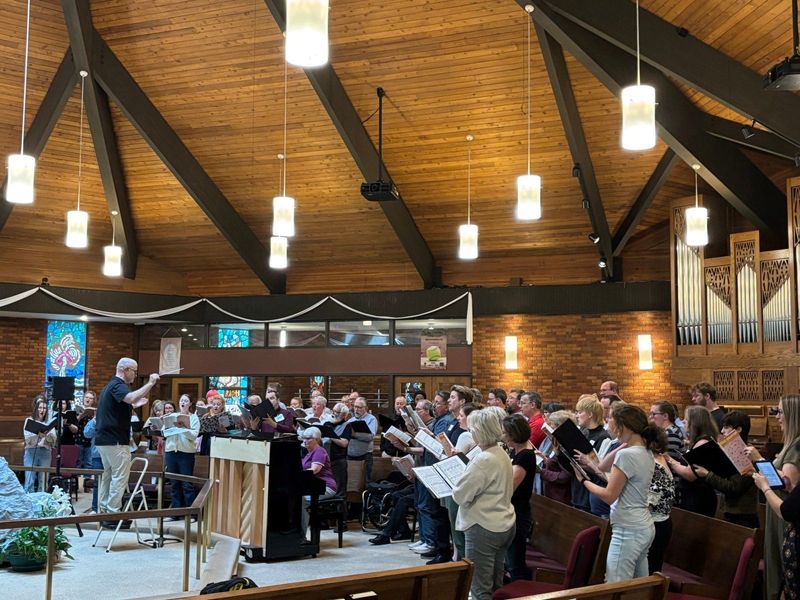
The 2026–27 season for Chamber Singers of Iowa City blazes to its peak in a program of spiritual and emotional fire. We conclude a rousing first year under the baton of Dr. Alex Koppel, associate director of choral studies at the University of Iowa. Accompanied by an orchestra, this concert will surely leave a mark after the final notes.
Mozart’s buoyant “Veni Sancti Spiritus” starts the program. This exuberant work is accompanied by strings and alternates between the full ensemble with a vocal quartet from members of the choir. Written when the composer was just 12 years old, the piece radiates his childlike joy while already revealing his genius.

Next in the program is Pēteris Vasks’ “Dona Nobis Pacem,” an introspective and self-reflective work. Accompanied by strings, the only text is “Dona nobis pacem,” or “grant us peace”.
On the other hand, Ralph Vaughan Williams’ “Dona Nobis Pacem” is a multi-movement cantata that combines texts from the Mass, passages from Scripture, and poems by Walt Whitman, a celebrated US poet, and John Bright, a nineteenth-century British member of Parliament. Whereas the work by Vasks is self-reflective, Vaughan Williams’ composition is expansive and explores societal themes.
The profound nature of the cantata stems from the complexity of the emotions, musical textures, and subject matter. Curiously, the title centers on peace, while much of the music explores the devastation of war. Large sections are anything but peaceful, as though Vaughan Williams intended to confront listeners directly with war’s horrors. In movement three, a line portrays Death and Night as sisters, a familial metaphor that is perhaps somewhat uncomfortable. Later in the movement, we hear text from the perspective of a soldier, “For my enemy is dead, A man divine as myself is dead.” This is a reminder that perhaps we’re more alike than we are different.
Other movements have texts that are challenging to grapple with, such as “We looked for peace, but no good came” and “Is there no balm in Gilead? Is there no physician there?” The composer expertly guides us through the variety of emotions so that we end with the choir singing the word “pacem” (peace) a cappella in what seems like a resolved C Major chord. However, the soprano soloist ends on an E, implying that we still have work to do in order to achieve peace.
You can buy tickets at the door or at https://tinyurl.com/IntoFullFlame. Join us at 3 p.m. on Sunday, June 7, at the Voxman Music Building Concert Hall (93 East Burlington St., Iowa City) for a memorable end to the season.
While this concert is the final performance for this season, Chamber Singers is always looking for new members. If you like to sing and would like to join a vibrant and supportive community, we are holding auditions for the 2026–27 season from 1:45 to 5 p.m., on Sunday, July 26, from 5:45 to 9 p.m., on Monday, July 27, and Thursday, July 30 . For more information and to sign up, head to https://www.icchambersingers.org/join.
Austen Wilson is a Bass 2 in Chamber Singers of Iowa City and the director of music ministries at St. Andrew Presbyterian Church in Iowa City.
This article originally appeared on Iowa City Press-Citizen: Chamber Singers’ season concludes with passion | Music Column
Reporting by Austen Wilson, Special to the Press-Citizen / Iowa City Press-Citizen
USA TODAY Network via Reuters Connect