A new year means resolutions. Typically, resolutions focus on self-improvement. Some people resolve to lose weight. Others to exercise more. Still others resolve that they want to read more or spend more time with family.

In the past, I’ve made those resolutions and more. This year, however, I’ve decided to try something new. In 2026, I am not resolving to improve myself. Instead, my resolutions are on behalf of food writers everywhere.
Specifically, I resolve to do my part to rid food writing of certain cliches that I find, at best, overused and, at worst, kind of vulgar.
Let’s start with the former. A ham-on-rye or a BLT is a sandwich. It is not, I repeat, not a “sammy.” Are our lives so hectic and busy that we don’t have time to write those additional three letters? And while we’re on the topic of sandwiches, hot sandwiches like paninis do not include “melty” cheese. The cheese is melted. Period. No cutesy use of “y” is necessary nor welcome.
The word “melt” seems to be a favorite of food writers. Take, for example, the phrase “melt in your mouth.” We’re eating here and not smelting iron. Besides, most things – other than chocolate – do not literally melt in the mouth. My steak doesn’t. Nor does good fried chicken or even a nice slice of pie. They are delicious…flavorful…orgasmic, even, but they are not “melt in your mouth.”
Still, these cliches are merely tired. Others call to mind digestive processes that I hope to ignore while eating. One of the worst is describing food as “mouth-watering.” Let’s be clear. The mouth does not water. It creates saliva – aka, drool. Dogs drool. A human being merely anticipates.
That said, “mouth-watering” is still better than the phrase “stick to the ribs.” Seriously? While I may not be a biologist, I do know that the foods I eat do not “stick to my ribs,” but instead break down in my stomach before passing through my intestines. I know that it is a metaphor to describe foods that are heavy and hearty, so why not say that? Why force me to imagine pieces of food literally sticking to my ribs like a shirt on a clothesline?
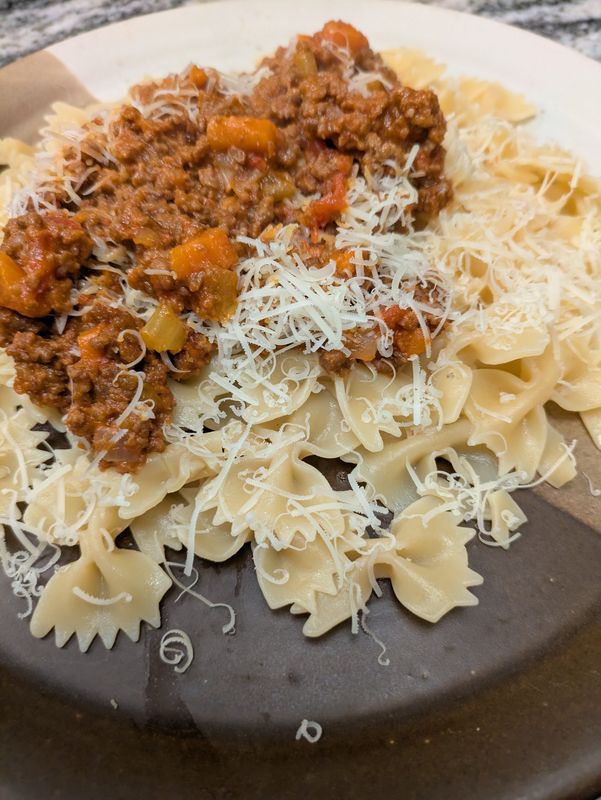
Which brings me to this week’s recipes. Normally, I write about baking. This week, however, the other Michael is undergoing knee surgery, and so I am responsible for at least some of our meals. The first one I made was a pasta with bolognese sauce, which is definitely hearty.
A bolognese sauce is similar to a ragu, a sauce that is reduced slowly over a low heat until it has a ridiculously rich flavor. It originated in Bologna, Italy and it consists of meat – pork and/or beef – and vegetables. The result is a pasta sauce that is thick and delicious.
It is not, however, “stick to your ribs.”
This is one resolution I am definitely keeping this year.
Pasta with Bolognese Sauce
I found this recipe for bolognese sauce in the New York Times late last year. I wanted to try it, but I never got the chance. With my winter break from school winding down, I decided it was now or never.
It was a good choice. Bolognese is perfect for a lazy winter weekend meal, especially with temperatures dropping into the teens.
That said, be sure to read the recipe through before you begin. A bolognese is a slow-cooked sauce. From start to finish, it will take you at least 3 hours to make. That may seem long, but it will be worth it.
Ingredients
1 tablespoon vegetable oil
3 tablespoons butter plus 1 tablespoon for tossing the pasta
½ cup chopped onion
⅔ cup chopped celery
⅔ cup chopped carrot
¾ pound ground beef (or you can use 1 part pork to 2 parts beef)
A pinch of salt
1 teaspoon of black pepper
1cup whole milk
1/8 teaspoon ground nutmeg
1 cup dry white wine
1½ cups canned Roma tomatoes, cut up, with their juice*
1¼ to 1½ pounds pasta
Freshly grated Parmigiano-Reggiano at the table
Heat the oil and the three tablespoons of butter in a large pan over medium. After the butter is melted, add the onion and cook, stirring occasionally until onion is translucent (roughly 3-5 minutes). Add the celery and carrot and cook together for about 5 minutes.
Add the ground beef (and the ground pork if you are using it). Cook, stirring constantly, until the meat is no longer pink. Use your spatula to break up the chunks of meat. Add salt and black pepper. Stir in the milk and cook – stirring regularly – until the milk has been absorbed. Season with the nutmeg. Add the white wine and stir regularly until absorbed. Next, add the tomatoes with their juice (*if you only have tomatoes packed in water, add 2 tablespoons of tomato paste). Stir to combine.
The next step is patience. Remember, a bolognese is a slow-cooked sauce. Reduce the heat to low and bring the mixture to a very gentle simmer. Cook for 2-3 hours, stirring occasionally. If your mixture starts to dry out and stick to the bottom of the pan, add a third cup of water and stir. After an hour or so, taste the mixture and season with more salt and pepper as needed.
Once you are about 15 minutes from being done, cook and drain your pasta. Add the remaining tablespoon of butter to the pasta and stir.
Serve bolognese atop the pasta with a hearty handful of the grated Parmiagano-Reggiano cheese.
Michael Knock is a food columnist for the Iowa City Press-Citizen.
This article originally appeared on Iowa City Press-Citizen: The hearty versatility of Bolognese | Food Column
Reporting by Michael Knock, Special to the Press-Citizen / Iowa City Press-Citizen
USA TODAY Network via Reuters Connect