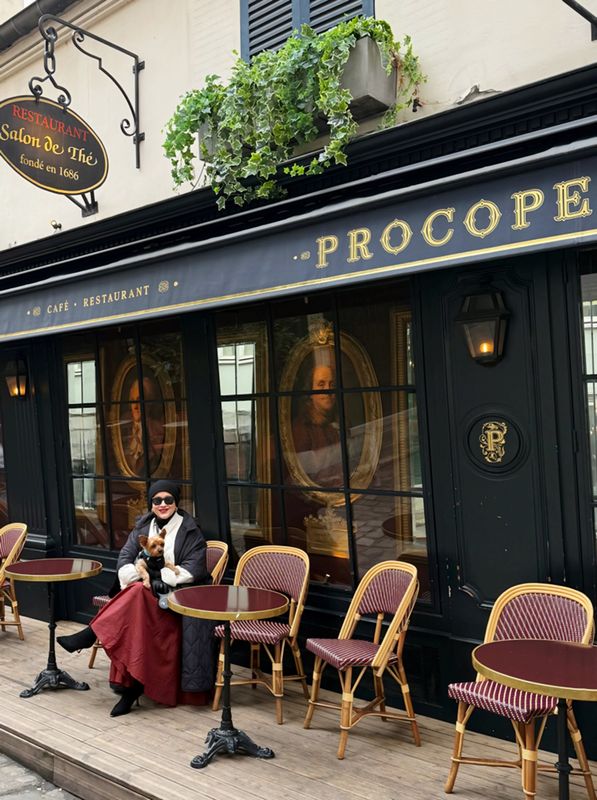
Revolutionaries’ Beef is a formidable dish. The foie gras-topped beef tenderloin served with Dauphinois Gratin (potatoes baked with cream and butter) made me repent my impulsive decision to order French onion soup as an appetizer. I tackled the hearty and exquisite meal under the portrait of Jean-Jacques Rousseau, author of the groundbreaking political treatise “The Social Contract” (1762), staring at me from the wall of Le Procope, Paris’ oldest restaurant.

The venerable establishment, which has been in continuous operation since 1686, displays the portraits of Beaumarchais and Diderot, whose ideas inspired the French Revolution, and Desmoulins and Danton, its active participants. Exhibiting antiquarian treasures such as Voltaire’s desk and Napoleon’s hat, Le Procope is a living shrine to the French Revolution of 1789 and the cataclysmic upheavals it unleashed.
From the back terrace of Le Procope, the portrait of Benjamin Franklin, the signer of the 1776 Declaration of Independence, the 1778 Franco-American Alliance, the 1787 US Constitution, and the 1783 Paris Treaty, which ended the American Revolutionary War, faces one of the oldest Left Bank cobblestone streets. His presence is a reminder that the French Revolution of 1789 was directly inspired by the American Revolution of 1776 and a testament to the Franco-American ties Franklin fostered while residing in Paris (1776-1778) and which were crucial for the US victory over Britain.
The French Declaration of the Rights of Man and of the Citizen (1789) was heavily influenced by Thomas Jefferson’s Declaration of Independence (1776). Stationed in Paris as the US Minister to France (1784-1789), Jefferson personally advised Marquis de Lafayette during the composition of France’s revolutionary founding document. Lafayette’s enthusiasm for revolutions was contagious. Inspired by his service in the American Revolution, he was the commander of the Paris National Guard during the early stages of the French Revolution. In 1790, he sent the main key to the Bastille, demolished as the embodiment of royalist repression, to George Washington. A symbol of liberty and friendship between the US and France, the key was on display at Washington’s presidential offices in New York City and Philadelphia – and, after his retirement, at the front hall of Mount Vernon, which Lafayette visited in 1784 and 1824–1825.
Next to the portrait of Franklin is Maximilian Robespierre, the mercurial leader of the Jacobin Club, which in the early years of the revolution attracted Napoleon Bonaparte, future First Consul (1799-1804) and Emperor of the French (1804-1815), and Louis Philippe, future king of the July Monarchy (1830-1848). Under Robespierre’s leadership, the revolution entered its bloodiest stage known as The Terror, with thousands guillotined at Place de la Revolution (today’s Place de la Concorde), including Louis XVI and Marie Antoinette, who was 37 at the time of her 1793 execution.
The Revolution of 1789 gave France its national holiday, Bastille Day, commemorating the July 14 storming of the Bastille fortress, which yielded the much-needed muskets, cannons, and gunpowder to the raging crowds. And its blue, white, and red tricolor flag, which combined the colors of Paris, red and blue, with the Bourbon white in a last-ditch attempt to reconcile the revolutionary and monarchist aspirations of the opposing sides. Jacques Louis David, Napoleon’s future propaganda artist responsible for the breathtaking “Napoleon Crossing the Alps” (1801-1805) and “Napoleon’s Coronation” (1807), added the finishing touches to the flag, which became synonymous with revolutionary agitation.
France’s rousing national anthem, Le Marseillaise, calling for patriots to spill the impure blood of their enemies, was composed by Claude Joseph Rouget de Lisle in Strasbourg in 1792 and carried later that year to the Battle of Valmy by volunteers from Marseille, thus the name of the anthem. This event is immortalized in the most famous sculptural group of the Arc de Triomphe (1806-1836), “The Departure of the Volunteers,” which commemorates the heroism of the defenders of France on the battlefields of the War of the First Coalition (1792-1797), with the winged personification of Liberty leading the way.
The chaos of the French Revolution of 1789 was not resolved with the end of The Terror, or the corrupt and self-serving administration known as The Directory, which came after. It was halted by the young and ambitious General Bonaparte, whose Coup of 18 Brumaire (which occurred on November 9, 1799, and is still named after the revolutionary calendar which was adopted in 1793 and abolished in 1806) brought him to the summit of power as the First Consul of France and, on December 2, 1804, France’s first emperor. He is the subject of my next column.
Professor Anna Barker teaches in the UI College of Liberal Arts and Sciences Russian Program. She is a Fellow of the International Napoleonic Society and serves of the Board of Directors of the Napoleonic Historical Society. Her book “13 Notes from Napoleon, Iowa: Musings on the Edge of the French Empire” was published in 2025 (Ice Cube Press).
This article originally appeared on Ames Tribune: The Age of Revolutions: The French Revolution of 1789 | Column
Reporting by Anna Barker, Special to the Press-Citizen / Ames Tribune
USA TODAY Network via Reuters Connect