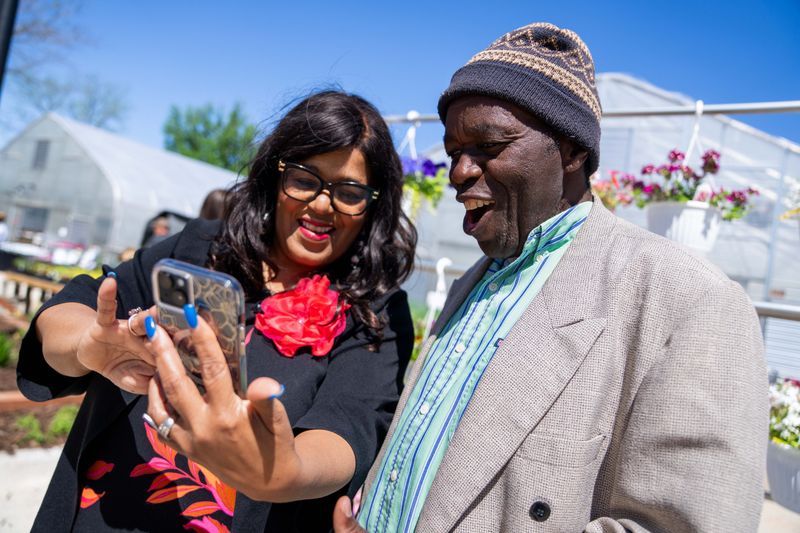
Spring has sprung at the greenhouses at Lutheran Services in Iowa as the organization unveiled its newest home for immigrant and refugee farmers.
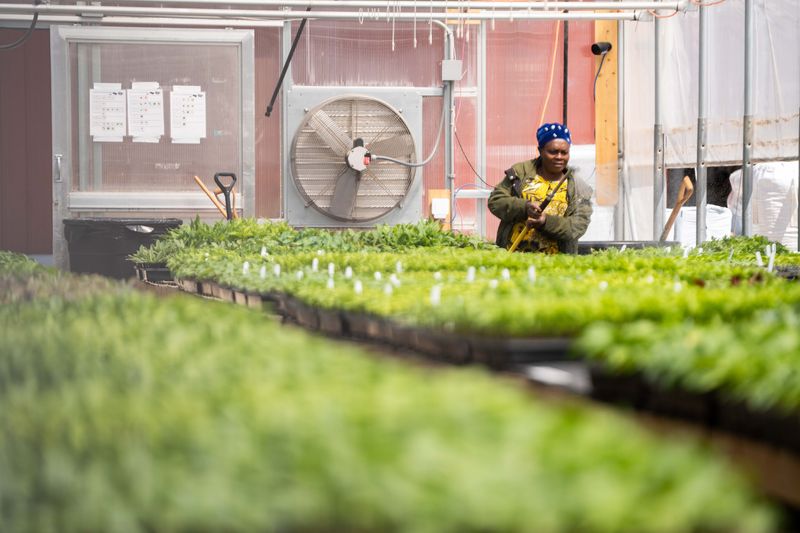
Rows of plants filled the former Dogpatch Urban Gardens site on a sunny Friday, April 24 morning, a sharp contrast to the storms that rolled through Des Moines the night before. LSI leaders used green scissors to cut a green ribbon, marking the debut of the Global Greenhouse, a permanent hub for the organization’s Global Greens program.

The event was more than a spring plant sale.
LSI said it is opening the greenhouse at 4600 NW 51st St. despite losing about $200,000 in annual federal funding for Global Greens, including U.S. Department of Agriculture grants that supported beginning farmer training and business development.
The nonprofit, one of Iowa’s largest human services agencies, said the cuts also affected other immigrant and refugee services, including citizenship education and financial literacy training.
“There have been moments where the support we counted on from the federal government has shifted or disappeared,” said Zachary Couture, Global Greens land and production supervisor. “But the work didn’t stop, and it won’t stop. This didn’t start with government funding. It started with people showing up.”
LSI bought the former Dogpatch property in 2025 for $435,000 using reserve funds. Jenny and Eric Quiner, who opened the site in 2017, also contributed a $100,000 gift of equity as part of the sale.
The purchase addressed a long-running challenge for the program, which previously relied on rented greenhouse space across the metro.
“We have an incubator farming program that helps people do that,” said Mike Wuertz, LSI’s vice president of programs and strategy development. “But we’ve had this persistent challenge with having greenhouse space available.”
Wuertz said the new site gives farmers, who previously had to travel as far as Boone, a predictable place to begin each growing season.
“That’s a lot of back and forth with plant trays and seedlings and all of that,” Wuertz said. “So this is helping provide some permanency for the farmers and for the program.”
The Global Greens program works with refugees, immigrants and other beginning farmers who want to grow food and start their own businesses.
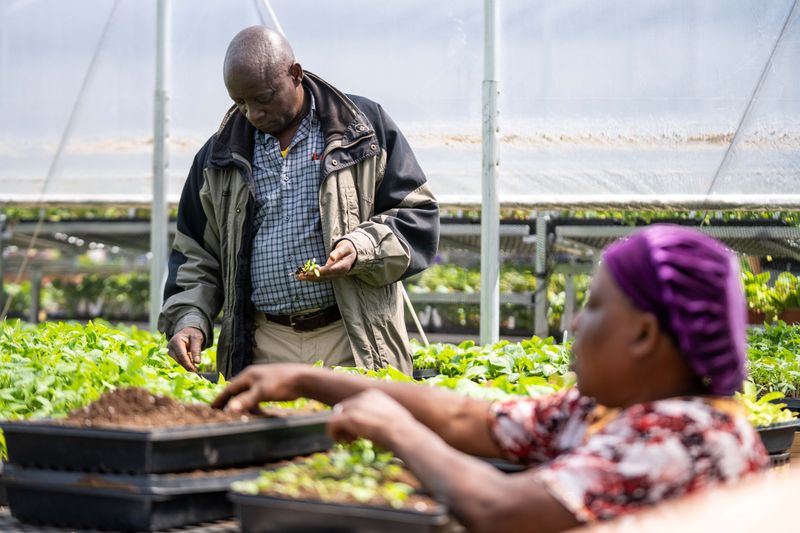
Farmers rent tray space inside the greenhouse to start their plants from seed, with staff, many refugees themselves, assisting with watering, fertilizing, seed selection and early plant care.
The site includes two 30-by-90-foot greenhouses on about 1.5 acres that will produce hundreds of thousands of plants each year.
“What you see here, it looks like a greenhouse, but it’s not just a greenhouse,” Couture said. “It’s someone renting just a small amount of space at a price that finally makes it possible to start or to scale up.”
The site also includes a community-led food pantry where produce regularly comes in and goes out.
Iowa Secretary of Agriculture Mike Naig said the project highlights how food production can happen in urban areas. Global Greens received a $2,786.50 Choose Iowa Value-Added Grant from Naig’s office in the 2026 round.
“What I love is the layered benefits,” Naig said. “We know how important it is to provide skills and training and give people an opportunity for a livelihood.”
The broader program includes about 20 garden sites across Des Moines and roughly 250 gardeners, offering field days and training on growing seasons, pest management and soil health.
Tika Bhandari, a Global Greens community resource navigator, said she has worked for LSI for nearly 15 years after coming to the United States as a refugee from Bhutan in 2008.
“I learned it all so slowly, so I don’t want my people to go the same route I went through,” Bhandari said. “So I’m here to help them.”
The program operates a farmers market at 1907 Carpenter Ave. from 9 a.m. to noon Saturdays.
Bhandari said the market participates in Double Up Food Bucks, allowing SNAP users to match their spending dollar for dollar, up to $2.50, to buy locally grown produce. She said the farmers market generated about $500,000 last year.
“The farmers are getting money for what they work for for so long,” Bhandari said.
Firmin Ntakimazi, another community resource navigator, said the program works with about 40 farmers, connecting them to LSI services, the Farm Service Agency, banks and other resources.
Ntakimazi, who fled Burundi during its civil war in 1993 and spent 13 years in Tanzania before coming to the United States as a refugee in 2006, said many participants bring farming experience with them.
“We approached them and said, most of us were farmers originally,” Ntakimazi said. “Most of our people don’t want to work in companies, can we start farming here?”
The program began with 20-by-20-foot city garden plots, then expanded to 13 acres in West Des Moines, he said. It now functions as an incubator program, with some farmers moving into independent operations. Ntakimazi said four farmers have bought their own land and are now farming full-time.
“It takes a whole year to have a business plan,” he said. “They are so proud to have their logo, their business name and their whole story.”
Nick El Hajj is a reporter at the Register. He can be reached at nelhajj@gannett.com. Follow him on X at @nick_el_hajj.
This article originally appeared on Des Moines Register: Nonprofit opens permanent greenhouse for refugee farming program
Reporting by Nick El Hajj, Des Moines Register / Des Moines Register
USA TODAY Network via Reuters Connect