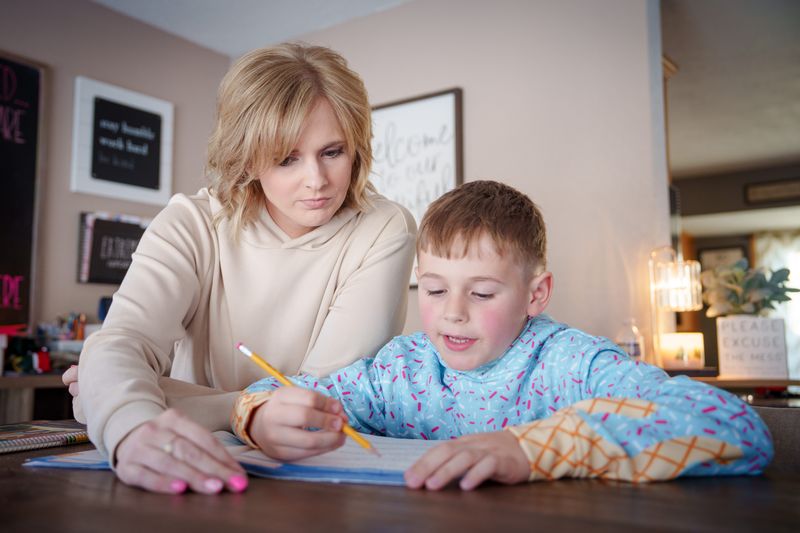
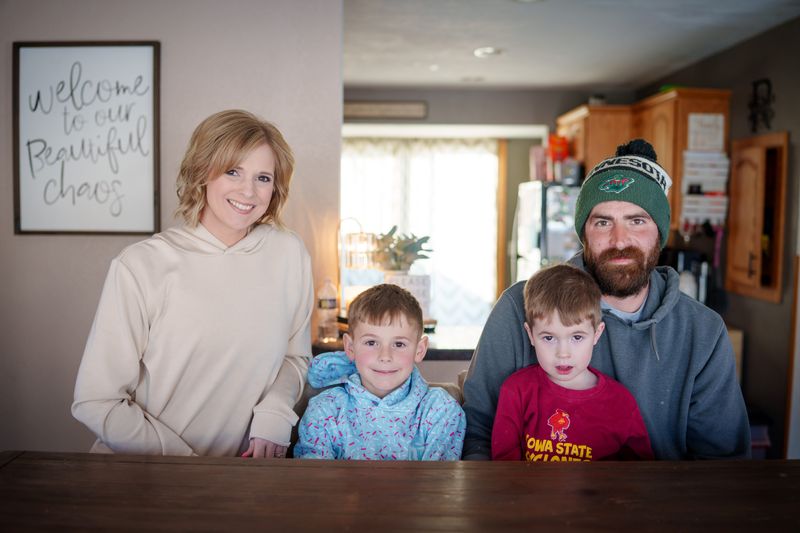
Megan Rassel used to send her oldest son to Kuemper Catholic School before finances grew too tight and made public education the affordable alternative.
But this year, two of Rassel’s sons, ages 4 and 8, are going to attend Kuemper in Carroll.

State dollars are now subsidizing her kids’ private education. Iowa’s new Education Savings Accounts provide $7,998 in state money for the 2025-26 school year for her 8-year-old son’s private school tuition and expenses.
“I just felt that, especially in this world today, it felt important that my kids have that faith-based education on top of a good academic education,” the Lutheran mom of three said. Her older son, 13-year-old Kaleb Gehling, has continued his education in Carroll’s public school system.
Rassel is one of a growing number of Iowans using the 2023 law that allows families — no matter their income — to apply for an ESA account that lets them divert the per-pupil state funding that would otherwise go to their local public school district and use it for private school expenses, including tuition.
In Carroll, the number of students living within the public school district and using ESAs increased 46% from the 2024-25 school year. Statewide, hundreds of students have left public schools for private schooling at the taxpayers’ expense.
Republicans and private school educators say the law has created true school choice for the state’s 510,430 students, including for families like Rassel’s.
“The ESA is allowing our families, who struggle with food insecurities and rent payments, to be better placed so that they can send their children to their school of choice and have better opportunities,” said principal Gretchen Watznauer of St. Theresa Catholic School in Des Moines.
St. Anthony Catholic School’s long-time principal Jennifer Raes says she no longer has to spend her time calling families to ask them to pay overdue balances. Now, she said, school officials know the funding they need will be there month after month.
“So, it’s taken a burden off families. It’s allowed them to have true school choice and access the schooling they want for their child and a faith education,” the Des Moines principal said. “And it’s allowed us to know that the dollars in our budget will actually be there so that you can make set plans.”
The law’s opponents say the savings accounts have effectively subsidized private schools at the expense of public education.
Indeed, 99% of the private school students in Iowa are now using ESAs to pay for their schooling, and most already attended private school before the law passed, according to a Des Moines Register analysis.
“This erosion of financial support for Iowa’s public schools is unsustainable and unfair,” said Josh Brown, Iowa State Education Association president, during a news conference on public education funding cuts. “It affects the majority of our student population in every community.”
Number of families using education savings accounts keeps growing
Three years after they were first introduced, education savings accounts are now widely used, according to the Iowa Department of Education.
In the current school year, nearly every student attending a private school has their tuition subsidized by the state through the ESA program: 41,044 of 41,497, or 99%, nonpublic school students used ESAs.
The program also appears to be increasing private enrollment.
In 2022-23, the last academic year before ESAs became available, there were 33,692 students enrolled in non-public schools. That number has since increased by more than 7,000 students in the 2025-26 school year.
This is the last year of a three-year rollout for ESAs.
When they first became available, the accounts were limited to families with household incomes below 300% of the federal poverty guideline. For a family of four, that would have been about $90,000.
In 2024-25, families with household incomes below 400% of the federal poverty guideline became eligible — about $125,000. ESA usage rose from about 46% of nonpublic students to about 71%.
Now, every family is eligible, regardless of income, although families must still be approved to participate in the program.
Specific data for the income levels of ESA beneficiaries is not available, but given their near-universal adoption throughout Iowa, it’s likely a large chunk of the more than 13,000 new ESA recipients this school year come from households with incomes of more than $125,000.
That, in turn, has helped bolster Iowa’s nonpublic schools.
Since 2023, 65 new nonpublic schools have opened in the state, compared with 17 that have closed.
Nonpublic school enrollment is up 22% since the 2022-23 academic year — kindergarten enrollment, specifically, is up 36% — while public school enrollment has dropped 3%.
Four of every five nonpublic schools in Iowa have seen enrollment increase since the ESA program began.
Conversely, four of every five public school districts in Iowa have seen their enrollment drop since the ESA program began.
Which parts of Iowa have been most affected by ESAs?
As has been the case the past two years under the ESA program, school districts in northwest Iowa have had the largest share of students within their boundaries using the savings accounts.
More than two in five students who live in the Boyden-Hull public school district, for example, are using an ESA to attend a nonpublic school such as Hull Christian School or Western Christian High School.
The same is true for at least one in four students living within the nearby MOC-Floyd Valley, Remsen-Union, Rock Valley and Sioux Center districts.
In places such as Carroll, the surge can’t be entirely attributed to an influx of nonpublic school students: Kuemper’s enrollment from the Carroll area changed little between 2024-25 and 2025-26.
But the portion of those students utilizing ESAs rose to nearly 100%.
Similar stories can be found throughout the state this year.
In the Western Dubuque school district, resident enrollment at St. Francis Xavier, Beckman Catholic and other nearby nonpublic schools increased by 19 students in 2025-26, while the number of ESAs granted increased by 363.
In West Des Moines, resident enrollment at nonpublic schools, including Dowling Catholic and Sacred Heart, increased by 65 students — about 5%. But the number ESAs in use in the area more than doubled, from 622 to 1,340.
This year’s increased ESA usage, however, can’t be attributed entirely to previously ineligible families already sending their children to nonpublic schools.
A flood of nonpublic schools have opened or earned accreditation throughout the state since the program began, increasing in number each school year.
In 2023-24, 11 nonpublic schools opened or were accredited. In the 2024-25 school year, 24 nonpublic schools launched or received accreditation, more than the past seven years combined.
In 2025-26, 30 nonpublic schools launched or earned accreditation.
That includes schools that serve communities that previously didn’t have accessible nonpublic schools, such as Bais Chaya Mushka-Oholei Menachem, a private Jewish school in Postville in northeast Iowa that opened this year.
Private schools remain a relatively risky endeavor, however; this year’s 30 new schools were offset by nine closures, the most in the past 10 years.
But the state overall has 48 more nonpublic schools since the ESA program began — an increase of more than 25%.
Basic reality: Fewer students means less funding for public schools
Private schools’ success is coming at the expense of public schools, education advocates contend.
Students leaving public schools for private ones means public schools are losing out on hundreds of thousands of dollars in per pupil state aid, they say.
The 2023 law does provide school districts with aid as compensation — which, for the 2025-26 school year, was about $1,656.24 for each student who attends a private school instead of their community public school. But public school officials say it doesn’t come close to offsetting the lost revenue.
At Ankeny Community School District, 98 students left ahead of the 2023-24 school year, costing the district $748,230 in state funding, said Samantha Aukes, spokesperson for the district.
During the 2024-25 school year, 106 students left, totaling $829,556 in lost aid, the district said. For the current school year, 79 students left the district for a nonpublic school, resulting in $631,052 in lost aid, officials said.
Those figures do not include the student reimbursement.
During the first year of ESAs, Johnston Community School District had 144 kids living in the district who attended private schools. Those numbers rose to 273 for the 2024-25 school year and 556 in 2025-2026, said Lynn Meadows, the district’s spokesperson.
The district’s 2023-24 certified enrollment count showed more than 70 students who previously attended Johnston had left to attend a private school that first year, Meadows said.
“This resulted in a funding decrease of approximately $405,000 in state aid,” said Ryan Eidahl, the district’s chief financial officer. “The total funding decrease was closer to $690,000 when we include the impact of lost property tax funding for those students.”
The 2024-25 certified enrollment count showed almost 90 students left for private schools, Eidahl said, resulting in a funding decrease of about $466,000 in state aid. That increased to $799,000 when adding in lost property tax funding and supplementary aid for those students.
During the 2024-25 school year, the district received $175,281 in supplementary aid from the state for students who left the district for private schools, according to officials. For the current school year, the district received $341,171.
Urbandale Community School District, this school year had 176 students leave the district for private schools which equates to approximately $1.4 million in lost aid, said Dena Claire, spokesperson for the district. This loss has contributed to the district needing to cut $1.5 million in expenditures ahead of the 2026-27 school year.
“We received approximately $212,080 in categorical funding for each ‘ESA student’ to help offset potential funding losses,” Claire said.
Race, language gaps remain
Tisha Hall of West Des Moines was hesitant to send her youngest son, who is Black, to St. Francis of Assisi Catholic High School and, later, Dowling High School because she worried he would be one of only a few students of color in his class.
“For us, the private school setting was really important,” said Hall, who is White. “… (but) he was going to go to a private school with people that don’t look like him. You know, there’s not a lot of diversity.”
The youngest Hall child was the only one to attend a private middle school, his mother said.
In middle school, he received tutoring for six months to bring him up to grade level. Now, in his third year at Dowling, he is taking higher level courses, including advanced geography.
Republicans have long argued that ESAs give more Iowa families access to private schools. Statistics show that since the start of the ESA program, there has indeed been an influx of students of color in the state’s nonpublic schools.
The number of Black students at nonpublic schools has nearly doubled in the past three years. The number of Asian students is up by more than 30% in that same time period and the number of Hispanic and Latino students increased by more than 20% in the past year alone.
But Iowa’s private schools remain predominantly White, more so than public schools. And public schools are becoming more diverse.
Ten years ago, 77% of Iowa’s public school students were White, compared with 84% of its nonpublic students. Today, 70% of public school students are White, compared with 79% of nonpublic students.
ESAs do not appear to have affected the trends in either category in a meaningful way.
The same can be said for Iowans for whom English is not their first language. The percentage of public school students that are classified as English learners is more than twice as high as in nonpublic schools, and it does not appear to have been affected by the ESA program.
Parent says she has found ‘the best environment for each kid’
While the changes ESAs are bringing to Iowa’s education landscape, they’ve also offered security for families like Rassel’s.
Rassel’s son, Kolten Gehling, 8, receives an ESA and tuition assistance to help cover the $9,500 tuition.
Even if her family’s finances were to change again or they lost the tuition assistance, ESAs would still make it affordable for her kids to attend Kuemper. While only half-way through the school year, Rassel has noticed positive changes in Kolten.
“He wasn’t struggling at Carroll, but just seeing his growth and everything at Kuemper has just been mind blowing,” she said.
Recently, the second grader has begun talking about receiving his first communion.
“I think that being at Kuemper has really opened him up to his faith, because I’ll be honest, we weren’t the best about going to church before or even now,” Rassel said.
She feels the education savings accounts gave her family a chance to choose what is best for each child.
“We have three kids, three different personalities, three different strengths and weaknesses,” Rassel said. “What works for one is not necessarily going to work for the other two. So to me, it comes down to it’s not about school choice in the sense of private vs. public, but what is the best environment for each kid based on their own personal needs and strengths and weaknesses to succeed.”
Tim Webber is a data visualization specialist for the Register. Reach him at twebber@registermedia.com and on Twitter at @HelloTimWebber.
Samantha Hernandez covers education for the Register. Reach her at (515) 851-0982 or svhernandez@gannett.com.
This article originally appeared on Des Moines Register: Iowa’s surging ESAs now subsidize 99% of private school students
Reporting by Tim Webber and Samantha Hernandez, Des Moines Register / Des Moines Register
USA TODAY Network via Reuters Connect