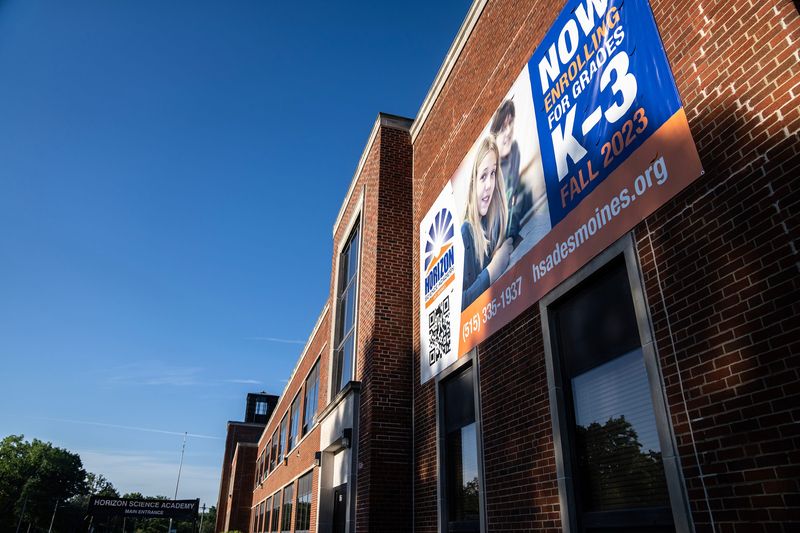
Iowa charter schools would get more state funding to pay teachers and homeschool families could charge tuition for their services under a wide-ranging “school choice” bill awaiting Gov. Kim Reynolds’ signature.
Senators voted 29-17 to pass House File 2754, sending it to Reynolds. House lawmakers passed the bill April 16 on a 53-34 vote.

Sen. Jesse Green, R-Boone, the bill’s floor manager, thanked Reynolds for her work “to put students first” and “put families in the driver’s seat.”
“The Republicans trust parents,” he said. “We want to support parents. We want to support students.”
Reynolds signed a law in 2021 expanding how charter schools can form in Iowa. In 2023, she signed a law making every family in Iowa eligible for a state-funded education savings account that can be used to pay private school costs.
“Public charter schools are an important emerging education model in Iowa and have seen a 213% increase in enrollment from FY23 to FY25,” Reynolds said in a statement. “When you trust parents, support educators and invest in students, outcomes improve, and that’s exactly what we’re doing.”
Sen. Molly Donahue, D-Cedar Rapids, said the bill takes taxpayer money out of public schools in favor of charter schools while still expecting public schools to cover the costs for charter school students to participate in programs and activities.
“Charter schools get the dollars and public schools get the bill,” she said.
Charter schools would receive funds for teacher pay
Charter schools in Iowa would receive $684 per student in Teacher Salary Supplement funding under the bill — for a total of about $1.3 million in funding next school year.
Currently, only public school districts receive Teacher Salary Supplement funding, but the bill would change the system to send funding to charter schools as well, based on the number of students who attend.
That means charter schools would receive about $1.3 million in the 2026-27 school year that currently goes to pay public school teachers’ salaries.
Donahue said charter schools should meet the same standards as public schools if they want to receive Teacher Salary Supplement funds.
“Our public school system with teacher supplemental aid is tied to clear expectations,” Donahue said. “Districts are required to meet minimum salary standards, adhere to negotiated agreements and operate within a transparent framework that ensures those dollars actually support educators. Charter schools are not held to any of these standards.”
Green said charter schools face the pressure of losing their contract if they aren’t performing as promised.
“When it comes to charter schools they are held to a higher expectation,” he said. “Otherwise they can’t maintain their charter status.”
In fall 2025, there were 1,382 students attending 16 Iowa charter schools from within 107 public school districts’ boundaries, according to an analysis of the bill from Iowa’s nonpartisan Legislative Services Agency.
According to the analysis, the largest number of charter school students last fall came from:
Homeschooling families could teach more unrelated kids, charge tuition
Families who offer homeschooling under Iowa’s independent private instruction model could could charge tuition and fees and no longer would face limits on how many unrelated students they could teach.
The bill would remove the current limit that prevents independent private instruction providers from teaching more than four unrelated children.
And it would remove the prohibition in current law on charging tuition, fees or other renumeration for instruction.
Sen. Herman Quirmbach, D-Ames, introduced an amendment to remove the homeschooling changes from the bill. He said the bill would allow “any Tom, Dick or Harriett to launch an independent private instruction school.”
“Some homeschool parents do an excellent job, I freely acknowledge that,” he said. “But this bill opens the door to greedy and unscrupulous opportunists.”
Green said the section on homeschooling “is one of the best parts of the bill” and argued many homeschooled students outperform their peers academically.
“Most people are surprised that this language is in code about not having tuition or a cap on the amount of students that you can have,” he said. “It’s time for this language to go.”
Charter school students could participate in public school extracurriculars
The bill would allow charter school students to participate in extracurricular activities at a public school as long as the student lives within that district’s boundaries or within a contiguous district to that school.
Students would not be able to join a public school’s athletic team if the charter school offered that sport within the past two years.
Charter school students also would not be able to participate in extracurriculars at a public school if their charter school already has an activities sharing agreement with a different public school.
Charter school students would have to pay the same activities fees as public school students to participate in the activity.
Charter school employees would be covered by IPERS
The bill specifies that charter school employees would be covered by the Iowa Public Employees’ Retirement System (IPERS).
Public schools would have to offer driver’s ed to charter students
Public school districts would be required to offer driver education courses to students who live within the district’s boundaries and attend a charter school, under the bill.
The charter school would be responsible for paying the public school district’s costs associated with providing the course.
UNI would be able to approve new charter schools
The University of Northern Iowa would be able to authorize new charter schools in Iowa, if the bill becomes law.
Currently, charter schools in Iowa can be created either by a local school board or authorized through the Iowa Department of Education.
The bill adds UNI as a third option.
Iowa has 18 authorized charter schools, as of March, according to LSA.
Iowans can apply for education savings accounts for each semester
The bill creates a second enrollment window for Iowa’s private school education savings accounts.
Current law allows families to request an ESA between Jan. 1 and June 30 preceding the school year when their student will be attending private school.
The bill adds a second period, between Oct. 15 and Nov. 15, when families can request an ESA for the spring semester.
A full year ESA will be worth $8,148 per student in the 2026-27 school year. Families who request an ESA for one semester would receive half that amount.
Private groups can participate in Iowa’s preschool program
Community groups, such as churches or nonprofits, could participate directly in Iowa’s voluntary preschool program rather than having to partner with a school district to offer preschool as they must do under current law.
The bill says the state would pay community-based preschool providers monthly. Democrats criticized the monthly payments, saying that school districts that offer preschool are only paid each year and many have long waiting lists.
“Why in the world would we give on-time funding for private schools but not for our public schools where 90% of Iowa families choose to send their children?” said Sen. Janet Petersen, D-Des Moines. “What do you have against public schools?”
Stephen Gruber-Miller covers the Iowa Statehouse and politics for the Register. He can be reached by email at sgrubermil@registermedia.com or by phone at 515-284-8169. Follow him on X at @sgrubermiller.
This article originally appeared on Des Moines Register: Iowa charter schools set for more funding under bill on Reynolds’ desk
Reporting by Stephen Gruber-Miller, Des Moines Register / Des Moines Register
USA TODAY Network via Reuters Connect