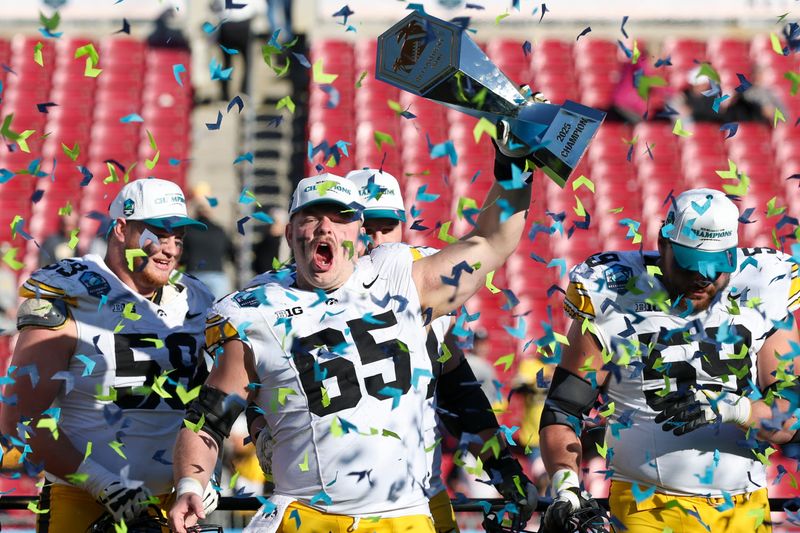
IOWA CITY — A historic NFL Draft is in the books for Iowa, with a program-record seven players selected in a seven-round draft.
However, within the Hawkeye football building, there was disappointment that there weren’t 10.

That’s how strong this 2025 Iowa football roster was. Seven outgoing Hawkeye seniors were picked, and at least another three were on the fence. Not one underclassman was in the group, either, underscoring how much veteran talent the 2025 Hawkeyes possessed.
One of the Hawkeye picks, fourth-rounder Kaden Wetjen, was on the putting green of a golf course when the Pittsburgh Steelers called. Wetjen’s selection became the most memorable of Iowa’s seven in the draft, as the podium announcement was also shown in real-time at Iowa’s 2026 spring scrimmage at Kinnick Stadium.
“I don’t know who was responsible for (showing) that, but that was awesome,” head coach Kirk Ferentz said. “Probably the best thing that happened today during the workout.”
To put the seven players in perspective, Iowa’s trophy-game rivals had a combined three draft picks — Iowa State, Minnesota and Nebraska with one apiece; and Wisconsin was shut out for the first time since 1978. This was a dominant showing from Ferentz, who has now had 101 players selected over 27 NFL Drafts as Iowa’s head coach.
“I am always clear about this: That is not a program goal of ours, at all. Like, there’s nowhere in the building you’re going to see that as a program goal. There are other things that are a lot more important,” Ferentz said. “But that being said, a lot of our guys want to be NFL players, and we want to recruit guys that want to be NFL players. Then you make the assumption that they’re willing to do the work, and at least we’ll give them a chance.”
The guys that heard their names called: center Logan Jones to the Chicago Bears (second round), offensive lineman Gennings Dunker to the Steelers (third), receiver/return specialist Wetjen to the Steelers (fourth), offensive lineman Beau Stephens to the Seattle Seahawks (fifth), linebacker Karson Sharar to the Arizona Cardinals (sixth), cornerback TJ Hall to the New Orleans Saints (seventh) and defensive end Max Llewellyn to the Miami Dolphins (seventh). Hall will notably go down as the Ferentz era’s 100th draft pick.
Another three that realistically could’ve been picked but signed free-agent deals: quarterback Mark Gronowski (Dolphins), defensive lineman Aaron Graves (Baltimore Ravens) and safety Xavier Nwankpa (Kansas City Chiefs). Defensive end Ethan Hurkett (Chiefs) and tight end Hayden Large (Bears) also signed free-agent deals in the draft’s immediate aftermath. Placekicker Drew Stevens has a tryout scheduled with the Washington Commanders.
The seven players selected exceeded the previous program record of six in the 2010, 2011 and 2012 drafts. Arguably, Iowa’s two best drafts other than this one were after the 2002 season (when three Hawkeyes — Dallas Clark, Eric Steinbach and Bruce Nelson — were snapped up in the first 50 picks) and the 2009 season (when of the six Hawkeyes chosen, four went in the first three rounds — Bryan Bulaga, Pat Angerer, Amari Spievey and Tony Moeaki).
History confirms that those might be the two best seasons in Ferentz-era history, both 11-win teams that entered the national-championship conversations in November of their respective campaigns.
So how does this NFL Draft revise our thinking, if at all, about the 2025 Hawkeyes?
True, the NFL Draft isn’t the be-all, end-all for a team’s place in history … the 2015 Hawkeyes, who won a school-record 12 games, had one player taken (seventh-rounder Austin Blythe) in the subsequent draft.
But I do think this draft elevates the way this group will be remembered. Iowa finished 9-4 and No. 17 in the national rankings, but, as we know, was within a whisker of knocking off national champion Indiana and playoff semifinalist Oregon. The Hawkeyes’ other two losses came when Gronowski was far from settled in at quarterback at Iowa State, 16-13, and when three offensive linemen (all future NFL players in Dunker, Stephens and Kade Pieper) were knocked out with injuries at USC, 26-21.
No excuses, of course, the losses are losses. But as was also pointed out following Iowa’s 34-27 win over Diego Pavia and Vanderbilt in the ReliaQuest Bowl, the Hawkeyes’ season point differential of plus-169 (378-209) was fourth-best in the Ferentz era behind 2002, 2008 and 2018 (in that order).
If the current 24-team playoff model that is being pushed by Big Ten Commissioner Tony Petitti (and is gaining steam perhaps in time for 2027) was in place last year, Iowa would’ve likely qualified and been a dangerous squad against anybody it had faced.
The way the Hawkeyes thrashed Wisconsin (37-0), Minnesota (41-3) and Nebraska (40-16) makes more sense when putting those programs’ woeful NFL Drafts in context. And it also gives more appreciation to Iowa’s 25-24 win over a Penn State squad that had eight players drafted despite James Franklin’s in-season firing. Indiana had eight players drafted, and Oregon had seven, by the way — so maybe it isn’t a surprise that Iowa gave both teams all they could handle.
Remember the 2025 season how you will. Given the talent, some will say it underachieved in the win column. But I’ll categorize this squad as playing one of the toughest schedules of the Ferentz era and will rank it as one of the five best teams he has assembled at Iowa.
I’ll put the 2002 team in its own tier and then 2009 as No. 2. After that, this 2025 team (I think) would’ve beaten 2015 on the field, fought closely with 2008 (really good matchup) and probably had a slight edge over Ferentz’s other nine- and 10-win teams of 2003, 2004, 2018 and 2019 and easily defeated the 10-win squads of 2021 and 2023.
All 101 NFL draft picks under Iowa football coach Kirk Ferentz
Note: First-round picks in bold.
Quarterback (3) — Ricky Stanzi (2011, fifth), C.J. Beathard (2017, third), Nate Stanley (2020, seventh)
Offensive line (24) — Eric Steinbach (2003, second), Bruce Nelson (2003, second), Ben Sobieski (2003, fifth), Robert Gallery (2004, first), Pete McMahon (2005, sixth), Marshal Yanda (2007, third), Mike Elgin (2007, seventh), Seth Olsen (2009, fourth), Bryan Bulaga (2010, first), Kyle Calloway (2010, sixth), Julian Vandervelde (2011, fifth), Riley Reiff (2012, first), Adam Gettis (2012, fifth), Brandon Scherff (2015, first), Andrew Donnal (2015, fourth), Austin Blythe (2016, seventh), James Daniels (2018, second), Tristan Wirfs (2020, first), Tyler Linderbaum (2022, first), Mason Richman (2025, seventh), Connor Colby (2025, seventh), Logan Jones (2026, second), Gennings Dunker (2026, third), Beau Stephens (2026, fifth)
Running back (3) — Ladell Betts (2002, second), Shonn Greene (2009, third), Kaleb Johnson (2025, third)
Wide receiver (5) — Kevin Kasper (2001, sixth), Kahlil Hill (2002, sixth), Marvin McNutt (2012, sixth), Ihmir Smith-Marsette (2021, fifth), Kaden Wetjen (2026, fourth)
Tight end (14) — Austin Wheatley (2000, fifth), Dallas Clark (2003, first), Erik Jensen (2004, seventh), Tony Jackson (2005, sixth), Scott Chandler (2007, fourth), Brandon Myers (2009, sixth), Tony Moeaki (2010, third), C.J. Fiedorowicz (2014, third), George Kittle (2017, fifth), T.J. Hockenson (2019, first), Noah Fant (2019, first), Sam LaPorta (2023, second), Erick All Jr. (2024, fourth), Luke Lachey (2025, seventh)
Defensive line (19) — Aaron Kampman (2002, fifth), Jared Clauss (2004, seventh), Matt Roth (2005, second), Jonathan Babineaux (2005, second), Ken Iwebema (2008, fourth), Adrian Clayborn (2011, first), Christian Ballard (2011, fourth), Karl Klug (2011, fifth), Mike Daniels (2012, fourth), Carl Davis (2015, third), Jaleel Johnson (2017, fourth), Anthony Nelson (2019, fourth), A.J. Epenesa (2020, second), Chauncey Golston (2021, third), Daviyon Nixon (2021, fifth), Lukas Van Ness (2023, first), Logan Lee (2024, sixth), Yahya Black (2025, fifth), Max Llewellyn (2026, seventh)
Linebacker (11) — Chad Greenway (2006, first), Abdul Hodge (2006, third), Mike Humpal (2008, sixth), Pat Angerer (2010, second), A.J. Edds (2010, fourth), Christian Kirksey (2014, third), Anthony Hitchens (2014, fourth), Josey Jewell (2018, fourth), Nick Niemann (2021, sixth), Jack Campbell (2023, first), Karson Sharar (2026, sixth)
Defensive back (20) — Matt Bowen (2000, sixth), Derek Pagel (2003, fifth), Bob Sanders (2004, second), Sean Considine (2005, fourth), Charles Godfrey (2008, third), Bradley Fletcher (2009, third), Amari Spievey (2010, third), Tyler Sash (2011, sixth), Shaun Prater (2012, fifth), Jordan Bernstine (2012, seventh), Micah Hyde (2013, fifth), Desmond King (2017, fifth), Josh Jackson (2018, second), Amani Hooker (2019, fourth), Michael Ojemudia (2020, third), Geno Stoen (2020, seventh), Dane Belton (2022, fourth), Riley Moss (2023, third), Cooper DeJean (2024, second), TJ Hall (2026, seventh)
Placekicker (1) — Nate Kaeding (2004, third)
Punter (1) — Tory Taylor (2024, fourth)
Picks by round under Kirk Ferentz (101) – First (13), second (13), third (17), fourth (17), fifth (16), sixth (12), seventh (13)
Hawkeyes columnist Chad Leistikow has served for 31 years with The Des Moines Register and USA TODAY Sports Network. Chad is the 2023 INA Iowa Sports Columnist of the Year and NSMA Co-Sportswriter of the Year in Iowa. Join Chad’s text-message group at HawkCentral.com/HawkeyesTexts. Follow @ChadLeistikow on X.
This article originally appeared on Des Moines Register: Record NFL Draft output enhances legacy of 2025 Iowa football | Leistikow
Reporting by Chad Leistikow, Des Moines Register / Des Moines Register
USA TODAY Network via Reuters Connect